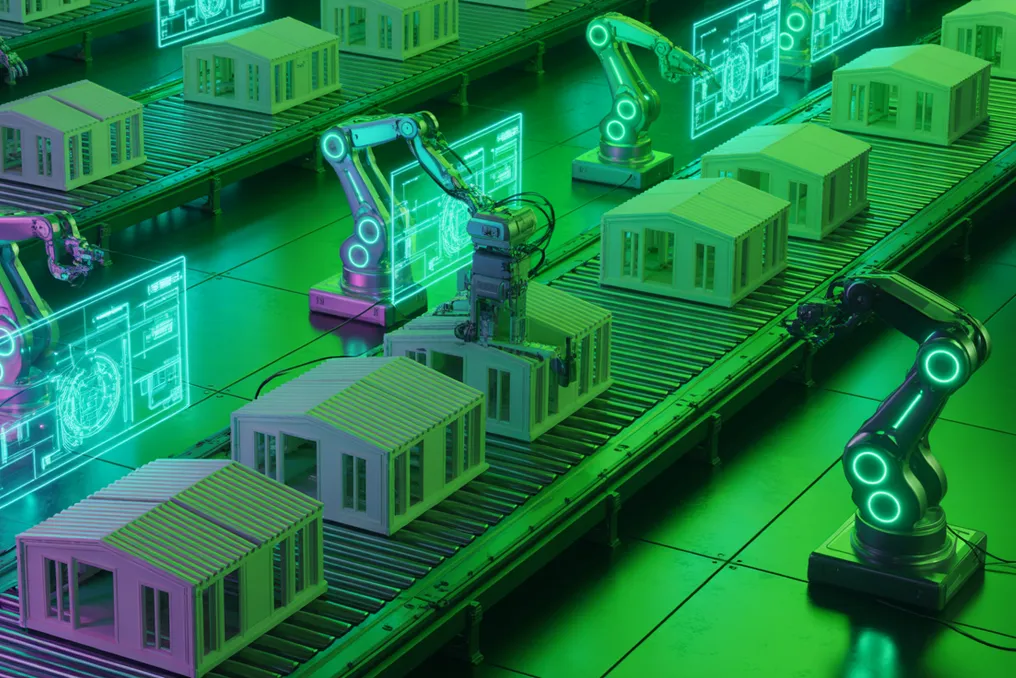
Reframe Systems raises $40 million to scale housing construction using artificial intelligence
Read more
Ventureburn
ventureburn.com

Reframe Systems raises $40 million to scale housing construction using artificial intelligence

Reframe Systems has raised $40 million to expand its robotics-based approach to residential construction. The funding round was led by Energy Impact Partners, with participation from Counterpart Ventures, E12 Ventures, Global Brain, Thin Line Capital, Up Partners, and LACI Impact Fund.

Existing investors, including Eclipse, VoLo Earth, Cubit Capital, RA Capital Management, MassMutual Catalyst, and Nor’easter, continued to support the company. These funds will allow Reframe to expand its network of microfactories and accelerate home delivery across North America.

The United States faces a housing shortage estimated at 4.5 million homes. Reframe believes that traditional construction methods contribute to this problem due to fragmented and labor-intensive processes. The company is capable of building infill housing in Somerville in just 180 days.

Most homes still rely on numerous subcontractors and a shrinking pool of skilled workers. This slows down construction, increases costs, and hinders scalability. Reframe utilizes small automated microfactories located near population centers where the need for housing is acute.

Reframe's approach differs from traditional modular construction, which often relies on large centralized factories. Reframe now applies automation principles to the construction process itself. The company's long-term goal is to build one million homes globally by 2040.

Reframe's microfactories can adapt production to local zoning requirements, climatic conditions, and architectural styles. Software coordinates projects with production, while robotics automates repetitive manufacturing tasks.

The company claims its method allows for building homes three times faster and at 35% lower cost compared to traditional construction. Anil Achuta, a partner at Energy Impact Partners, noted: 'Reframe impressed us with their unique combination of Physical AI and manufacturing discipline.'

Reframe integrates robotics, software, and digital work instructions throughout the entire construction process. This system enables builders of varying skill levels to efficiently assemble manufactured components. The company reports that every completed project generates data that can improve future construction.

This creates a network effect where the software, robotics, and production processes become more efficient over time. To date, Reframe has completed the construction of 10 homes, including multi-unit buildings with additional rooms and three-story apartments. Eight of these homes are already occupied.

Next year, the company plans to deliver another 114 units. Projects include developments in Massachusetts, New Hampshire, and California. In Adams Circle in Devon, Massachusetts, Reframe is completing 12 units.

A five-story residential building in Roxbury and a development in Thornton, New Hampshire, are also planned. In Altadena, California, the company is completing a wildfire-resistant bungalow and a residential unit for a family recovering from devastating fires.

The new funding will support Reframe's expansion beyond current production capacity. The company is preparing to launch FAB1, a microfactory in Billerville, Massachusetts. FAB1 is designed to reach full factory readiness in less than 70 days after receiving the site keys.

Operations are expected to begin on October 5th. The site requires less than $5 million for equipment. Reframe anticipates producing up to 500 multi-family units or 250 single-family homes annually. The company intends to use the additional capital to accelerate deliveries in New England.

Reframe was founded in 2022 by former Amazon Robotics executives Vikas Enty, Felipe Polido, and Aaron Small. This team previously worked on large-scale automation systems and helped deploy over 500,000 robots in Amazon's fulfillment network.

Similar stories

Emerald AI raises $150 million to scale flexible data center capacity
Read more
ventureburn.com

Emerald AI raises $150 million to scale flexible data center capacity

Emerald AI has successfully raised $150 million in a re-signed Series A funding round, valuing the company at $1.05 billion. The funding was co-led by Energize Capital and DCVC, and attracted strategic investors from global energy and technology sectors.

The company currently includes 12 Fortune Global 500 enterprises among its investors, who also participate in Emerald AI's Strategic Advisory Board. With the capital raised, the company plans to accelerate the commercial deployment of its solutions worldwide.

Emerald AI's clients include data center operators, artificial intelligence companies, and electric utilities. The company develops software that enables data centers to become flexible electricity consumers. The Emerald Conductor platform manages AI workloads concurrently with the use of local energy resources.

The system automatically regulates energy consumption when grid load periods coincide, while ensuring the protection of critical AI computing tasks. This approach could potentially help data centers gain faster access to power sources and reduce the strain on local infrastructure during peak demand. According to Emerald AI, their technology is capable of freeing up over 100 gigawatts of capacity, referring to the existing US power grid.

The company notes that this capacity can become available before new infrastructure is built, as traditional energy grid projects can take many years to become operational, whereas the electricity demands of AI data centers are growing rapidly.

Emerald AI conducted five demonstration projects in the United States and London. These trials took place in commercial data centers in Arizona, Illinois, and Virginia, as well as in Oregon and London. The company aims to bridge the time gap between demand and availability through software. Partners in these projects included NVIDIA, EPRI, Oracle, Nebius, and National Grid.

Emerald AI has now moved beyond demonstrations and begun commercial deployment. Its software is fully operational in a data center in California, where flexible energy consumption was demonstrated during grid stress. The company also plans additional large-scale deployments, having partnered with Silicon Valley Power for a flexible interconnection program that gives data centers access to additional grid capacity in exchange for providing proven and managed energy flexibility.

Furthermore, Emerald AI is collaborating with Digital Realty and NVIDIA in Virginia on the development of the Vera Rubin AI Research Farm in Manassas, which is expected to have a capacity of around 100 megawatts, and its energy-flexible design has been tested.

Emerald AI CEO, Dr. Varun Sivaraman, stated that AI can help solve its own energy supply problem. He emphasized that the company's demonstrations showed the capability of precisely tuning data center energy consumption. The company's goal is to implement this capability wherever AI infrastructure is developing to strengthen grid reliability and support AI growth.

Energize Capital and DCVC noted that Emerald AI has quickly reached the stage of commercial deployment, and their investment reflects the growing demand for solutions meeting AI's energy requirements. Other participants in the funding round included NVIDIA, Samsung Ventures, Siemens, and GE Vernova. Salesforce Ventures, Aramco Ventures, and RWE also joined the round, strengthening the company's position at the intersection of AI infrastructure and energy, giving it the capital to expand deployments into new markets and assist utilities in managing growing demand.

Twin1 AI raises $20 million to scale AI-powered digital twins for professionals
Read more
ventureburn.com

Twin1 AI raises $20 million to scale AI-powered digital twins for professionals

Twin1 AI has successfully raised $20 million in a seed funding round while simultaneously moving its product out of stealth development. The company creates artificial intelligence-based digital twins designed for knowledge workers.

The funding round was co-led by venture capital firms Bessemer Venture Partners, Tribeca Venture Partners, and Aramco Ventures. The company plans to expand its teams in San Mateo and London, as well as invest in technology development and marketing activities. The Twin1 platform is designed to preserve professional knowledge, judgment, and work context.

The company's goal is to help organizations scale this expertise through artificial intelligence. Twin1's approach prioritizes privacy and human oversight when implementing enterprise AI. This provides the company with capital for developing commercial operations and technologies.

Twin1 provides every specialist with an AI-managed digital twin that evolves alongside their work. These twins have access to authorized emails, meetings, documents, and work systems. Using this context, they can respond to queries and assist in completing business tasks.

The company claims that its system can enhance existing AI agents through deeper professional context, leading to more personalized enterprise AI implementation. Twin1 has developed six levels of privacy and governance control. These mechanisms regulate interactions between humans, digital twins, and AI systems, integrating corporate policies, existing permissions, and human approval requirements, which prevents unauthorized access to confidential knowledge.

Furthermore, Twin1 manages a network that connects individual digital twins across different organizations. This allows for the identification of relevant expertise and coordination of work by gathering information while respecting permissions, yet maintaining human control. This forms a level of coordination between humans and enterprise AI agents. The company also offers a model context protocol server for enterprises, which grants approved AI agents and corporate tools access to controlled context.

The system can also initiate actions based on information contained within individual twins. Twin1 calls this approach the foundation for sovereign enterprise AI. The platform has already been implemented by partners in various industries, including legal, financial, and energy companies. Clients mentioned include Linklaters, Orrick, Dechert, Customers Bank, and Aegis Energy; the company reports that some clients have automated between 30% and 50% of communication work.

Twin1 was founded in 2025 by individuals such as Lewis Liu, Tom Cahn, Huiting Liu, and Jonathan Budd. The founders previously worked on enterprise AI through Eigen Technologies. Several investors from Eigen also participated in the new funding round. This support reflects continued confidence in the team's experience in enterprise technologies. CEO Lewis Liu emphasized that human expertise remains central to knowledge-based organizations, stating that AI should augment individual knowledge, not generate generic outputs.

Twin1 aims to preserve professional judgment while increasing the reach of each employee, believing this will help expertise accumulate across different organizations. Bessemer Venture Partners noted that corporate knowledge remains fragmented across organizations and believes Twin1 can provide a contextual layer between teams and systems. Tribeca Venture Partners described the platform as a coordination layer for enterprise AI, while Aramco Ventures highlighted the team's experience working with regulated corporate environments. The next phase of work will focus on increasing adoption in knowledge-intensive industries. The company positions individual digital twins as a new interface for enterprise AI, and its success will depend on the balance between automation, privacy, governance, and human agency.

Velaura AI raises $110 million to scale high-efficiency AI computing
Read more
ventureburn.com

Velaura AI raises $110 million to scale high-efficiency AI computing

Velaura AI has successfully raised $110 million in a Series A funding round, valuing the company at over one billion dollars. The round was led by Seligman Ventures, with participation from Capricorn Investment Group, Prosperity7 Ventures, and existing investors including Mayfield, Maverick Silicon, MARA, Premji Invest, and Samsung Catalyst Fund. StepStone Group also participated in the financing.

The capital raised will accelerate the development of the company's portfolio of AI computing power and advance its commercial activities. Velaura is targeting two growing areas: high energy-efficiency data center computing and Physical AI applications.

The company believes that energy consumption is becoming a serious constraint for artificial intelligence infrastructure. Although major cloud providers are actively investing in AI data centers, securing electricity and cooling capacity remains an increasingly complex challenge.

Velaura's core technology is the Titan Core silicon platform. This platform provides patented intellectual property and digital chip design capabilities. The company claims that Titan Core can deliver two to four times higher performance per watt.

The technology is oriented towards mathematical operations used in AI accelerators. It has already been implemented at a commercial scale, deployed in over 30 million ASICs utilizing leading semiconductor manufacturing processes. Velaura also demonstrates data on yield quality and production reliability.

The technology is planned to be applied in AI accelerators, and the architecture will be expanded for Physical AI applications. These applications include intelligent robots, drones, and autonomous systems that operate under strict power and heat dissipation constraints.

Rajiv Kemani, co-founder and CEO of Velaura, noted that further progress in AI will require improving the economic efficiency of computing. He added that the company aims to build a silicon and software foundation for this transition.

As AI infrastructure consumes more electricity, data center operators face the need to improve computing efficiency. Higher energy consumption also entails additional cooling requirements, which can increase the cost of deploying AI capabilities.

Velaura directs its solution at eliminating these limitations at the silicon level, focusing on increasing performance without a proportional increase in energy consumption. Furthermore, the company sees potential beyond traditional data centers, as Physical AI systems require efficient computation to operate in the real world, and robots cannot rely on the same resources as large data centers.

Velaura's leadership team includes executives and engineers from major technology companies such as Apple, NVIDIA, Google, Qualcomm, and Marvell. Their experience spans the development of low-power and high-performance semiconductor platforms and contributions to products shipped to billions of devices.

The new funding will be used to accelerate the development of Titan Core, as well as to expand engineering and customer teams. Additional resources will support deeper collaboration with strategic partners and customers in the fields of AI infrastructure and Physical AI development.

This funding reflects the growing investor interest in energy-efficient AI infrastructure, as power availability is increasingly viewed as the main barrier to AI expansion. Velaura's approach may allow for more computational power to be placed within existing energy constraints and reduce the thermal load on AI infrastructure.

The company positions its technology as suitable for both hyperscale and edge applications, giving it a presence across several segments of the growing AI computing market. Its headquarters in Silicon Valley place it within a dense semiconductor ecosystem.

Popular