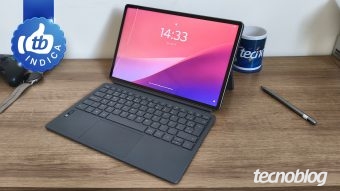
A tablet with 512GB of storage offers the advantage of storing a large number of applications, documents, photos, and videos without needing external storage. This capacity is available in both more powerful devices, such as the Galaxy Tab S11 Ultra and iPad Air M4, and in more budget-friendly alternatives from Xiaomi and Lenovo.
In this guide, Tecnoblog has compiled seven 512GB tablets to buy in 2026, comparing them based on storage capacity, performance, screen, microSD expansion capability, and features for work and study. The pros and cons of each model are also presented.
Galaxy Tab S11 Ultra
The 512GB Galaxy Tab S11 Ultra model uses UFS 4.0 storage, providing higher data transfer speeds compared to previous generations. Furthermore, the device supports space expansion using a microSD card up to 2TB, allowing heavy files, videos, and documents to be stored outside internal memory—an advantage over the iPad, which does not support microSD.
The combination of 12GB of RAM and the MediaTek Dimensity 9400+ processor makes this tablet one of the most equipped for multitasking, editing applications, gaming, and use in PC mode with DeX. The 11,600 mAh battery provides up to 23 hours of video playback. It is also equipped with a 14.6-inch (2960 x 1848 pixels) Dynamic AMOLED 2X display with a refresh rate up to 120Hz. The package includes the S Pen and a keyboard case, which is beneficial for those planning to partially replace a laptop with a tablet.
iPad Air
The 512GB iPad Air is a good choice for Apple fans, as the company does not use a microSD slot. This tablet demonstrates excellent performance for image and video editing, multitasking, and professional applications thanks to the M4 chip and 12GB of RAM. The Liquid Retina display is available in 11 or 13 inches with resolutions of 2360 x 1640 or 2732 x 2048 pixels, respectively, but the refresh rate is 60Hz.
For those who want to use the tablet as a computer, the Magic Keyboard adds a trackpad and smart connectivity, eliminating the need for Bluetooth. However, this accessory is sold separately. There is also an iPad version with the A16 chip in 512GB, which is a more affordable option for users of the Apple ecosystem. Like the iPad Air, it lacks a microSD slot, although external drives can be used via the USB-C port for file transfer. The A16 processor is sufficient for general navigation, document work, studying, meetings, and standard multitasking. The iPad model features an 11-inch Liquid Retina display with a resolution of 2360 x 1640 pixels and a 60Hz refresh rate.
Galaxy Tab S10+
The Galaxy Tab S10+ also offers 512GB of UFS 4.0 internal storage, ensuring faster data read and write speeds compared to other standards. Additionally, the device has a microSD slot up to 1.5TB, allowing internal space to be used for more applications, photos, and videos. The tablet is equipped with the MediaTek Dimensity 9300+ chip for high performance in image editing, social media content creation, and heavy gaming. The screen adheres to the brand standard: Dynamic AMOLED 2X with a 120Hz refresh rate, measuring 12.4 inches with a resolution of 2800 x 1752 pixels. Its 10,090 mAh battery supports up to 16 hours of video playback, according to Samsung, which also offers the S Pen and keyboard case support for PC mode.
Lenovo Idea Tab Pro Gen 2
The Lenovo Idea Tab Pro Gen 2 features 12GB of RAM and 512GB of UFS 4.0 storage, guaranteeing faster data transfer speeds than UFS 3.1. The device also allows adding a microSD card up to 2TB if the user wishes to separate frequently used applications and documents from other types of files. Processing is handled by the Snapdragon 8s Gen 4 and Adreno 825 GPU, creating a configuration capable of running heavy games, performing multitasking, and handling demanding applications. Its 13-inch screen has a 3.5K resolution and a 144Hz refresh rate, surpassing the smoothness of models from Apple and Samsung.
The Lenovo package includes a case, a keyboard with a touchpad, and a rechargeable stylus. The Xiaomi Poco Pad X1 is intended for those looking for 512GB and advanced features without purchasing a premium model. The configuration includes 8GB of RAM and UFS 4.0 storage. Compared to the Galaxy Tab, the Poco Pad X1 does not support memory card expansion. As an intermediate tablet, it is equipped with the Snapdragon 7+ Gen 3 4nm processor, which lags behind the processors in the previously listed Samsung and Apple models; nevertheless, with 8GB of RAM, it can run games, heavy applications, and operate in multitasking mode. Overall, it has an 11.2-inch screen with a resolution of 3200 x 2136 pixels and an adaptive refresh rate up to 144Hz. The 8,850 mAh battery provides up to 11 hours of streaming video, according to Xiaomi.
The VAIO TL 12 is also available in retail with 12GB of RAM and up to 512GB of internal storage. It uses the Unisoc T820 chipset and features a 12.6-inch AMOLED screen with a fixed 60Hz refresh rate. The tablet comes with a magnetic keyboard, protective case, and VAIO Pen. The 12GB of RAM helps when working with multiple applications, and the integrated keyboard and touchpad allow for document work and content viewing without extra accessories. The Unisoc T820 belongs to a lower performance category than the chips used in other models in this review. Although 512GB is useful for local storage of large amounts of files, this model is not the best choice for resource-intensive editing tasks or applications requiring significant computational power.
Before choosing a 512GB tablet, it is important to consider not only the storage capacity but also the performance and expandability. You should check the following: The Poco Pad X1 is the best budget tablet with high storage capacity. It combines 512GB UFS 4.0, 8GB RAM, a Snapdragon 7+ Gen 3 processor compatible with multitasking and gaming, and an 11.2-inch screen with a 144Hz refresh rate. The drawback is the lack of microSD support. According to Kingston, 512GB can hold approximately 428,571 photos at 12MP or about 2,688 minutes of 1080p video and 1,042 minutes in 4K. These figures are approximate, and the actual available capacity is less due to formatting and other storage functions. Yes, it is suitable for basic video editing, documents, navigation, meetings, classes, and multitasking. Models with keyboards and systems like iPadOS and Android/DeX have features similar to a computer, but application compatibility may limit the tablet's use for studying or work. For complex editing, specialized software, or more complex workflows, a laptop remains the more suitable tool.