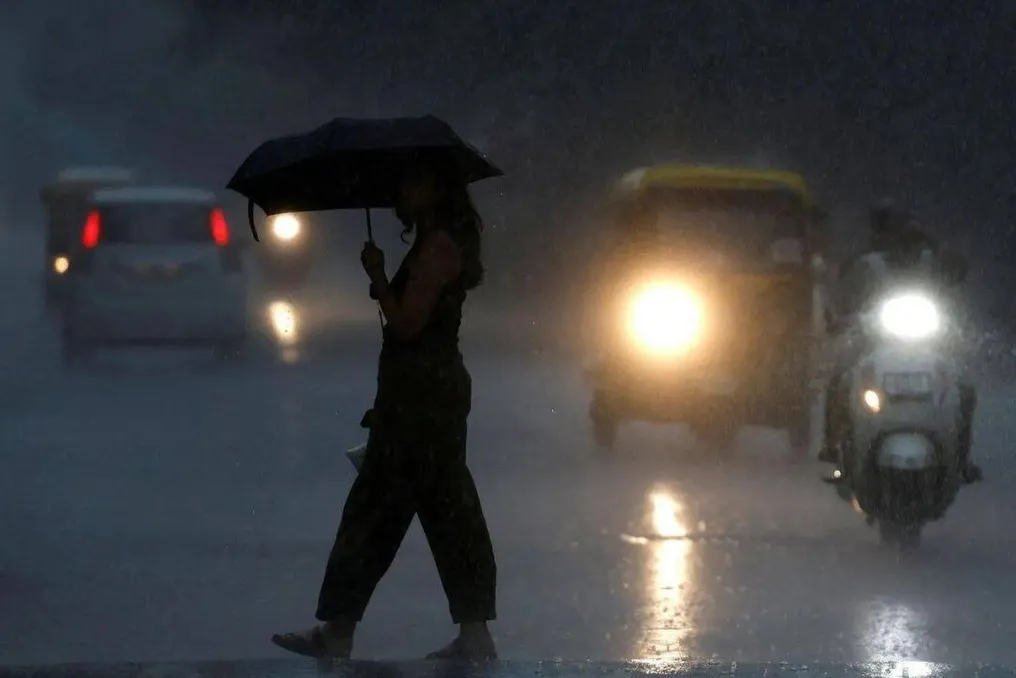
The India Meteorological Department (IMD) has published a major forecast regarding the monsoon in India for September. According to IMD data, the average rainfall across the country is expected to be below normal in September. In its monthly forecast released on Monday, the department stated that September's rainfall could be less than 91% of the Long Period Average (LPA).
The long-term average for September is 167.9 millimeters, established based on rainfall data recorded between 1971 and 2020. Thus, according to IMD estimates, the probability of achieving normal rainfall levels in September this year is low.
The meteorological service expressed concern not only about the level of precipitation but also about temperature. IMD predicts that the average maximum temperature in the country in September is likely to exceed the norm. This means that, in addition to reduced rainfall, higher than usual heat may be felt in September.
IMD also presented weather data for August 2026. According to the department, August 2026 was the hottest August in India's history since 1901. During this period, the average temperature across the country was 28.01 degrees Celsius, compared to the normal average temperature for August of 27.34 degrees Celsius. The average minimum temperature in August 2026 was also the highest since 1901, reaching 24.36 degrees Celsius against a normal level of 23.68 degrees Celsius. This indicates an increase in both daytime and nighttime temperatures in August.
Despite the temperature reaching record highs in August, the precipitation situation was also not typical. IMD reported that 213.3 millimeters of rain were recorded across the country in August 2026, which is the seventh lowest rainfall in August since 2001. The main reason cited for the reduced rainfall in August was the moderate or strong El Niño situation in the equatorial Pacific Ocean. A strong phase of El Niño currently persists in the equatorial Pacific Ocean.
IMD Director of Meteorology, Mrityunjaya Mahapatra, noted that sea surface temperatures in the central and eastern equatorial Pacific remain above normal, and this situation is expected to strengthen in the coming months. Four low-pressure systems formed during August, remaining active for 26 days. However, the benefit from the rainfall caused by these systems was not felt in all regions of the country.
According to IMD data, the rainfall associated with these systems was concentrated mainly in the Gangetic plains. Because of this, other parts of the country faced a deficit of rainfall. Thus, despite the formation of precipitation systems in August, their impact was not uniform across the country. While the Gangetic plains experienced high rainfall activity, many other regions suffered from insufficient rain.
In conclusion, IMD forecasts that rainfall in September will be below normal. With a normal September rainfall level of 167.9 millimeters, the actual amount is expected to be less than 91%. Furthermore, the trend of exceeding the normal average maximum temperature is likely to continue in September, meaning the country will have to face both less rainfall and hotter than usual heat.
Mrityunjaya Mahapatra also emphasized that the El Niño condition in the Pacific Ocean may intensify. The meteorological service pointed to this situation as one of the main reasons for the reduced rainfall in India in August. Overall, although India experienced the hottest August since 1901, the rainfall was also below normal, and IMD forecasts a continuation of reduced rainfall in September, with attention remaining focused on both precipitation and temperature.