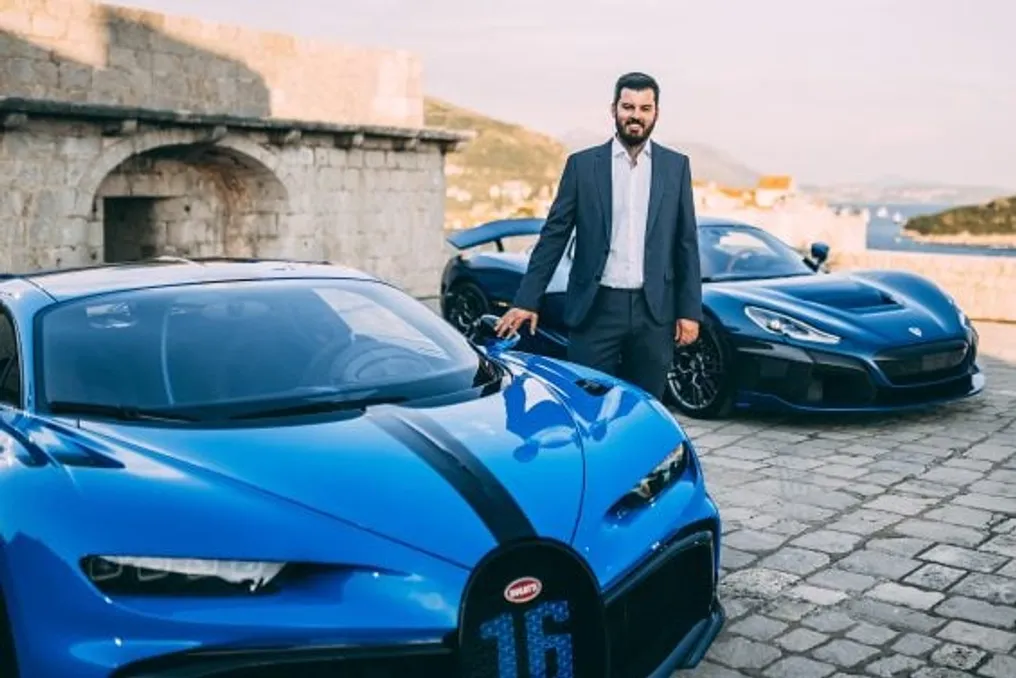
The creator of electric hypercars recently stated that high-performance sports vehicles will continue to rely on fossil fuels for a considerable period. In an interview given to the American network CNBC, published on August 25th, Mate Rimac explained that the automotive industry is dividing into two distinct segments: everyday cars will migrate to electrification, while sports and hypercars will maintain the use of combustion fuels.
This position, according to the executive, is not motivated by nostalgia but by commercial reasons. He argues that absolute performance has ceased to be the decisive factor in the market. As an example, Rimac points out that it is currently possible to acquire in China a vehicle faster than any sports car produced ten years ago, for an approximate value of R$ 260 thousand (US$ 50 thousand).
To illustrate his point, Rimac uses an analogy from the watchmaking sector. He observes that although only about 5% of watches are produced in Switzerland, this location concentrates most of the sector's profit. Despite a smartwatch offering superior functionalities to a traditional mechanical watch, the consumer rarely pays the equivalent of R$ 1 million (US$ 200 thousand) for one.
When the Rimac Group took over Bugatti in 2021, in partnership with Porsche, the executive was tasked with developing an electric model for the brand, as requested by Volkswagen and Porsche. Although he already had a ready-made electric hypercar and recognized that adapting it for Bugatti would be the simplest path, he opted for a more complex approach, even challenging his own shareholders.
The result of this effort was the launch of the Tourbillon, which succeeds the Chiron. Instead of relying exclusively on batteries, the vehicle incorporates an 8.3-liter turbocharged V16 engine, generating 1,000 hp, developed in collaboration with the British company Cosworth, complemented by three electric motors that provide an additional 800 hp. This combination totals 1,800 hp and 305.9 kgfm, allowing it to accelerate from 0 to 96 km/h in just 1.9 seconds and reach speeds of up to 380 km/h, or 445 km/h using the Speed Key.
The aesthetic philosophy of the Tourbillon reflects this same logic of exclusivity. While the market tends to prioritize digital screens, the Tourbillon's instrument panel is analog, built with materials such as titanium, sapphire, and ruby by Swiss watchmakers and positioned behind the steering wheel. This feature is not accidental, as 'tourbillon' is the term used for a high-precision watch mechanism. The car is assembled in Molsheim, France, and the V16 engine comes from the group's factory located in Croatia, the same production line as the Nevera, the electric hypercar that holds over 20 performance records.
The 250 units planned for the Tourbillon have already been sold, with prices starting at around R$ 22.9 million (3.8 million euros). Furthermore, the base price is only the starting point; according to Rimac, the average customization cost for the buyer ranges between R$ 3.1 million and R$ 3.6 million (US$ 600 thousand to US$ 700 thousand), covering options such as exclusive paint jobs, leather, and custom stitching. For this specific audience, Rimac believes that the purchase is not about regaining time, but rather about obtaining an object that tells a story and reflects the owner's identity.