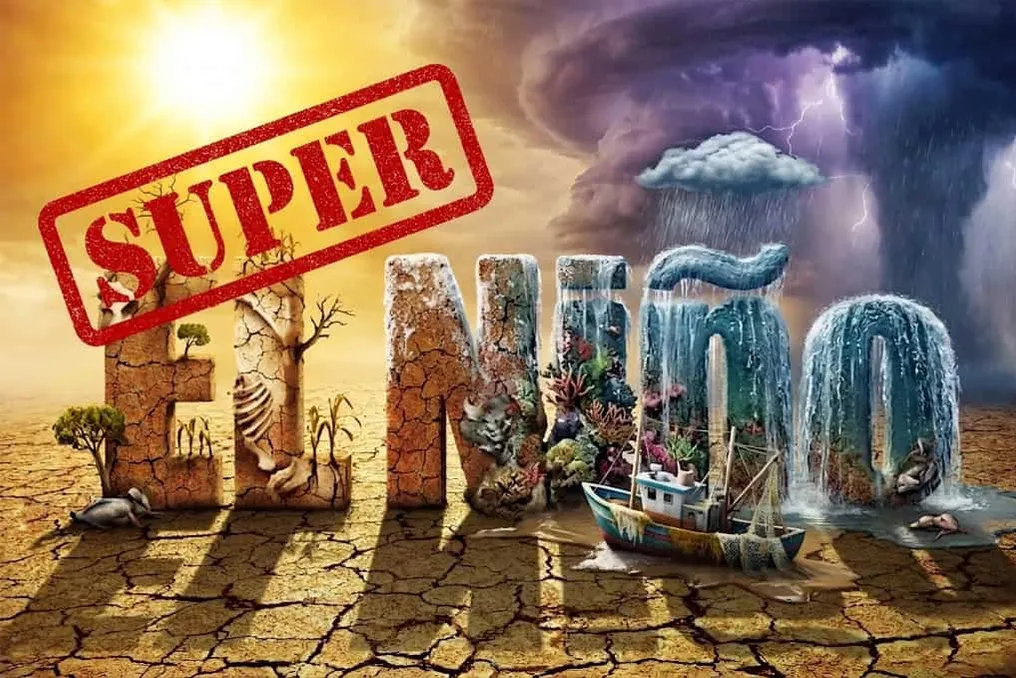
The abnormal warming of the Pacific Ocean waters triggers global climate changes, a phenomenon known as El Niño. For 2026, this event is expected to exceed current scientific parameters and could establish itself as the most powerful recorded in the last 150 years.
Alerts issued by the Met Office, the British meteorological agency, suggest that the average increase in equatorial Pacific sea surface temperature, which normally varies between 1°C and 2°C in common events, could exceed 3°C in the coming months. If this forecast is confirmed, the current event will surpass the records of El Niños that occurred in 1982/83, 1997/98, and 2015/16.
Adam Scaife, responsible for long-term forecasting at the Met Office, stated in a release that this is an unprecedented occurrence, saying: 'I have never seen such an intense sign of El Niño in our forecasts.' He added that the confirmation of the models will far exceed any recent human experience with global climate impacts.
To understand how the warming of a single ocean affects global climate, it is necessary to analyze atmospheric dynamics. Normally, trade winds blow from east to west at the Equator, moving the warmed waters to the western part of the Pacific. During El Niño, the strength of these winds decreases, allowing heat to disperse towards South America.
Ana Cristina Palmeira, a meteorologist, Doctor of Sciences from the University of São Paulo (USP) and professor at the Federal University of Rio de Janeiro (UFRJ), explained this mechanism during the program Olhar Espacial last Friday (21). She detailed that under El Niño conditions, wind intensity drops, causing warm water from the west side to migrate towards the American coast in the equatorial region of the Pacific.
Palmeira emphasized that the energy accumulation is not just superficial but in a deep layer, comparable to a pool, representing a vast reservoir of potential energy. She stressed that because the Pacific is a gigantic ocean, any change in it has the capacity to affect the entire globe.
The intensity of the phenomenon is determined by the thermal deviation. According to Ana Cristina, increases of up to 1°C classify an event as weak, while values above 2°C indicate a very strong event. She noted that the rate of temperature increase this year is impressive to researchers, saying: 'This one in 2026 has much higher temperature increase rates than previous ones. I think this calls attention to the word 'Super', because we have never had a value growing so rapidly before.'
Global Climate Impacts
Changes in atmospheric circulation will result in severe consequences, mainly in tropical zones. Prolonged periods of drought are predicted in Central America, the Western Pacific, Southern Africa, and northeastern Australia. In India, the monsoon pattern already shows significantly below-average rainfall volumes.
The magnitude of the risk evokes dark historical memories. In conversation with The Guardian, Professor Hayley Fowler from the University of Newcastle warned that the current Super El Niño could reach the scale of the 1877-78 event. During that period, climate crises led to global food shortages and resulted in approximately 50 million deaths.
Brazil experienced the effects of that era during the 'Great Drought' (1877–1879), which devastated Ceará and the Northeast. This drought caused the death of half a million people due to hunger, thirst, and diseases such as smallpox, initiating the first major migration wave in the country's history.
In contrast to the drought in tropical areas, the phenomenon tends to generate intense storms in southern Brazil, the Horn of Africa, Western Europe, and eastern China. The Pacific Ocean is expected to record more frequent and powerful cyclones, while the Atlantic may have fewer hurricanes, although with more destructive isolated storms.
The effects on Brazilian territory will vary depending on the region. In the South, the scenario points to abundant rainfall and storms. Ana Cristina explained: 'The increase in rainfall and the number of cyclones at sea brings a lot of high tides, higher waves, and a much rougher sea. It affects Rio Grande do Sul, Santa Catarina, Paraná, and even a small part of western São Paulo.' She added that when a cold front retreats, and a cold, dry air mass returns to a warmer and moister area due to El Niño, this contrast generates clouds favorable for tornado formation.
In the North and Northeast regions, the warning is for water scarcity and extreme heat. The specialist stressed: 'If we are talking about lack of rain, we are talking about problems with drought, supply, and agriculture. The aggravating factor of a dry and very hot environment are wildfires and more frequent heatwaves,' mentioning the fragility of Amazon rivers, essential for local transport.
Global Temperature Projection
In addition to regional impacts, the vast amount of heat released from the Pacific into the atmosphere will raise the planet's average temperature. Since the thermal response peaks in the year following the event's peak, Met Office estimates indicate a very high probability that 2027 will be hotter than 2024, temporarily exceeding the 1.5°C limit stipulated by the Paris Agreement.
For scientists, it is crucial to monitor the evolution of real-time data, keeping in mind the fundamental role of oceanic measurements in disaster prevention. Ana Cristina highlighted: 'All of us in the geoscience field need observational data. We work a lot with numerical modeling and future projections, but our foundations will always be that observation itself.'
Faced with a rapidly transforming ocean and a phenomenon without parallel in recent decades, the meteorologist reinforced the importance of science and collaboration to face the future: 'There are many good people working, each in their specialty. We also need support for science and for the population to really listen to us.'