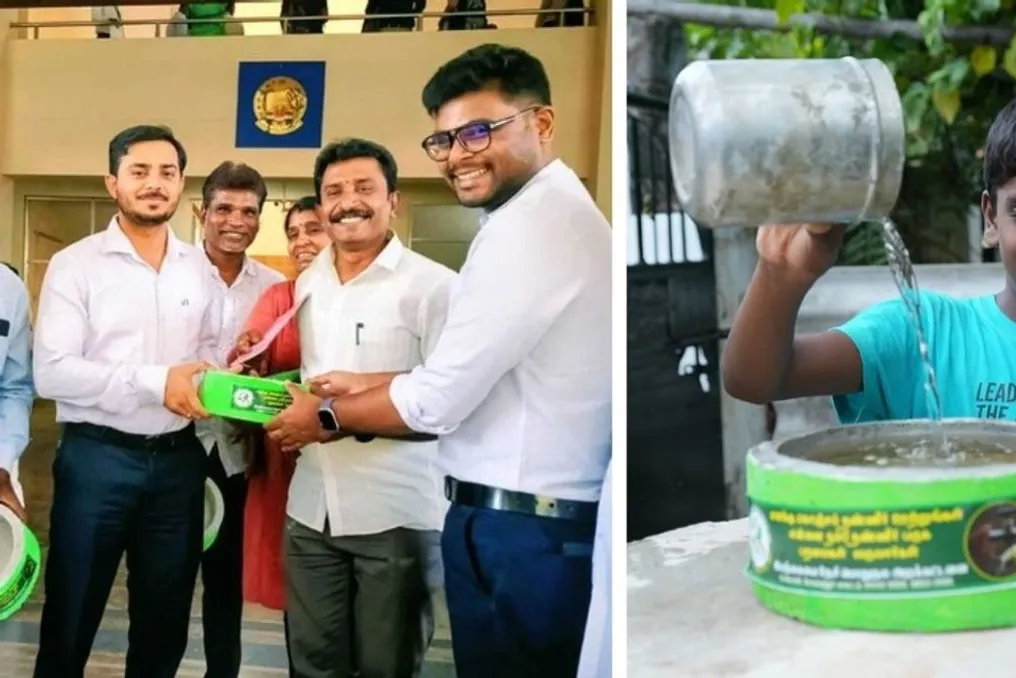
As the monsoon season approaches in parts of India, hot and humid days can make it difficult to be outdoors. While water is easily available for humans, birds in increasingly urbanized cities often struggle to find a source of drinking water.
In urban areas, access to natural water bodies such as ponds, lakes, and streams is often limited, turning the search for clean water into a daily problem during hot months. It was this concern that prompted a group of people in Pollachi, Tamil Nadu, to take action.
The charity 'Iyarkkaiyai Nesi' (Love for Nature) developed a simple solution—making small, durable bird feeders costing only about 30 rupees.
A Simple Idea for Thirsty Birds
The founder of the foundation, Vetrivel, told The Better India that the idea arose from concern over the lack of accessible water for birds in cities. He noted that in rural areas, water is more accessible due to the presence of ponds, lakes, and agricultural lands, whereas in cities, water sources are virtually non-existent because of buildings and limited greenery.
About five years ago, Vetrivel began placing water containers for birds during the summer. Initially, he used discarded oil cans, cutting them up and filling them with food and water. However, the cans rusted over time, making them unsuitable for long-term use. Furthermore, he worried that regular feeding might alter the natural foraging behavior of birds.
This prompted the team to look for a more durable way to provide water. As a result, a simple concrete bird feeder was created, specifically designed for birds.
Local Production
The design of the feeder is quite simple. The team uses round PVC pipes with diameters of 10 and 8 inches as molds. A mixture of cement and sand is poured into them, with one side sealed to create a shallow basin. Each feeder can hold approximately 2 to 2.25 liters of water.
These bowls are designed so that birds can safely drink from them and also use them for bathing, especially in hot weather. The initiative is also aimed at keeping costs low. Depending on the materials and production process, each feeder costs between 24 and 30 rupees. Using materials costing around 18,000 rupees, including sand, cement, and paint, the team can produce 600 to 700 feeders, excluding labor costs.
Vetrivel explained that if labor costs were included, the price would be around 90–100 rupees per unit. Because team members voluntarily donate their time and effort, they can maintain a low cost and maximize the number of feeders produced.
Over 6450 Feeders Distributed
Over the last three years, the organization reports having distributed more than 6,450 free water feeders. Recipients include schools, colleges, commercial enterprises, government institutions, and forest departments across the state of Tamil Nadu.
However, the team's work is not limited to distribution. They also conduct awareness campaigns about bird conservation and urge people to support the feeders by regularly cleaning and refilling them with water. This response has stimulated greater participation. Several private individuals have started installing feeders on terraces and balconies. Schools, in particular, have become active participants, with students helping to maintain and fill the feeders.
To prepare for the summer demand, the team manufactures the feeders in advance, starting in December. They are then distributed throughout Tamil Nadu during the warmer months, usually from January to August.
Students Become Part of the Effort
Some of the most active participants in this initiative are schoolchildren. Harigokul, a 6th-grade student at Eripathy Government High School, said: 'The team came to our school and explained to us why birds are important and how we can help them in the summer.' He added: 'I bought three feeders, took them home, and installed them at my grandmother's house and on my terrace. I feel good doing something for the birds.'
Another student, Majlilan, reported that the school received hundreds of these feeders. 'We placed them all over the campus and filled them with water daily. Sometimes we even leave leftover food nearby. It is truly amazing to watch different species of birds and their activities. Many birds regularly visit here,' he said. For the students, maintaining the feeders has become a small but significant part of their daily routine.
Small Bowl, Big Idea
What started as Vetrivel's attempt to provide water for birds has turned into a larger community effort. The organization's approach is simple: make a durable water source accessible, widely distribute it, and encourage people to take responsibility for its maintenance.
For those who want to help city birds, the solution does not necessarily require complex installation. Sometimes it can start with a shallow bowl of clean water placed in a safe spot and a willingness to ensure it remains full. As Vetrivel and his team have shown, a small intervention can allow a greater number of people to care for the wildlife that shares their cities.
If you plan to put out a bird feeder, a little attention can make it safer and more useful. Here is what is recommended to keep in mind: keep the water shallow; place it in a safe spot, inaccessible to predators or cats; clean and refill it regularly; avoid adding food unless recommended; keep it away from heavily polluted or chemically treated areas.