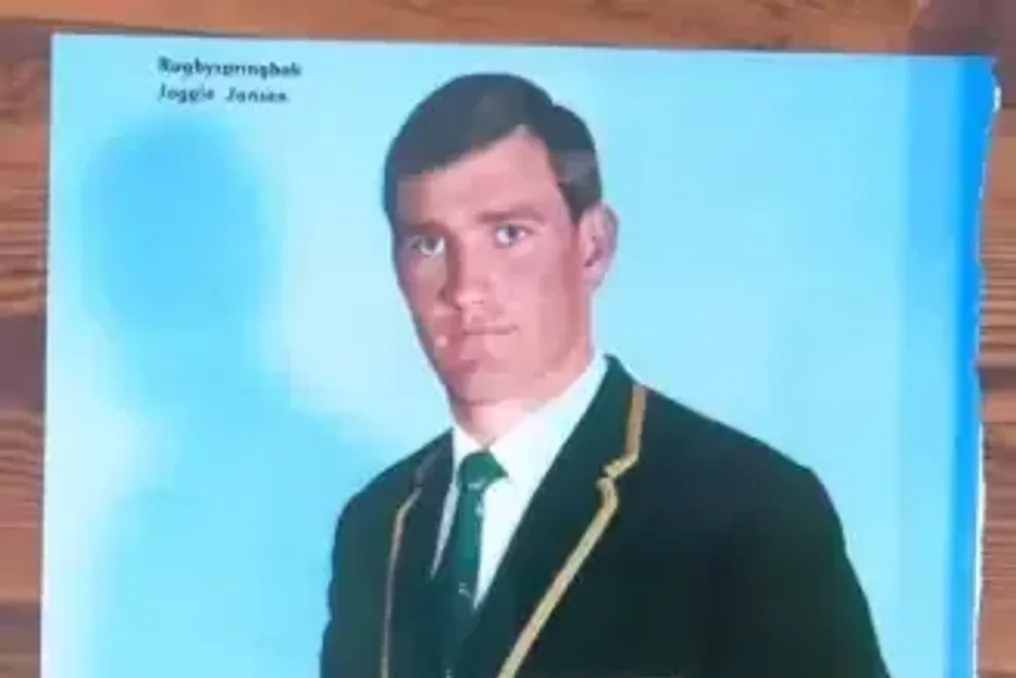
Springbok legend Joggie Jansen, pictured in a green jacket, was at the Cape Town stadium during the match when the Boks defeated the All Blacks in another epic clash of rivals. The following day, 78-year-old Jansen passed away from a heart attack.
Jansen played ten matches in the Test series for the Springboks (from 1970 to 1972) and lost only twice. He played 61 matches for Free State and was a key player for the team that won the Currie Cup for the first time in 1976.
Last week, watching from the stands, Jansen was likely recalling his difficulties against the All Blacks in 1970. The Boks won the series 3-1, and Jansen played a significant role in this success thanks to his fierce tackles.
The Main Rivalry in Rugby
When the All Blacks arrived in South Africa in 1970 after a 17-match unbeaten run, it was expected that they would easily overcome the Springbok team, which had no wins in the four-match tour of Great Britain and Ireland. David de Villiers' team had lost to England and Scotland, drawn with Ireland and Wales, and now faced the mighty New Zealand team, nicknamed the 'Unsmiling Giants.'
Before the first match at the packed Loftus Versfeld stadium on July 25, 1970, De Villiers asked every Springbok player to do something special to inspire belief in the possibility of defeating the giants. Four minutes after the match started, the captain began the game by calling an All Blacks scrummaging maneuver near the try line. He instructed hooker Piston van Wyk to strike the ball through the scrummage. When the ball popped out at the opposite end of the scrummage, flanker Piet Greiling darted in and passed it to De Villiers for a playful point.
The crowd of 70,000 cheered approvingly, but three minutes later, they erupted in delight. All Blacks scrumhalf Chris Laidlaw passed to flyhalf Wayne Cottrell, who ran toward the blind side and was about to pass to original Jonah Lomu and Brian Williams when a controlled missile suddenly flew in, and Cottrell was pinned as if run over by a tank. This missile turned out to be 22-year-old centre Joachim 'Joggie' Jansen, and his crushing shoulder tackle to the midsection made Cottrell lose confidence throughout the series. This tackle was hugely significant: in an instant, the wind of belief filled the sails of the Springboks, while doubt gripped the All Blacks. The Boks knew the All Blacks were making mistakes and won the match 17-6, and the series 3-1.
The Hand of Danny Craven
There is a fascinating story behind Jansen's famous tackle, and Mr. Rugby, Danny Craven, was involved in this fateful moment. The story began back in 1949 when another All Blacks team with a fearsome reputation arrived in the city. Craven was a Springbok selector and convinced the rest of the committee that to stop the fast-running backline from Kei, they needed to debut a centre named Rick van Suur. Craven noticed Van Suur fiercely tackling in Rhodesia during the Currie Cup, and this tobacco farmer proved to be a great success in the series that the Springboks famously won 4-0.
Fast forward to 1965, at the annual Craven Week high school meeting. Doc Craven invited Van Suur to conduct a training seminar with the backline players, including 17-year-old Joggie Jansen from the Free State team. Jansen recounted in 2020, 50 years after the 1970 series: 'This 'tackle' originated at Craven Week in 1965. Rick van Suur was invited to show us how to tackle. It happened that he chose me to demonstrate how to dive, spreading my arms and driving with my shoulder. I thought: 'Hmm, this might work...''
Five years later, Cottrell confirmed that Van Suur's technique—perfectly executed by Jansen—did indeed work. Surprisingly, before the first match, Jansen had never attended a Springbok match as a spectator, let alone played in one. He recalls that before the match started, his centre partner Mannetjie Roux whispered to him: 'Don't pay attention to the Haka... Just watch Cottrell, who will blindly pass to Williams early in the game.' The 19-year-old Williams was of Samoan descent and later became one of the greatest figures in the game; he was knighted by Queen Elizabeth II for his services to rugby.
The All Blacks had never heard of Jansen before this match; he wasn't even widely known in South Africa. 'I seemed to appear out of nowhere,' said Jansen, born on February 5, 1948, in Griquatown. 'But after the first match, my life changed.' Joggie was one of seven children, and his brother Eben later played for the Boks in 1981. 'We didn't have farmhands, so we did everything ourselves. The girls sewed and baked—my sister was nicknamed 'Testy' because she constantly baked to feed her hungry brothers and sisters.' He added: 'We were very lucky that there was a football field near our yard. As a boy, I scored many tries for the 'Springboks' against the 'All Blacks' on that field.'
Joggie Jansen's Scissors Move
Joggie could not have known that he would one day do exactly this—score against the All Blacks. 'Before the second match in 1970 in Newlands, Mannetjie told me I would score that day. I was stunned, but after thinking about it, I replied: 'I will score, but you have to tell me when...'' They pre-planned the 'scissors' maneuver, which involved the inside centre moving outwards, the outside centre running into the gap, and receiving a pass from the flyhalf. During the match, Mannetjie suddenly shouted: 'Scissors! Here is your try!' Joggie sprinted forward, tackled Fergie McCormick, brought down Graham Thorne, and dove under Brian Louch's tackle attempt to score a brilliant try. He noted that the crowd noise gave him goosebumps, but his teammates' reaction was restrained. 'In that era, players didn't hug or celebrate like they do now,' Jansen smiled. 'Only Jan Ellis said in his deep voice: 'Mooi (beautiful) man!'' The All Blacks won the second match, and the series moved to Port Elizabeth. When the All Blacks selected their team, they moved the dangerous Williams from the wing to the outside centre, and Boks coach Johan Klaassen became concerned.
Powerful Tackle Against the All Blacks Centre
Klaassen asked the team to suggest ways to stop the sturdy Williams, who technically should have been opposite Roux. Jansen recounts how the team discussion went: 'Mannetjie said: 'I can't bring this guy down. But,' and placed his hand on my shoulder: 'My partner here can!' And I was moved to position 13 in defense to stop Williams.' He says he barely slept, and at dawn the next day, Mannetjie rushed into his room, which he shared with Gert Muller. He jumped onto the bed and exclaimed: 'Did you sleep well? Brian Williams! Are you afraid of him? No. Good...' Then he left the room. In the bus, Mannetjie reserved a spot for him and started again: 'Brian Williams.' 'What's wrong with him?' I asked irritably. 'What is his strength?' he replied. 'He pushes off strongly with his left foot.' 'Brian Williams... Are you scared?' And so Mannetjie continued until I got tired. 'Enough now.' 'Okay, you are ready,' he smirked. At the start of the game, Mannetjie passed me the ball late, and I took the ball with Williams, but I had enough time to turn and deliver a hip shot. Williams rose unsteadily and rubbed his shoulder. Soon after, he received the ball, and I saw him preparing to jump off that left leg. I charged into him with all my might. I went low, and simultaneously Jan Ellis and Piet Greiling hit him from above. It was a collective tackle, and we crashed into a tangled heap. Williams was no longer the same.' The Boks won the match 14-3, and the series concluded 3-1 the following week at Ellis Park. Jansen once again played a vital role. This time it was a ferocious tackle on All Blacks fullback Gerald Chamber. The ball slipped, and Roux picked it up, and winger Muller scored the decisive try. Jansen recalls that Roux was ecstatic. 'Mannetjie was jumping and shouting that he had won a 'teelram' (pastoral or prize lamb). Mannetjie was a farmer-sheep herder and a Springbok supporter who promised him a lamb if he scored or scored a try.' This is a chapter from Mike Greenaway's bestseller 'The Fireside Springbok.'