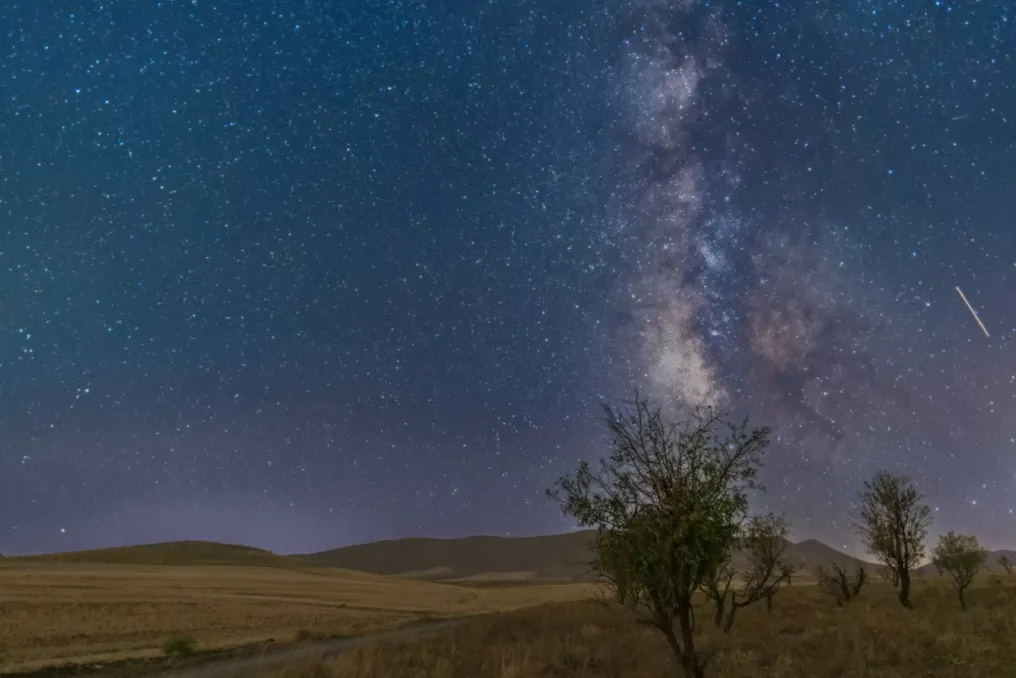
Sutherland, a small town in the Karoo region, located on the Roggeveld plateau in the Northern Cape, is situated at approximately 1,450 meters above sea level. It is surrounded by vast arid landscapes, mountains, sheep farms, and some of the darkest skies in the country. Due to its remoteness from daily life, yet proximity to Cape Town, it is ideal for a good weekend getaway.
The drive from Cape Town takes about four hours, depending on the chosen route and stops. To get there, you need to turn off the N1 highway onto Matiesfontein and proceed up the mountain road, where the scenery becomes increasingly dramatic as you ascend to Sutherland.
Sutherland is most famous for two things: the stars and the cold. In winter, temperatures regularly drop below zero; the minimum temperature recorded here in 2003 was -16.4°C. However, it is the sky that has put this tiny Karoo settlement on the world map.
Astronomical Fame and History
On the outskirts of the town is the South African Astronomical Observatory, where the dry climate, altitude, and exceptionally low light pollution create ideal conditions for observation. The South African Large Telescope, known as SALT—the largest optical telescope in the Southern Hemisphere—is also located here.
Nevertheless, when visiting Sutherland, one should not limit themselves only to the stars. The town is a collection of old stone buildings reflecting the history of the Anglo-Boer War, farmers, Karoo lamb production, Afrikaans literature, unusual roadside stops, mountain passes, and a surprising connection to tulips. And, of course, there is the famous silence.
One of the first places to explore the history of Sutherland is the large Dutch Reformed Church in the town center. It was completed in 1899 and designed by architect Charles Freeman, who also designed the Dutch Reformed Church in Graaff-Reinet. However, its early history was linked to military actions: during the Anglo-Boer War, British troops occupied Sutherland, using the church as a fort and barracks. Today, British graffiti can be seen inside the building, and the ruins of the military fort remain on Rebelspoek on the outskirts.
Furthermore, upon entering Sutherland from Matiesfontein, you can find the Anglo-Boer War cemetery. Sutherland even experienced a mini-siege when Boer forces reportedly shelled the British-controlled town for about ten hours.
SALT Telescope and Astrotourism
Sutherland's isolation is perfect for astronomers due to minimal artificial lighting, dry air, and the observatory's high location above the surrounding Karoo. These conditions make the area particularly suitable for astronomical observations. The result is a night sky capable of making even someone who usually cannot distinguish Orion from a garden sprinkler stop and look up.
SALT is the central object. Its primary mirror has a diameter of 11 meters and consists of 91 individual hexagonal mirrors, each measuring one meter. It is the largest optical telescope in the Southern Hemisphere and one of the largest in the world. Astronomers use SALT to study faint and distant objects in the universe, and its enormous light-gathering capacity allows scientists to investigate objects too weak to be seen with the naked eye.
Although visitors cannot simply enter the research complex at night, they can take daytime tours of the observatory to learn about the telescope and the scientific research conducted there. The SAO also offers night programs using visitor telescopes. It is important to check the current schedule, as these tours depend on weather and seasonal changes.
Stargazing is possible without visiting the observatory. Sutherland's private planetarium offers digital shows and evening observations, and establishments like Sterland provide their own astronomy tours. Local tourist guides also feature specialized stargazing events at local farms and accommodation sites.
Culture, Geology, and Travel
The cold should not be underestimated. Even in summer, standing outdoors under the Karoo sky at night can be chilly, and in winter, extremely harsh. Layered clothing is necessary. South Africa's national astrotourism strategy designated Sutherland as an important destination for astrotourism, noting that the area already attracted between 14,000 and 15,000 visitors annually. This has also stimulated growth in housing, restaurants, stargazing services, and other tourist amenities around the observatory.
In 2025, SALT marked 20 years since its opening. An annual report showed how the telescope helped transform the economy and society of Sutherland, by which time the town had 74 guest houses providing employment for nearly 500 people. The anniversary celebration also included community events in Sutherland and highlighted the role of astronomy, education, and tourism in the town.
To experience astronomy without waiting for darkness, planetary pedestals depicting the planets of the Solar System are located along Sutherland's main road. They were designed to give visitors an idea of relative sizes and distances. This route is often called the Star Mile, and walking down a quiet Karoo street, contemplating the size of the universe, is a typical Sutherland activity.
Not far from the observatory is Salpeterkop, an extinct volcanic feature last active about 66 million years ago. This is an unusual sight in this landscape: an ancient volcano in one of South Africa's most renowned astronomical locations. For those wanting more, tours of Salpeterkop are offered, including those in the Rogge Cloof area. Such a hike gives Sutherland a completely different dimension—instead of looking billions of years into space, you are looking at Earth's geological history beneath your feet.
Winter Sutherland is different. Although snow is not guaranteed, when it falls, the stone buildings, mountains, and dusty roads of the town suddenly take on a more European appearance. Snowfall is unpredictable, so you cannot simply book a weekend in July expecting a white town. But if the forecast promises it, accommodation fills up quickly.
The cold is also part of the appeal. The record of -16.4°C is impressive, but even ordinary winter nights can be very frosty. Dress appropriately. And don't be disappointed if there is no snow; a clear winter sky may be a more magnificent sight.
Since Sutherland is small, you shouldn't spend the entire weekend just seeing the main attractions. Take an hour just to walk around. Look for old Karoo houses, stone structures, Victorian stoeps, and weathered walls—small details easily missed while driving through the town. Old cemeteries, handmade gravestones, and reminders of the people who passed through this isolated settlement are found here. The Anglo-Boer War Cemetery and the Jewish Cemetery are of particular interest to those interested in the lives and deaths of people here.
It is also worth checking out the old farmhouses and clay-roofed homes—structures that tell the story of how people adapted to the harsh climate long before modern insulation and underfloor heating existed.
Nature and Surroundings
Sutherland is beautiful precisely because the town itself is only part of the story. About 45 km from the town, the Ouenberg pass cuts through the dramatic mountain landscapes of the Karoo, offering views of lower landscapes and the distant Ceres Karoo mountains. This is a trip where the journey itself is the main attraction. Don't rush; stop when safe, and let the landscape speak for itself.
If you arrive from Matiesfontein, the Verlatenklip pass is one of the memorable parts of the journey. This pass rises sharply into Roggeveld and was designed by Thomas Bain, son of the renowned South African road builder Andrew Geddes Bain.
For more adventurous trips, Skurweberg offers 4x4 routes through the rugged Karoo terrain, as well as opportunities for hiking and mountain biking. The surrounding landscape is magnificent, but this is not a leisurely scenic drive. Conditions must be checked, your vehicle's suitability confirmed, and bookings made in advance.
The landscape of Sutherland may seem harsh at first glance, but upon closer inspection, many interesting details emerge. Roggeveld gets its name from Secale africanum, wild rye growing in the region. Other interesting plants include Sterbum, Oliphantspruit, and Daubenya aurea. Sterbum is especially beautiful during its spring bloom, adding unexpected color to the otherwise earthy landscape. And, of course, the tulips.
It seems somewhat absurd to think of tulips in the Karoo. Nevertheless, Sutherland has a long association with them. According to legend, Reverend M.B. Brink, who studied in the Netherlands, noticed a similarity between the Dutch climate and the cold conditions of Sutherland and began experimenting with tulips. The flowers grew well in the cold climate, and tulip cultivation became an unusual part of the region's agricultural history. Bulbs are planted in autumn and mainly bloom in spring, making September a particularly interesting time to visit if you want to see the colors of the Karoo.
Gastronomy and Accommodation
After long drives, walks, and gazing at the sky, you will certainly want to eat. Fortunately, Sutherland is a sheep-rearing country, and Karoo lamb is an obvious choice. South African Tourism itself highlights traditional Karoo dishes and lamb as part of the Sutherland experience.
For a full meal, local options include The Blue Moon and Karoo Kombuis, which offers traditional Karoo cuisine. Sutherland Hotel is also a useful stop in the town center, especially if you prefer the atmosphere of an old Karoo hotel over a modern, polished look.
For something different, Discover Sutherland & Planetarium & Coffee shop combines tourist information and coffee with the city's astronomical history—a useful place to start getting acquainted with the area. There is also Tjol se Gat, located in an old wagon on the Verlatenklip route, making it a particularly colorful stop on the drive from the town. This place feels like Sutherland: remote, informal, and slightly unexpected.
When traveling along the road, look for treats at farm stalls, such as homemade pies, biltong, droëwors, rusks, and preserves. The Karoo is not a place to rush, so it is better to stock up on supplies, find a scenic view, and have lunch where there are more sheep than cars.
Despite its small size, Sutherland offers quite diverse accommodation. For a deeper immersion into Karoo life, Rogge Cloof is one of the well-known options in the wider Sutherland area. It combines accommodation with the landscape and astronomical experiences that make the region special. Tourist guides show 15 living units accommodating up to 50 guests.
This option is worth considering if your Sutherland weekend is meant to be about more than just staying in town and visiting attractions. If you prefer to wake up on an active sheep farm rather than in the town center, Karoo Rustigheid Gasteplaas offers farm stays, as well as trails for hiking and cycling, and the open Karoo landscapes that are worth coming here for. The Blue Moon is in a quieter part of Sutherland and combines accommodation with a restaurant, which is convenient if you want to maintain a relaxed pace.