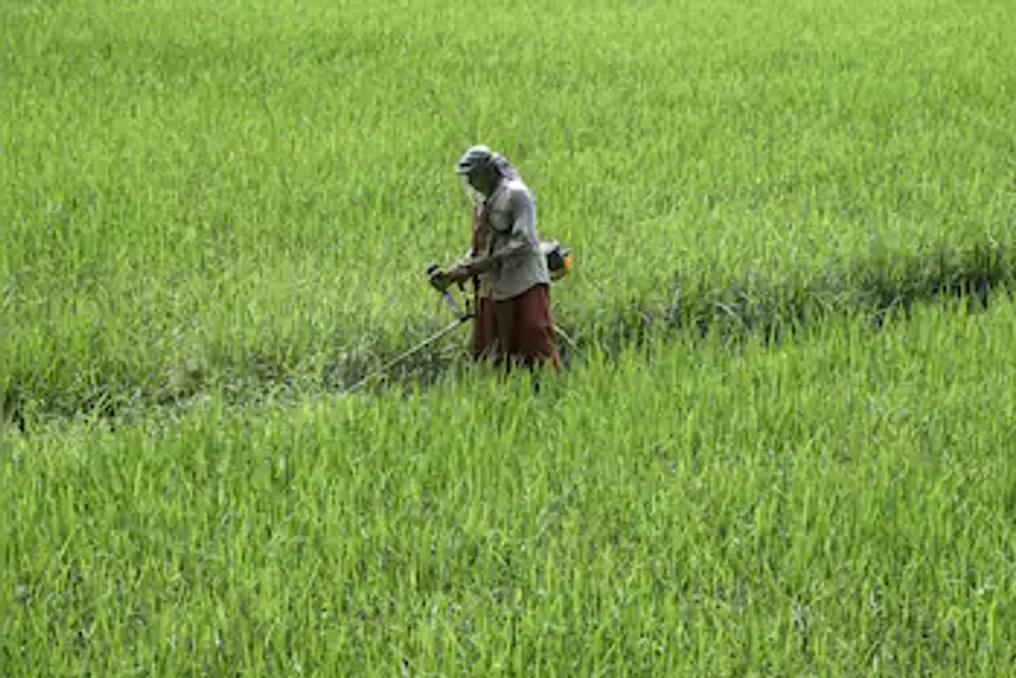
Gross domestic product growth in agriculture and related sectors reached 3.6% in the first quarter of fiscal year 27
Read more
Business Standard
business-standard.com

Gross domestic product growth in agriculture and related sectors reached 3.6% in the first quarter of fiscal year 27

According to the latest data from the Ministry of Statistics and Program Implementation (MoSPI), the gross domestic product (GDP) in the agricultural sector and related industries showed a growth of 3.6% in the first quarter of fiscal year 27. This figure is lower compared to the 4.4% recorded during the same period last fiscal year.

Experts suggest that the overall growth for the entire fiscal year 27 will be around 3.5–4%. The slowdown in growth may have been caused by low production levels in animal husbandry and livestock farming, which suffered from floods and intense heat between April and June.

Madan Sabnavis, chief economist at Bank of Baroda, noted that the influence of the animal husbandry sector on GDP is becoming more probable, as agricultural activity in India is usually at a low level in April-June, and the market mainly receives residual harvests. He added that the actual impact of the weak monsoon season on the GDP of agriculture and related industries during fiscal year 27 will be felt in subsequent quarters.

Sabnavis also forecasts that the GDP of agriculture and related industries for the entire fiscal year 27 could be 3.5–4%, which aligns with the long-term trend of the sector but has a clear downward bias. This downward bias is due to the fact that despite the recovery of rainfall, the sowing area for cotton will remain below last year's level. Thus, even with improvement due to late rains, the deficit will not be eliminated.

Meanwhile, the data also showed that at current prices, GDP growth in the first quarter of fiscal year 27 reached 7.5%, up from 4.7% during the same period last fiscal year. In the fourth quarter of fiscal year 26 (January-March), GDP growth in agriculture and related industries at constant prices was 3.9%.

As of August 30, the southwest monsoon in India was nearly 14% below the average cumulative figure, with eastern and southern peninsular India recording deficits of almost 26% and 24%, respectively, from June 1 to August 30, 2026. Rainfall in June was more than 36% less than normal, which sharply reduced cotton sowing areas. However, a strong surge in July helped reduce the deficit.

Furthermore, recent data from the Department of Agriculture (as of August 28, 2026) indicates that the sowing of cotton crops has been completed on an area of about 109 million hectares. This area is 1.7% less than in the same period last year and almost 3% below the normative area. Sowing of most crops is now nearly complete across India.

Similar stories

India Ratings and Research raises India's GDP growth forecast for FY2027 to 6.8% amid El Niño and Middle East risks
Read more
business-standard.com

India Ratings and Research raises India's GDP growth forecast for FY2027 to 6.8% amid El Niño and Middle East risks

India Ratings and Research (Ind-Ra) has raised its forecast for real Gross Domestic Product (GDP) growth in India for 2026–2027 by 10 basis points, bringing it to 6.8 percent from the previously projected 6.7 percent in May. The reason for this increase is lower than expected global crude oil prices.

Nevertheless, the rating agency warned that the economic momentum will be constrained by the ongoing El Niño phenomenon, geopolitical difficulties, inflation, and trade risks. Consequently, actual figures are expected to remain significantly below the preliminary estimate of the National Statistical Office (NSO) of 7.6 percent for the 2026 fiscal year.

Economic Forecast Details

In its mid-year economic outlook report, the agency listed risk factors for GDP growth in the 2027 fiscal year. These include geopolitical events, particularly the unresolved conflict in the Middle East, high overall inflation, currency depreciation, weaker than expected global trade growth, a base effect due to strong GDP growth in the 2026 fiscal year, the probable El Niño weather pattern, and the recent announcement by the US government regarding a 100 percent tariff on India for purchasing Russian crude oil.

Ind-Ra lowered its baseline estimate for crude oil prices for the 2027 fiscal year to $85 per barrel, which is lower than the initial forecast of $95 per barrel.

Devendra Kumar Pant, Chief Economist at Ind-Ra, noted during a press conference that the decline in oil prices below the initial forecast is a positive factor. He added that all else being equal, every $10 drop in oil prices leads to a 44 basis point increase in growth, but aspects related to monsoons partially offset this effect.

Climate Impact and Inflation

The agency considers weather-related risks, particularly El Niño, as the main constraint on Indian agricultural production and consumer prices. Rapid weather changes are already affecting food prices and consumer price inflation. The agency forecasts that the adverse base effect will contribute to food inflation for at least until October 2026.

Ind-Ra projects a slowdown in agricultural GDP growth to 2 percent in the 2027 fiscal year, compared to 3 percent in the 2026 fiscal year. A sharp jump in Wholesale Price Index (WPI) inflation to 8.5 percent is forecasted for the 2027 fiscal year (compared to 0.4 percent in 2026), while retail inflation according to the Consumer Price Index (CPI) will average 4.9 percent. Retail inflation is expected to peak at 5.9 percent in the third quarter of the 2027 fiscal year before declining to 5 percent by the fourth quarter of the 2027 fiscal year.

The agency also expects the Reserve Bank of India (RBI) to maintain its current policy stance on interest rates and monetary policy throughout the remainder of the 2027 fiscal year.

Private consumption expenditure, which accounts for more than half of GDP, is expected to grow by 7.2 percent in the 2027 fiscal year, slower than the 7.7 percent growth in the 2026 fiscal year. Ind-Ra attributes this slowdown to higher inflation, weakening rural incomes due to the impact of El Niño on agriculture, and sluggish urban demand.

External risks remain high. The Current Account Deficit (CAD) is projected to widen to 1.5 percent of GDP in the 2027 fiscal year, up from 0.6 percent in the 2026 fiscal year.

Mega Arora, Director at Ind-Ra, emphasized that from a prospective view, attention should be paid to concerns over the US announcement of tariffs up to 100 percent on India for purchasing Russian crude oil. She added that although the US Senate passed the bill, it has not yet taken effect, and it remains a critical risk factor for India's trade trajectory.

Gross Fixed Capital Formation (GFCF) is projected to grow by 8 percent in the 2027 fiscal year, largely supported by public sector capital expenditure. Ind-Ra expects the central government to adhere to the budget deficit target of 4.3 percent of GDP.

Popular