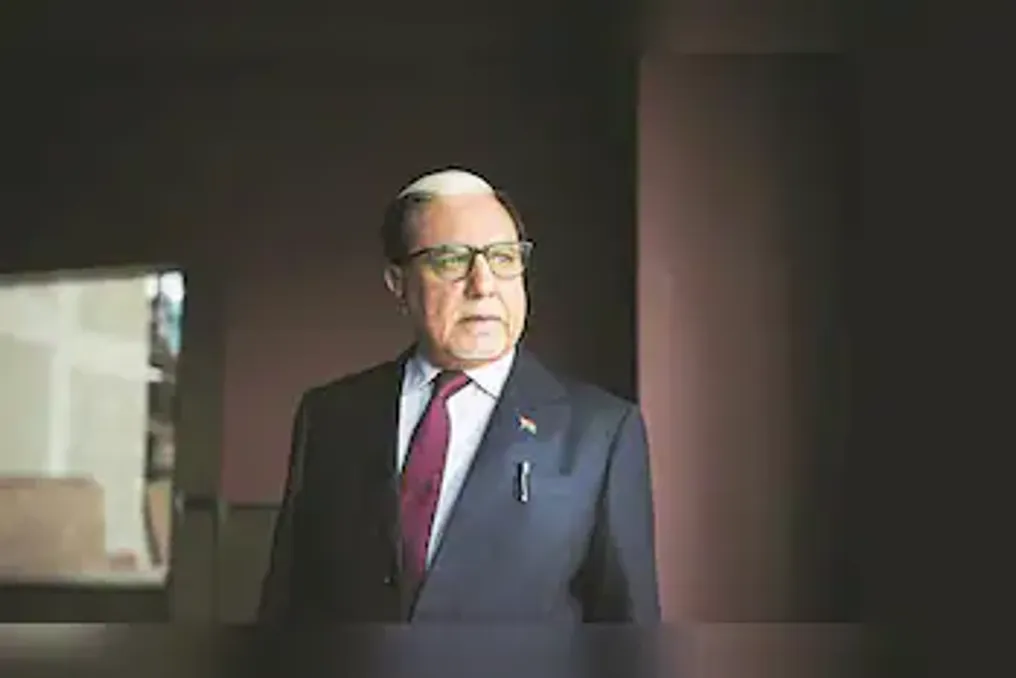
The National Company Law Appellate Tribunal (NCLAT) will on Tuesday consider objections from several financial institutions against the approval by the National Company Law Tribunal (NCLT) of the repayment plan presented by Essel Group founder Subhash Chandra in his personal insolvency case.
The appeal was urgently filed with the appellate tribunal on Monday by General Counsel Tushar Mehta, who represented the interests of creditors, including LIC Housing Finance, HDFC Bank, and Union Bank of India. NCLAT agreed to schedule the hearing for Tuesday at 10:30 AM.
The creditors seek to overturn the NCLT's decision, which effectively allows Chandra to settle the claims recognized in his personal insolvency case by paying creditors ₹6.25 crore, as well as ₹25 lakh towards the insolvency process. The recognized claims before the tribunal amounted to approximately ₹22,006.57 crore.
The proposed payout amount is about 0.03 percent of the recognized claims, implying a recovery deficit of nearly 99.97 percent. During the request for an urgent hearing, Mehta told the appellate tribunal: 'There are two or three important issues being decided, and if these conclusions are correct, we may face a complete loss of the intent and purpose of the Insolvency and Bankruptcy Code (IBC)'.
Several creditors had previously opposed Chandra's proposal in the NCLT. Among them were HDFC Bank, Axis Bank, Canara Bank, RBL Bank, and Union Bank of India, which voted against the plan. Nevertheless, the proposal received support from 80.81 percent in the creditors committee.
A key issue likely to be examined by the NCLAT is the voting rights of certain financial creditors whose support proved decisive. Opposing creditors questioned the participation of entities allegedly linked to Chandra or his family, including Veena Investments, Direct Media Distribution Ventures, World Crest Advisors, Lemonade Capital Advisors, and Corpcall Capital Advisors. Their votes helped exceed the required threshold for the plan.
LIC Housing Finance specifically questioned the lack of forensic audit of Chandra's financial position. This organization stated that it could only recover about ₹38 lakh against a recognized claim of approximately ₹1,322 crore under the plan.
Meanwhile, HDFC Bank reported that it expects to recover only about 3.2 percent of its claim and opposed the settlement. Proceedings against Chandra began in 2022 when Indiabulls Housing Finance approached the NCLT under Section 95 of the IBC regarding a personal guarantee provided by Chandra for a corporate loan.
The proceedings under review concern Chandra as a personal guarantor, not treating the entire sum of ₹22,006 crore as money personally borrowed by him. This distinction became central to the dispute surrounding the NCLT's decision.
Chandra disputes the total figure of ₹22,000 crore, asserting that the claims related to him as a personal guarantor were significantly lower. According to his version, the claims considered by opposing creditors amounted to about ₹3,992 crore. His office also stated that several underlying borrowers have already repaid significant amounts, and the remaining liabilities should be settled and recovered from the borrowing companies, not treated as Chandra's personal debt.
The repayment plan was submitted to the NCLT after disagreements in the initial bench, after which the matter was referred to a third judicial member. Nilesh Sharma, appointed as an additional judicial member in February 2026, ultimately approved the plan on August 25.
The NCLT's decision has since drawn opposition from both private and public creditors, including LIC Housing Finance, Canara Bank, and Union Bank of India, who are among those challenging it. Thus, the hearing at NCLAT on Tuesday will scrutinize both the quantum of recovery and the validity of the voting process, as creditors argue that the NCLT's decision could have broader implications for the functioning of the personal guarantee insolvency regime under the IBC.