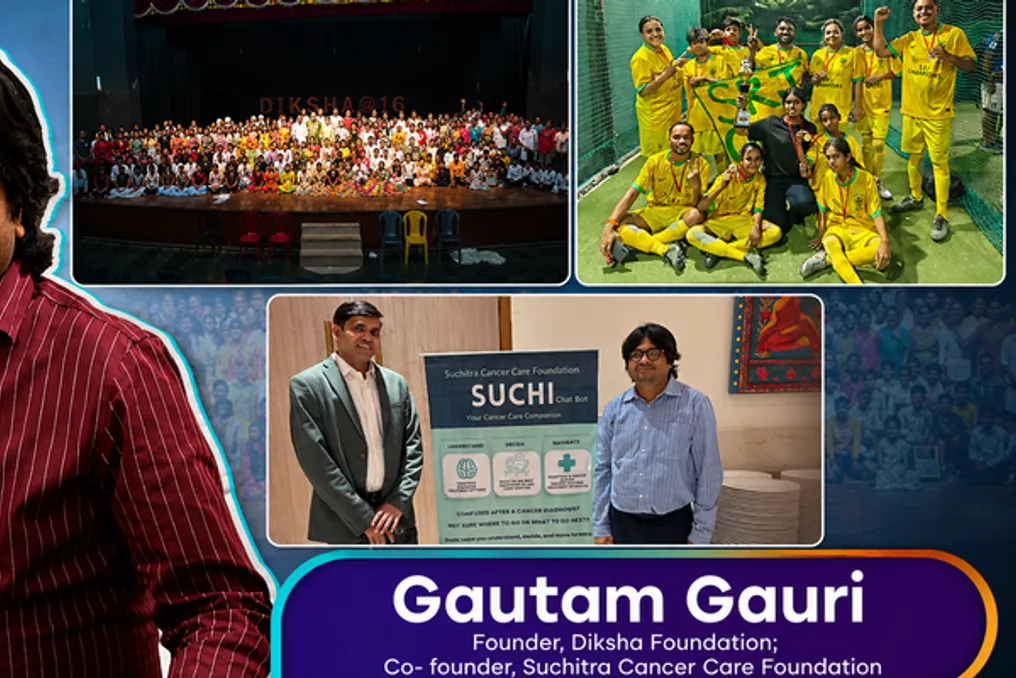
When Gautam Ghauri returned to Patna in 2010 after leaving his corporate job, he did not have a grand business plan. His main concern was one question: how to provide children from low-income families with the best opportunities for education and development?
This question became the starting point for the creation of the Diksha Foundation. Today, almost 16 years later, Gautam's work has expanded beyond education to cover cancer awareness, healthcare, and artificial intelligence (AI). Along this journey, he experienced a personal tragedy—the loss of his mother to cancer—and transformed it into a social initiative, using technology to ensure access to reliable information and opportunities across Bihar.
Gautam's story reflects not only the establishment of social organizations but also the transformation of Bihar, where people committed to long-term grassroots work are opening up new prospects for local communities.
In a recent interview with YourStory, Gautam Ghauri, founder and CEO of the Diksha Foundation, as well as co-founder of the Suchitra Cancer Care Foundation (SCCF), spoke about his decision to return to Bihar, the development of the Diksha Foundation, the cancer treatment initiative in memory of his mother, and his experience using AI in education and healthcare.
Gautam earned a Bachelor of Engineering in Computer Science from Birla Institute of Technology, Mesra, from 1999 to 2003, and subsequently completed an MBA from the Institute of Management Technology (IMT) in Ghaziabad from 2005 to 2007. After graduating, he began his career as a business analyst at Cognizant, working in the company's analytics division in Gurugram. Despite a successful career progression, by 2010, he decided to return to Bihar and contribute to his home state.
This decision was also supported by his family's strong connection to public service. His father, Tilak Raj Ghauri, worked in the Finance Department of Bihar and held the position of budget officer for over ten years. His mother, Suchitra Ghauri, was the director of DAV School in Patna.
Initially, his father doubted the financial viability of leaving a stable job, but Gautam had already made a firm decision. He recalls: 'There was optimism in Bihar at the time. Many people were returning from other states, and I felt it was the right moment to contribute. I wanted to know if it was possible to make a significant impact by living and working in my own city and state.'
The Diksha Foundation started very modestly. Gautam visited villages around Lalu Nagar and Jagdeo Pat in Patna and asked families if they would send their children to a new learning center. The center was located about two kilometers from the residences of many children near the railway tracks. Nevertheless, within just a few days, 30 to 40 children enrolled.
For Gautam, this was the first sign that the need extended beyond schools and textbooks; children also needed spaces where they felt heard, understood, and encouraged.
Initially, large institutional grants were unavailable. The team created a live Google sheet where friends and supporters could make small donations according to their means, ensuring complete transparency in fund usage.
Sangeta Didi joined the initiative from the beginning and remains with the organization to this day, serving as a teacher and community leader.
The activities of the Diksha Foundation were never limited to academic teaching. The organization aimed to connect education with voices, confidence, and overall child development.
About a year after its launch, Suchitra, Gautam's mother, joined the Diksha Foundation as a full-time volunteer. She worked directly with the children and played a vital role in creating more welcoming and humane learning centers. According to Gautam, his mother believed that education was more than books and exams; children should have the opportunity to express themselves, ask questions, and be heard.
In 2015, about five years after the founding of the Diksha Foundation, Gautam received a Commonwealth scholarship and went to Cambridge University, where he obtained an MPhil in Education from 2015 to 2016. His research focused on the goals and values of education. Ideas such as Howard Gardner's Theory of Multiple Intelligences and Amartya Sen's Capability Approach helped provide a theoretical foundation to many educational practices already being explored at the Diksha Foundation.
However, Gautam decided not merely to replicate foreign educational models in Bihar. Instead, he adapted the ideas to local conditions and needs.
Today, approximately 800 children and adolescents participate in Diksha's educational programs. About 500 children attend the KHEL learning centers of the Diksha Foundation in Patna, Bihta, and Sarairanjan. Another 300 adolescent girls participate in the Empowering Futures program operating in six Patna communities.
During Bihar's scorching summer months, when temperatures often exceed 40°C, Diksha's learning centers serve as more than just classrooms. Children spend their days and evenings there, learning, playing, and socializing until around 6:00 PM. Many parents work in construction, daily wage labor, or other professions, making the centers a safe and supportive environment for their children.
With support from Feeding India, meals are also provided to children at the centers. Over time, the role of these centers has evolved: former students return, mothers participate in events, and children use these spaces not only for learning but also for sharing their experiences and challenges. Gautam explains: 'We no longer see this as just an after-school program. It has turned into a community learning hub.'
Around 2017–2018, Gautam's father began showing early symptoms of dementia. His mother, Suchitra, cared for him while she herself began experiencing rapid weight loss and recurring fever. Despite consultations with several doctors, the illness was not immediately diagnosed. Eventually, it was discovered that she had cancer, and by then, the disease had significantly progressed.
Gautam took her to Tata Memorial Hospital in Mumbai for treatment, while his father remained in Patna under the care of a caregiver. Gautam spent nearly three months completely focused on hospital visits and treatment. After his mother's death, it took him almost a year to emotionally recover. However, this experience ultimately led to the creation of the Suchitra Cancer Care Foundation (SCCF).
Dr. Amit Kumar, who participated in his mother's treatment, later became a co-founder of the foundation with Gautam. Today, SCCF runs cancer awareness programs and works to provide patients and families with accurate information. Gautam also hosts a podcast called Gautam OncoTalks, where he converses with oncologists from across India.
The foundation's online educational library on cancer contains over 50 videos, including expert discussions, awareness sessions, conferences, and podcast episodes. For Gautam, the issue of cancer goes beyond mere treatment. Patients and families must navigate doctors, tests, medical terminology, and complex decisions. Access to reliable information and guidance can make this journey less overwhelming.
Technology has always been part of Gautam's journey. His career at Cognizant began with analytics and technology, and the rise of generative AI gave him a new opportunity to apply these skills for social impact. SCCF is currently developing Suchi—an AI-based cancer information guide designed to help patients and families understand accurate medical information and ask better questions during consultations. The goal is to make it accessible in regional languages such as Bhojpuri and Nepali.
Meanwhile, Diksha is developing Rusty—an AI tutor built on the Bihar board curriculum. This project is supported under the JPMorgan Chase Force for Good program. Diksha also conducts life skills development programs via WhatsApp using Glific.
For Gautam, AI is not a replacement for teachers or doctors. Instead, he sees technology as a way to improve access to information and guidance, especially in resource-constrained regions. He notes: 'In a state like Bihar, the problem is not just a lack of resources. People often face difficulties in getting correct information and direction too. If technology can help bridge that gap, then it is worth experimenting.'
In 2010, Gautam walked through the villages of Patna, talking to children and their families. Today, his work spans education, cancer awareness, and artificial intelligence. In these years, Bihar itself has undergone changes. New opportunities have emerged in education, technology, and the social sector. People like Gautam have chosen not just to observe these changes but to actively participate in shaping them.
Nevertheless, for him, the greatest lesson of this journey is not in technology, institutions, or models. It lies in consistent presence and commitment. Gautam reflects: 'You will not always have solutions for every problem. Big transformations won't happen every time. But if you stay with people long-term, you create a space of trust.'
Perhaps this is the most important aspect of his 16-year journey. Whether it is education, cancer treatment, or AI, his work has always been focused on one idea: living among people, understanding their needs, and making information and opportunities more accessible wherever possible. Bihar may have been the starting point of Gautam Ghauri's journey, but even after 16 years, it remains the center of his story. It is here that his work found meaning, and it is here that his heart continues to belong.