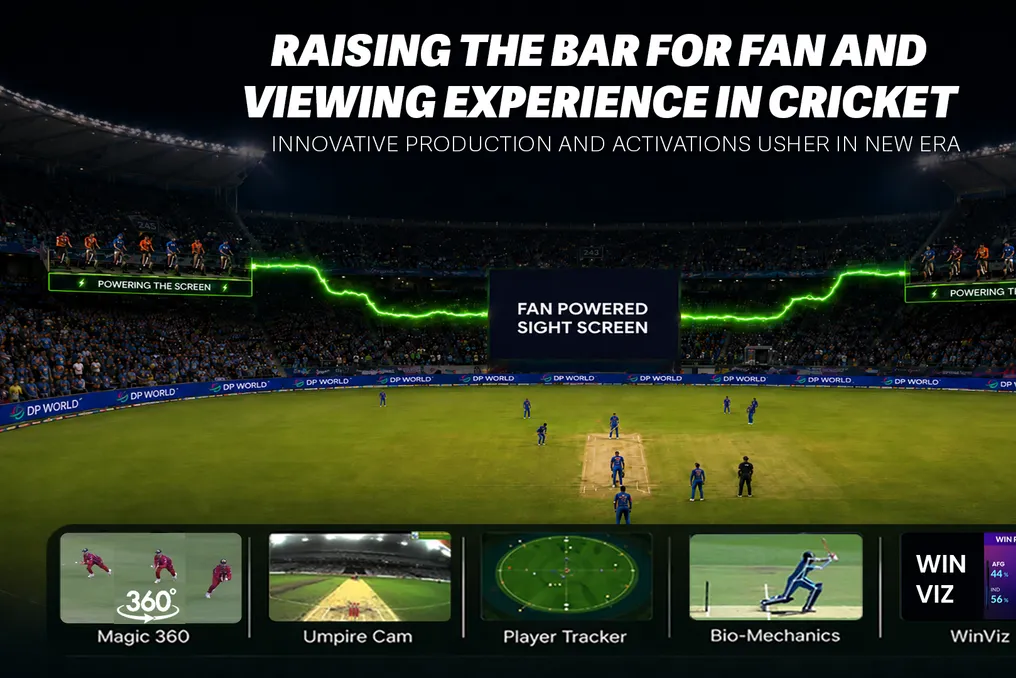
Cricket broadcasting has significantly evolved since the BBC used to broadcast matches from one side of the stadium with only three or four cameras. Today, viewers receive a completely different experience thanks to the use of multiple camera angles, smart graphics, and the introduction of new technologies that allow brands to integrate into the broadcast without compromising its integrity.
During the bilateral series between India and Afghanistan, starting on September 13th in Delhi, various broadcasting innovations will be presented for the first time.
Similar to the film industry, where directors have recognizable stylistic techniques—such as Martin Scorsese's tracking shots, Alfred Hitchcock's Dolly Zoom effect, or Wes Anderson's symmetrical framing—sports are developing their own visual language. This language includes unique camera angles, effects, and graphics that make live action more cinematic. An example of this approach is the use of NFL Films to create a distinctive style in American football.
Over the last three decades, cricket has adopted similar innovations as the game's popularity has grown, especially in India. The India versus Afghanistan series will bring together several such technologies.
One of these is the Magic 360 Cam, which allows a specific moment to be 'frozen' and then unfolded through multiple angles, creating the illusion of the field rotating 360 degrees, reminiscent of some scenes from the movie 'The Matrix.'
Motion analysis and camera angles technologies
The Skel Track system will provide a biomechanical overview of player actions, demonstrating body movement during a shot. This technology is designed to help viewers understand aspects such as weight transfer, head angle, and balance.
The Umpire camera, equipped with AI-based stabilization technology, will also be used to provide a first-person view from the umpire's perspective. Player trackers will display the position of fielders in real-time, allowing fans to observe the field setting and imagine themselves as captains.
These technologies open up opportunities for brands to run contextual advertising and deliver messages during the broadcast without overloading the visual elements that viewers are already seeing during the match.
The series will also introduce what is considered innovative in cricket: a fan-powered scoreboard. At stations with branded bicycles, viewers can pedal, generating kinetic energy that powers the scoreboard. The idea is to convert energy generated by fans into a visible part of the live cricket experience.
Instead of traditional diesel generators, the scoreboard will use clean kinetic energy produced by spectators. This combination of sport, fitness, technology, and sustainability creates opportunities for brands related to health, fitness, lifestyle, and energy to interact with fans. Furthermore, this concept gives brands a chance to extend their activations beyond the stadium through content and storytelling around the venue.
Rights holders' opinion
Bhairav Shant, co-founder of ITW Universe, the rights holder of the series, explained the intention behind enhancing the quality of bilateral cricket broadcasting: 'Our goal has always been to create platforms where brands can go beyond mere presence and become part of the fan experience. The India versus Afghanistan series allows us to do exactly that, combining innovative broadcasting assets with interactive fan activations.'
He added that they aim for brands to engage with the audience at moments that are exciting, relevant, and memorable, thereby promoting deeper engagement and better recall.