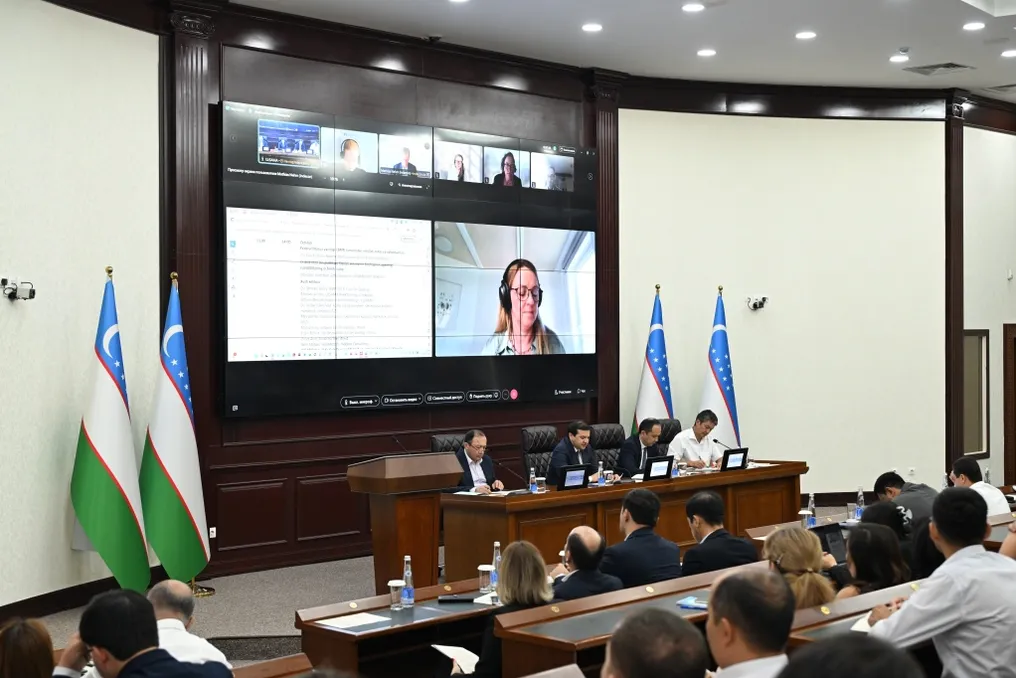
Uzbekistan is studying Germany's experience in public property management to improve the efficiency of using state-owned assets. Specialists from the State Assets Management Agency of Uzbekistan (UzSAMA) received information from representatives of the German Federal Agency for Real Estate Management (BImA) on how digital accounting, centralized management, maintenance, sale, and rental of properties are carried out in Germany.
This interest is driven by a large-scale reform of state property in Uzbekistan. It is planned that by 2030, the non-state sector will account for 85% of the economy, and the number of state-participated enterprises will be reduced sixfold. Consequently, the state faces the task not only of privatizing assets but also of finding ways to manage the remaining state property competently.
Key aspects of the German experience
The central element of the seminar was a presentation by BImA, the structure responsible for managing federal real estate in Germany. German experts demonstrated practical methods for dealing with such assets to the Uzbek side. Jörg Musial, Head of Sales at BImA, and Robert Erfen, Head of State Property Department, covered topics such as centralized object administration, maintaining digital registers, property maintenance, and methods for utilizing underutilized assets.
Procedures for assessing, realizing, and leasing state assets were also discussed in detail. For Uzbekistan, the issue of including unused real estate in economic circulation—that is, finding ways for idle state properties to generate economic profit—is critically important.
Reasons for Uzbekistan's interest in German practices
At the opening of the seminar, UzSAMA Director General Sohibjon Murodov emphasized that Germany possesses many years of experience in managing state assets. He particularly noted the attractiveness of the BImA system, as well as the transparent procedures for assessing, selling, and renting state real estate. Murodov stated that studying Germany's extensive institutional experience is crucial for developing a modern, digital, and transparent system of state asset management in Uzbekistan.
The importance of this experience is also linked to the fact that state real estate in Uzbekistan is distributed among numerous structures. A centralized approach will allow for the establishment of unified rules for the accounting, maintenance, and operation of these assets. At the same time, the Uzbek side does not aim to directly copy the German model but intends to study existing tools and adapt those that comply with local legislation and the specifics of state property management.
These changes are taking place against the backdrop of reduced state participation in the economy. Since a large part of enterprises and assets will be transferred to the private sector, the state will need to manage the property remaining in its ownership more effectively. Thus, state real estate management is becoming an independent area of reform, covering buildings, land plots, and other objects that can be used, leased, or sold by the state.
The German side sees mutual benefit in the cooperation. Kristina Klass, head of the department at the German Federal Ministry of Finance, noted that Uzbekistan is actively implementing reforms in the field of state asset management and privatization. According to her, Germany is interested not only in sharing accumulated experience but also in monitoring the transformation of the state asset management system in Uzbekistan.
The current seminar continued the cooperation between Uzbekistan and Germany in the field of state property management, which began in 2009. During this period, with technical and expert support from the German side, the laws 'On State Property Management' and 'On Privatization of State Property' were created in Uzbekistan, and the first Corporate Governance Code was developed. Currently, a revised version of the Corporate Governance Code is being prepared jointly with German partners, and a new edition of the law 'On Joint Stock Companies and Protection of Shareholders' is under government review.
Training events, seminars, and delegation exchanges are also being conducted in parallel. With the participation of the German Agency for International Cooperation (GIZ), Uzbek specialists visited Germany to study privatization and state asset management practices. Now, the focus of cooperation is expanding: in addition to privatization and corporate governance, it also covers state real estate management.
The parties agreed to continue work in three stages. The first step will be online seminars for UzSAMA specialists. Next, German experts will visit Uzbekistan to analyze the local system and determine the most promising areas of cooperation. The final stage will be a visit of the Uzbek delegation to Germany to get firsthand knowledge of BImA's activities. Therefore, the next stage of the reform is not only the realization of state property but also the construction of a more effective system for its accounting, management, and use, the tools for which will be determined during future meetings.