ArchDaily opens vacancies for social media collaborators
Read more
ArchDaily Brasil
archdaily.com.br

ArchDaily opens vacancies for social media collaborators

ArchDaily is recruiting professionals to join its content team, specifically to work on social media. The organization's social media teams are responsible for converting content produced by ArchDaily into high-performance and visually appealing digital content for various social media channels.

The role requires the collaborator to create and adapt content, demonstrating great creativity and collaboration skills to disseminate architectural concepts to a global audience.

Main responsibilities

Tasks include publishing and editing ArchDaily content in specific formats for each network, ranging from Instagram carousels to TikTok and LinkedIn posts. It is necessary to monitor the performance of these publications, using the collected data to refine future ideas, formats, or adaptations.

Other responsibilities involve assisting in the growth and administration of the platform's community, in addition to proposing original initiatives—whether new angles, formats, or methods of presenting architecture online—while always maintaining coherence with ArchDaily's identity and standards. The work must be carried out in close partnership with the design and content teams, requiring flexibility to handle changes in priorities and projects in daily life.

Desired profile

The ideal candidate should have between two and three years of experience in social media, preferably in the architecture or design sector. It is essential to have a keen eye for discerning relevant architectural stories, with education or experience in the field being a plus.

Practical experience in managing organic profiles is required, including planning, publishing, and analyzing results across various platforms, with specific proficiency in TikTok. Written and spoken English communication must be clear and confident; proficiency in Spanish or Portuguese will be considered an advantage.

Requirements also include organization and proactivity to manage multiple deadlines and platforms without constant supervision. Skills in architectural photography, video production, and editing are highly valued. Furthermore, excellent interpersonal communication, a collaborative spirit, and a solution-oriented mindset are expected. Practical knowledge of tools such as Adobe Creative Suite, Canva, Meta Business Suite, and data analysis platforms is necessary. Finally, the position is remote, but the professional must have availability and flexibility to travel to events, fairs, and coverage, potentially working both behind the scenes and on-site video editing.
Similar stories

Indie Web: A Movement Rescuing Personal Website Creation and the Diversity of Old Internet
Read more
super.abril.com.br

Indie Web: A Movement Rescuing Personal Website Creation and the Diversity of Old Internet

The report recalls the state of the internet in 1994, when journalist Fátima Cardoso highlighted the variety of content on the World Wide Web, a technology that was new in Brazil and accessible only to a few scientists. Although the worldwide computer network existed since 1969, the web emerged decades later.

Cardoso described that before the web, finding files required prior knowledge of the resource's name, making the internet unintuitive, comparing the first visit to a hostile metropolis.

This situation changed in 1989 when physicist Tim Berners-Lee developed a method to link pages. Subsequent inventions, such as the HTTP protocol and HTML language, are still used today. The first historical website was created by Tim at CERN in 1991 and remains functional.

From the beginning, the concept of the web suggested a space to be explored, using browsers to access sites through addresses (URLs). This access was theoretically free globally, as if Berners-Lee had provided the basic elements for a more connected and accessible network.

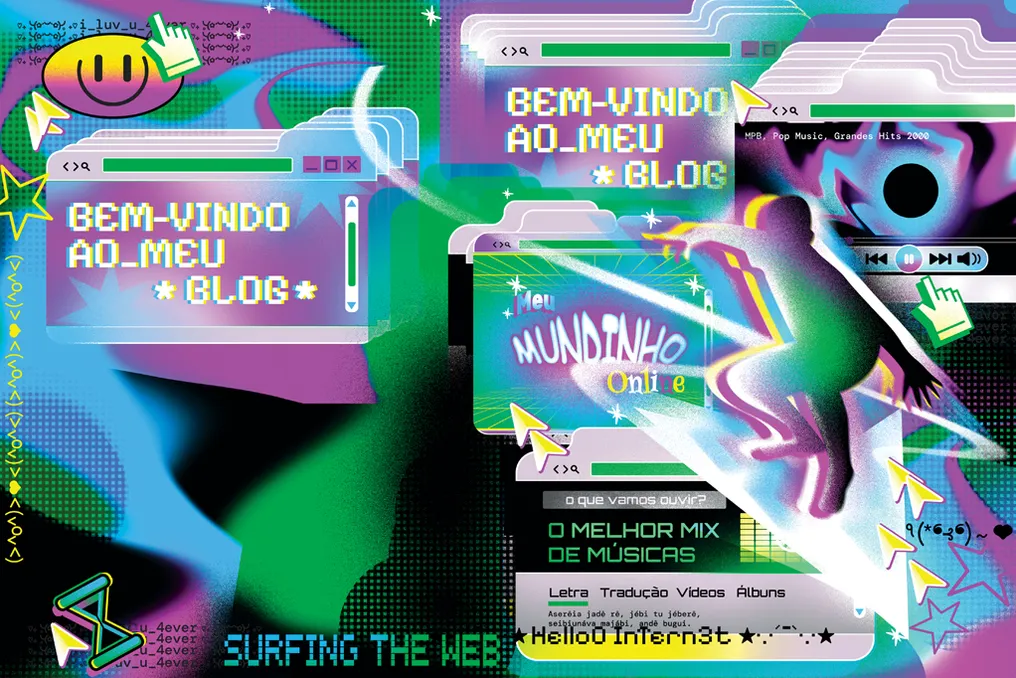
To illustrate the aesthetic diversity of the indie web, three artists—Luisa Prado, Tayrine Cruz, and designer Cristielle Luise—were involved in the editing. With the advance of the web to home computers, GeoCities became the most visited site in 1998. This service allowed anyone to create a homepage, categorizing URLs by themes, such as science fiction in «/Area51» or romance in «/Paris».

Thus, the first virtual communities emerged, formed by common interests and the vast amount of content available for sharing. Many who lived through this phase remember with nostalgia the chats with strangers and the personalization of their websites, reflecting a technological optimism about a more democratic and educated future.

Tim Berners-Lee stated that the web's infrastructure aimed to promote collaboration, compassion, and creativity, seeking to be a tool for human empowerment. However, in a 2024 statement, he expressed frustration, noting that while the first decade fulfilled this promise, the last decade contributed to eroding these values.

Currently, with 90% of Brazilians over 10 years old owning a mobile phone, the negative impacts of irresponsible internet use—affecting mental health, privacy, and democracy—are widely known. However, there is an alternative: recognizing that digital life is not limited to large corporations.

While social networks are compared to walled monocultures, the indie web represents small initiatives, a digital 'family farming.' In it, content does not have an expiration date and is not subject to censorship or exclusion due to decisions made by companies or governments. It is an interdisciplinary movement that seeks a web closer to its original conception.

Nyle Coelho, a software engineering student, expresses the loss of the magical and personal aspect of the internet, something she did not experience. When she entered the digital environment, the trends were Instagram and Snapchat, contrasting with the richness of archives found in old fandom blogs.

Rodrigo Ghedin, a journalist and editor for the User Manual, points out that blogs persist, but the competition for attention is intense. Ana Rodrigues, a Portuguese software developer and organizer of IndieWeb, defines this movement as the search to exist on the web independently of social media and corporate web. She emphasizes that the general goal is to allow people to have 'their own home' on the web.

Rodrigues compares social media profiles to rented apartments, subject to the landlord's rules, whereas a personal website is a property, offering greater autonomy against bans or censorship. Millions of Brazilians experienced this risk with Orkut, which disappeared in 2014.

HTML and CSS languages, thirty years old, facilitate creation because there is vast supporting material online. Daniel Kossmann, an AI product manager, laments the loss of content upon the closure of Orkut, viewing his own 15-year-old website as a personal archive of thoughts.

Authors of long-lasting blogs value the fact that their old texts are found and appreciated, something unlikely on platforms like Twitter. Unlike social media, whose algorithms prioritize ephemeral news, personal websites allow authors to publish more intimate or interdisciplinary content, as exemplified by Vinicius Garcia, a game developer, who unified his digital presence on a single site.

Format freedom is also a differentiator; personal websites can include complex elements such as music players or secret passages, unlike the standardization of applications. Although the experience may be less predictable, it reflects the network nature of the web, where links—defined by Berners-Lee as the basic unit of construction—are crucial for freedom of expression.

Popular