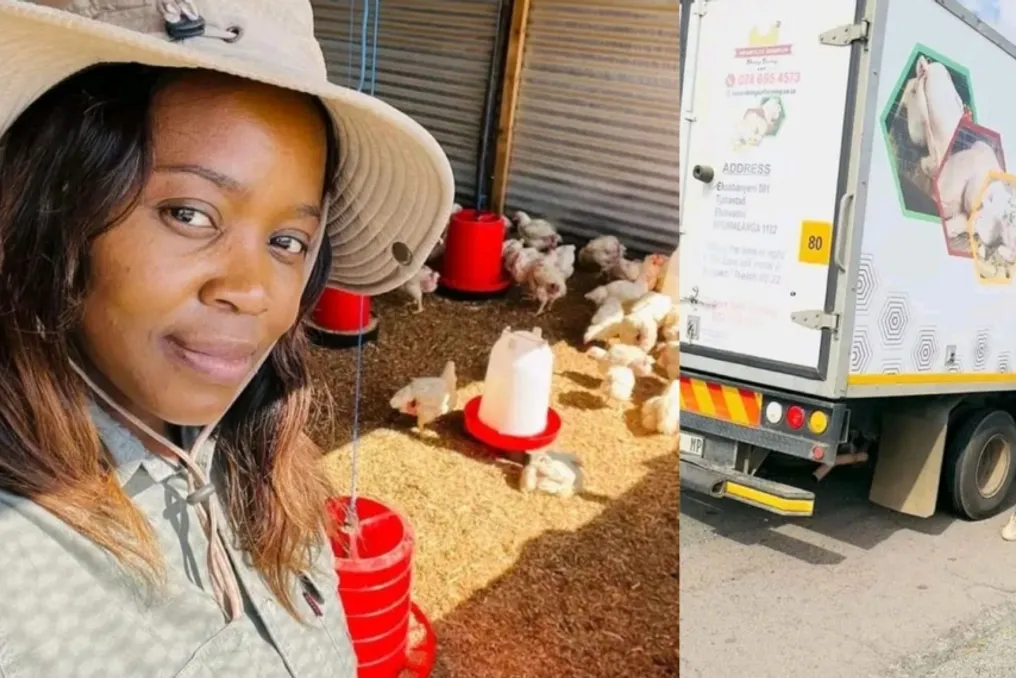
Lebogang Dludlu, CEO of Nkanyezii Group, utilizes her entrepreneurial mindset and problem-solving skills to transform the perception of modern agriculture in South Africa. Through vertical integration, continuous learning, and addressing systemic gaps, this former electrical engineer has turned a modest poultry enterprise on tribal land into a rapidly growing, diversified agricultural empire.
Although Dludlu did not grow up in a farming family, business has always been a part of her life. Her late grandmother, Philippina Mohlwa, was a businesswoman, and her mother, Peggy Medupe, was also actively involved in entrepreneurship. Dludlu notes that it was this entrepreneurial environment that taught her to value hard work, resilience, and the ability to create opportunities.
Dludlu's roots lie in Ekangala, east of Tshwane, where she grew up in a family of six. She received her primary education at Zivuseni Primary School and later graduated from Lingitjudu High School. She recalls being hardworking and focused on her studies from an early age, which helped her gain admission to higher education.
Initially, she chose a career in engineering, earning a diploma and a BTech in Electrical Engineering at TUT Witbank campus. Furthermore, she obtained a BTech and a Master's degree in Project Management from the University of Pretoria. Her pursuit of knowledge continued in 2023 when she earned a Master's in Sustainable Agriculture from the University of the Free State, and she is currently pursuing an MBA at Henley Business School.
Personal milestones also marked this period. Dludlu met her husband, Isaac Dumsane Dludlu, in 2010. The lobola ceremony took place in 2012, followed by their wedding in 2017.
Dludlu built her career as an electrical engineer at Eskom. However, observing the vast, untapped potential in agriculture inspired her to transition into entrepreneurship. Two years after their wedding, the couple launched their agricultural venture using their own funds, despite having no formal farming experience. Working on tribal land, they started very small, producing poultry and selling the first batch to Dludlu's mother.
She emphasizes: 'The most important thing for me was that we started with what we had. We didn't wait for everything to be perfect before taking the first step. We started small, learned as we went, and kept building.' As the business demonstrated viability, it attracted support programs and agricultural development opportunities, allowing the couple to reinvest profits into infrastructure.
In 2023, Dludlu left Eskom to dedicate herself fully to the business. Her husband, a master mechanic who worked at Sasol, soon joined her full-time. Dludlu explains that her professional background in engineering and project management played a significant role in her modern approach to business, especially in planning, systems, problem-solving, and large-scale project management.
Today, Nkanyezii Group has evolved into a multifaceted enterprise. While poultry remains the core, the business has diversified into livestock and crop farming, and is actively building its own abattoir and establishing the TerraGrain feed mill. Meanwhile, Nkanyezii Group supplies products to a wide network of individual consumers, resellers, local businesses, boarding schools, and day care centers across Mpumalanga and Gauteng.
Dludlu has also expanded the business's presence in real estate, as well as in the flower and hospitality sectors through Naledi Flower Boutique and Coffee Shop, which has outlets in Witbank and Bethal. Together, these enterprises provide employment for over 100 permanent and part-time staff.
She shares: 'My biggest achievement is seeing how the business transforms into something much bigger than we initially imagined.' She adds: 'I am proud that the businesses we create are not just aimed at making a profit. They are aimed at creating jobs, solving problems, creating opportunities, and contributing to local economic development.'
The company faces the challenge of bringing TerraGrain to full production capacity, increasing poultry and livestock output, and fully establishing an end-to-end processing and distribution network. Dludlu also aims to support the next generation by regularly conducting mentorship sessions for aspiring farmers and young entrepreneurs. Her advice to those considering a future in agriculture is to shift their perspective from mere production to strategic entrepreneurship. She urges: 'Look beyond the simple farmer and start thinking like an agri-entrepreneur. There are many gaps and opportunities in agriculture. You don't have to produce the same product as everyone else. Look at the entire value chain and ask yourself: where is the gap? What problem can I solve? What can I do differently?'