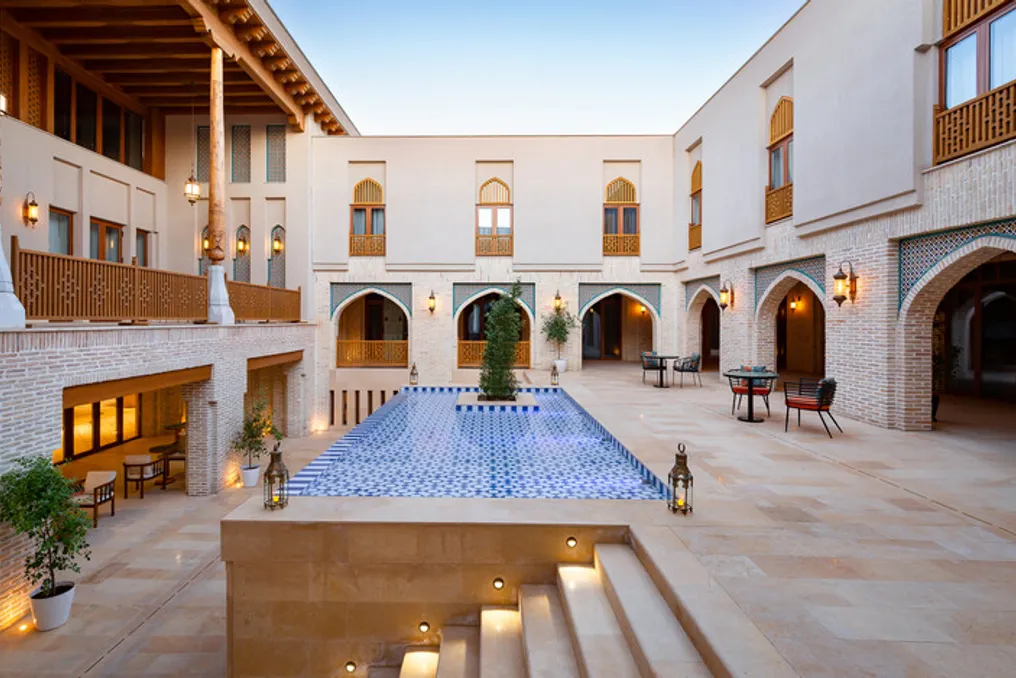
Amidst the urban transformation of Uzbekistan, the ARC Architects office develops an architectural approach focused on establishing a connection between the past and the present. Founded in 2017 by Bobir Klichev, this studio emerged from the architecture community of Bukhara and maintains a strong link to the country's cultural and climatic specificities.
With offices in Tashkent and Bukhara, ARC blends minimalism with ethnic references to create a contemporary language firmly anchored in its environment. Instead of simply replicating traditional Uzbek architectural style, the studio is dedicated to understanding how this legacy can be recontextualized today, a process that inevitably dialogues with the multiple historical layers present in the nation.
For centuries, cities like Samarkand and Bukhara functioned as important commercial and cultural hubs in Central Asia. The architecture of these localities evolved around narrow alleys and internal courtyards, forming urban structures where buildings and communal spaces are inseparable.
In the 20th century, this continuity underwent significant changes due to Soviet dominance. Centralized planning, construction standardization, and industrialization profoundly modified the cities, especially Tashkent, which was extensively rebuilt after the 1966 earthquake. Consequently, the country began to exhibit diverse architectural models, preventing the consolidation of a single modern language.
It is in this scenario that ARC Architects establishes its professional practice. In a growing market, driven by civil construction, the tourism sector, and the attraction of foreign investment, the office aims to consolidate a contemporary architecture that is not based on copying external models nor on the literal reconstruction of the past.
ARC operates across various project scales, ranging from residences and interiors to hotels, commercial buildings, and large urban developments, accompanying projects from the conception phase to execution. However, regardless of the dimension, the central priority is always the valorization of local production. Materials, techniques, and labor from the region are integrated not only for identity reasons but also for their potential to reinforce local economy and knowledge.
An example of this is the Country House KK-1234, located in the mountainous area of Tashkent, where local stone and the work of regional stonemasons harmonize with the topography and natural characteristics of the terrain.
In Bukhara, the interaction between architecture and context takes on another layer of meaning. At the Mercure Bukhara Old Town Hotel, characteristic elements of local architecture, such as courtyards, ayvans, and traditional materials, are reinterpreted to meet the needs of a modern building. Thus, historical references cease to be mere ornaments and begin to shape the spatial organization, thermal comfort, and the building's relationship with the city.
As Uzbekistan experiences a period of rapid growth and greater openness, architecture is increasingly called upon to respond to these changes. This raises a broader question: how can architecture accompany the transformation of a country without neglecting what makes it unique? In this sense, modern offices like ARC assume a crucial role. Their work demonstrates that developing a contemporary architecture in Uzbekistan does not require a binary choice between what already exists and what is to come, but rather the discovery of new ways to interpret and build the nation from these two dimensions.