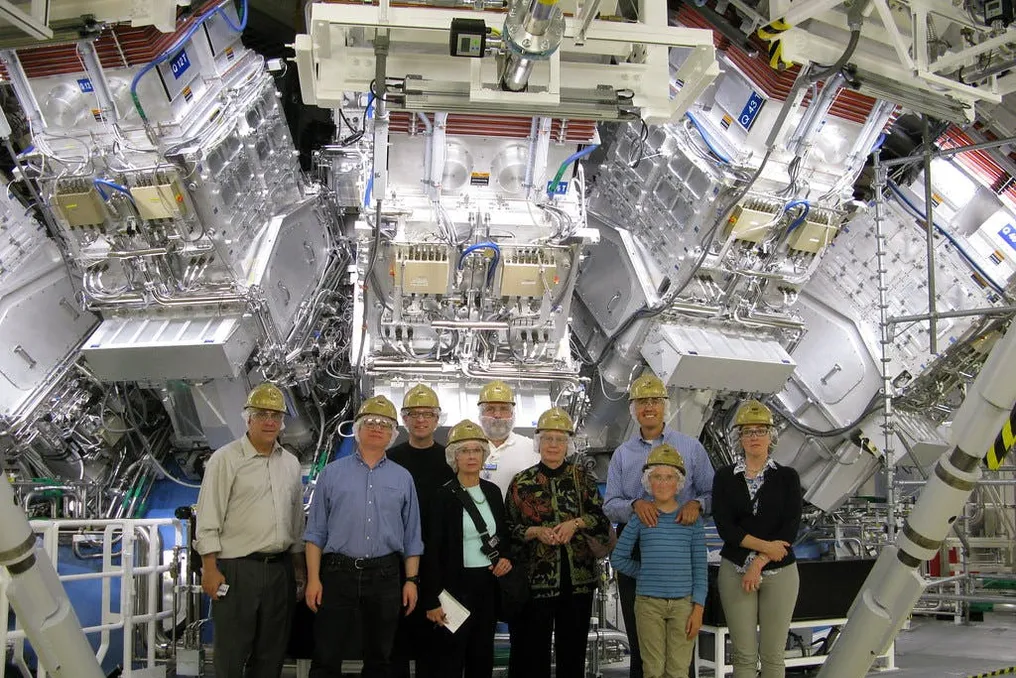
Amid the rapid increase in costs for creating artificial intelligence infrastructure and the massive energy consumption of data centers, there is a global urgent need for unlimited clean energy sources. Dongxi Fusion has addressed this large-scale challenge by raising $44.6 million (equivalent to 300 million yuan) to bring commercial laser fusion to life.
The startup is not limited to simply improving solar panels; its goal is to achieve the ultimate objective in infinite energy, namely laser inertial thermonuclear fusion. The company's management recognizes the critical importance of this task, as further scaling of artificial intelligence requires energy sources that will not lead to planetary overheating.
Dongxi Fusion is moving from theoretical calculations to creating verifiable engineering solutions. This means taking laser fusion out of the academic environment and immersing it in complex practical work, including developing high-energy laser drivers, designing targets, experimental diagnostics, and system integration.
To accelerate the development process, the company is utilizing AI research. The main task remains complex but clear: to make fusion energy practical and create a system capable of operating repeatedly on a commercial scale. Engineering verification is the new frontier.
Nuclear fusion energy is known for its high cost, which rapidly depletes seed capital in deep technologies. Nevertheless, Dongxi has achieved significant success by securing funding of 300 million yuan in a pre-seed funding round. This indicates a high level of confidence.
These large investments came from a strategic combination of institutional and state investors, including ICBC Investment, Suzhou Guotou, and Oriza Holdings. The collaboration between banking giants and state-backed capital at such an early stage is a serious signal indicating that China views laser fusion as a crucial long-term national priority for ensuring the future of global energy.
The potential of nuclear fusion lies in creating a zero-carbon and non-radioactive waste energy source. However, the approach of laser inertial confinement goes further: scientists force atoms to merge under immense pressure using perfectly synchronized lasers to act on a microscopic fuel pellet, resulting in a powerful release of clean energy.
This is significant not only for providing basic power supply but also for powering the next century of human progress—from unprecedented AI data centers to vast smart cities and large-scale global manufacturing. If Dongxi Fusion successfully solves the system integration problem, the enormous energy barrier holding back next-generation technologies will disappear.