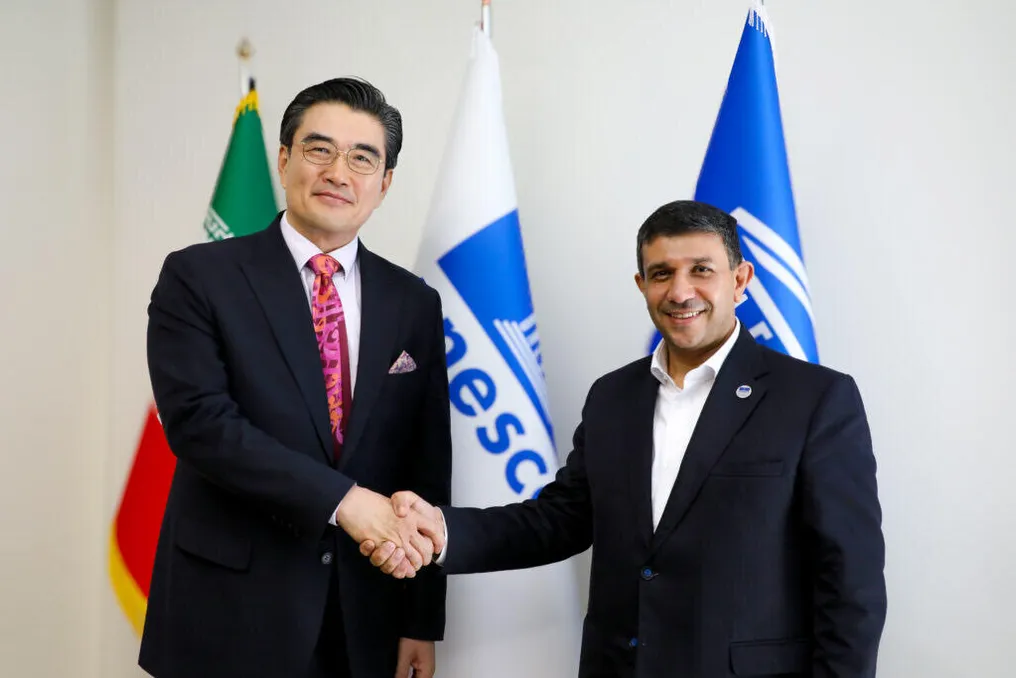
The Ambassador of the Republic of Korea in Iran recently visited the Iranian UNESCO National Commission. During the visit, he met with Dr. Hassan Fartousi, Secretary-General of the Iranian National Commission for UNESCO, and other colleagues to discuss opportunities for developing joint cooperation in the fields of education, culture, science, and tourism.
At the meeting, which was attended by colleagues from the UNESCO National Commission and a representative from the Ministry of Foreign Affairs, Dr. Hassan Fartousi expressed gratitude for the cooperation and assistance provided by the Embassy of the Republic of Korea during the visit of the Iranian delegation to Busan. He also thanked the Korean side for their support in organizing and hosting the Iranian delegation at the 48th session of the UNESCO World Heritage Committee and for the successful inclusion of 'Alamat Castle and its associated fortifications' in the World Heritage List.
The Secretary-General of the Iranian National Commission for UNESCO emphasized the significance of this event, noting that the inscription of Alamat Castle on the World Heritage list was the result of a 25-year process of preparation and dossier finalization. He stressed the need to utilize international potential to protect, promote, and preserve this world heritage site.
Dr. Fartousi continued the presentation by introducing the specialized working groups and the Department of External Relations of the Iranian National Commission for UNESCO, detailing existing opportunities for scientific, cultural, and specialized interaction between the two countries. The discussion also covered UNESCO Category 2 centers and governing bodies, as well as relevant opportunities available in South Korea, focusing on identifying areas for joint work.
Another important topic of discussion was the inclusion of 'Alamat Castle and its associated fortifications' in the World Heritage List. The Ambassador of the Republic of Korea, speaking about his visit to Alamat and a tour of the historical site, expressed his astonishment and admiration upon personally viewing this cultural heritage, and also highlighted its potential to present the history and culture of Iran. Kim Joonpyo, the Ambassador of the Republic of Korea to Iran, also noted the importance of developing bilateral cooperation in the field of tourism. During the negotiations, tourism was presented as a platform for strengthening mutual understanding between nations and transmitting cultural heritage and historical values to future generations.
In conclusion, both sides emphasized the enormous potential of relations between Iran and South Korea in the cultural, scientific, educational, and tourism sectors, as well as the need to continue the dialogue to transform these opportunities into concrete joint operational programs.
In a separate meeting held on July 11, Seyed Reza Salehi-Amiri, Minister of Cultural Heritage, Tourism, and Handicrafts of Iran, met with Kim Joonpyo, the South Korean Ambassador, to discuss expanding cooperation in culture, tourism, handicrafts, and creative industries. Salehi-Amiri noted that entering the creative industries economy is one of his ministry's strategic goals, and South Korea's experience in this area is valuable for Iran. He also pointed out 29 Iranian sites inscribed on the UNESCO World Heritage List and 58 sites on the tentative list, emphasizing the importance of including Alamat. The Minister proposed holding reciprocal exhibitions of historical and cultural artifacts, implementing joint restoration projects, expanding university cooperation, and utilizing South Korea's experience in digital technologies and artificial intelligence in the fields of cultural heritage, tourism, and handicrafts. He also announced Iran's readiness to participate in cultural exhibitions in Seoul and invited South Korea to participate in the Tehran International Tourism Exhibition.
For his part, the Ambassador spoke about his first provincial trip to Iran, which was to Qazvin, where he visited Alamat Fortress, and expressed hope that inclusion in the World Heritage List would help present Iran's cultural heritage to a wider international audience.
Parallel to the 48th session of the World Heritage Committee in Busan, Minister Salehi-Amiri held a meeting with Ho Min, head of the Korea Heritage Service, and proposed creating a joint Iran-South Korea task force for the restoration, preservation, and digital documentation of cultural heritage. The Korean side welcomed this proposal. The meeting took place immediately after the inscription of 'Alamat Castle and its associated fortifications' on the Iranian World Heritage List as the 30th tangible cultural object of UNESCO. This proposal reflects the determination of both countries to turn the achievement of inscription on the World Heritage List into sustainable technical and operational cooperation in the field of cultural heritage preservation.