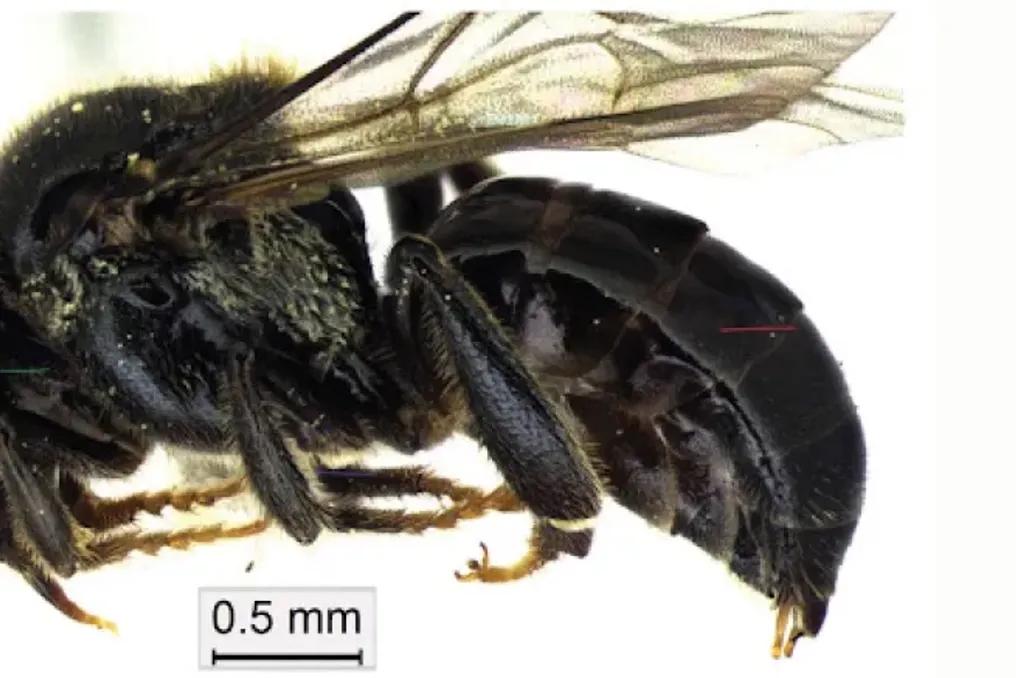
Researchers have discovered a new species of stingless honeybee that lives almost a meter underground in the hilly terrain of Northeast India. The discovery was made by a group of scientists from the University of Agricultural Sciences, Bengaluru, the University of Nagaland, and the Central Agricultural University (Imphal).
This new species, named Tetragonula nagalandensis, adds to India's biodiversity list, bringing the total number of known stingless bee species in the country to 19.
The team identified the insect after a thorough search in the forests of Nagaland. Unlike common honeybees, which build hives on trees or buildings, these bees are subterranean and live beneath the soil. To find them, researchers had to excavate wild colonies found in damp earth, following entrance tubes leading to nests buried up to 80 centimeters deep.
Since the females of stingless bees look very similar across different species, the team captured males in a container of water for precise differentiation. Their unique reproductive anatomy serves as the necessary feature for identification.
Despite the similarity to its closest relative, T. kyrdemkulaiensis, Tetragonula nagalandensis is noticeably smaller, with a body length of about 5 millimeters. Under the microscope, researchers revealed clear differences in the lower part of the male body and its reproductive organs, specifically an L-shaped incision and a sharply curved penis valve, distinguishing it from any other known species. The habitat of this species is also unique: while some bees arrange brood in layers, this species forms compact clusters of brood cells, protected by several thin layers of wax and organic material to survive in the moist underground environment.
The name nagalandensis was chosen in honor of the state of Nagaland, where this bee was first discovered, in the Mizepheap region. In addition to discovering a new species, the researchers achieved a second scientific breakthrough by capturing the first male of the related species, T. srikantanathi. This second bee is known for its suspended nests, where brood is raised in horizontally hanging cells one cell thick.
Stingless bees play a vital role in pollinating local crops and wild vegetation. Researchers assert that by studying the specific morphology of the male bees and their nesting methods, scientists can better protect these fragile populations from habitat loss. They express hope that this discovery will prompt more systematic surveys of India's ecosystems to find more species that may be hidden right beneath us.