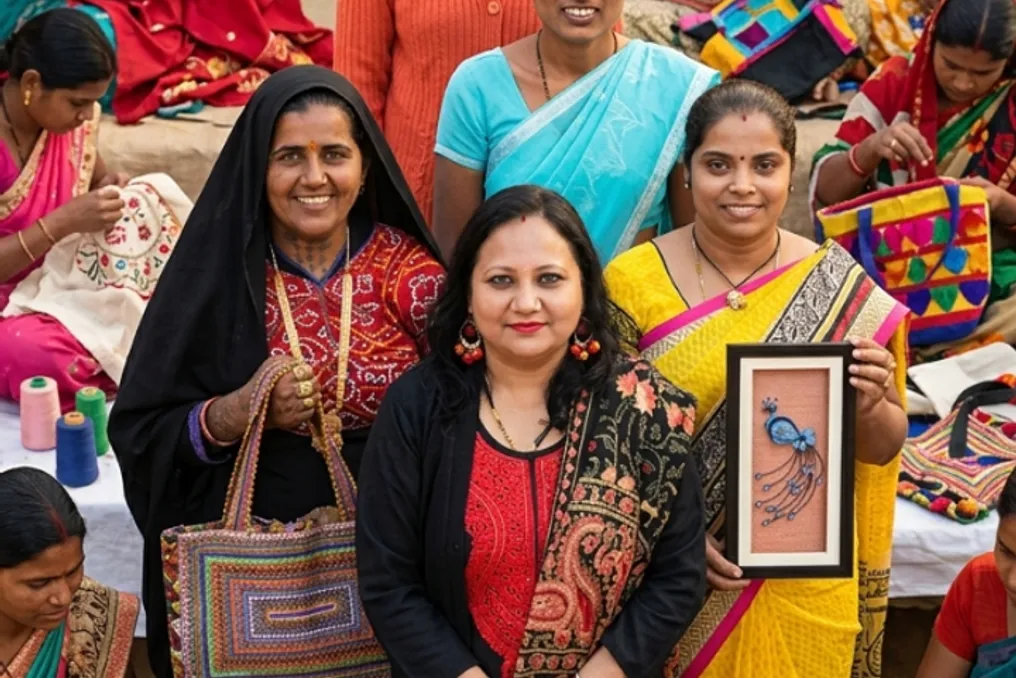
Five women managed to monetize their traditional skills by starting businesses and providing livelihoods for many others. These women used their knowledge to build enterprises while simultaneously helping create opportunities for numerous others.
Gunawati, who survived polio at the age of two and married at sixteen, independently mastered the art of quilling. In Sivakasi, Tamil Nadu, she began transforming paper scraps into works of art and a source of income for herself.
Through her enterprise, Guna's Quilling, she sells jewelry, figurines, postcards, and wall hangings. Gunawati has trained over 2000 artisans, predominantly housewives, students, and children from orphanages. Furthermore, she assists some students in promoting their products.
In 2015, Gunawati spoke at an event hosted by the British Council and received awards from the Lions Club and the Tamil Nadu government.
When Godavari's husband lost his job, she needed a way to support the family. The idea of making paper lamps came after she saw such a lamp at a local market in 2009, starting production at home. After banks refused loans, relatives provided Godavari with a small interest-free loan. Later, financial assistance and guidance from BYST helped her develop Godavari Akashkandil.
Her paper lamp business provides employment for other women, allowing them to earn independently. It generates over 30 lakh rupees in annual income, and Godavari was also honored with the 'Women Entrepreneur' award.
Sobita, who married as a teenager, conceived Seuji in 2002. In Assam, Telangana, she united rural women to produce organic fertilizer and traditional Assamese japi.
Seuji's organic fertilizer is made from cow dung, banana plant residues, worms, and fallen leaves, and is sold for 50 rupees per 5 kg bag. The japis are produced for customers and local markets.
Sobita's main goal is to eliminate middlemen. The women control the entire process, from idea and production to sale, which gives the group greater control over work and income.
Pabiben, who could not finish school due to financial difficulties, learned traditional embroidery from her mother. In 1998, she joined the Rabari women's group and honed her skills. She later developed the Hari Jari technique, which uses pre-made elements attached by machine, creating items such as vibrant Pabi Bags, blankets, and cushion covers.
Her enterprise employs over 60 women in her village of Bhadroi, helping them gain skills and financial independence. In 2016, she received the Jankidevi Bajaj Puraskar award.
In 1993, Anita founded Bhojpur Mahila Kala Kendra to empower women through education and vocational training. This organization has trained over 25,000 women in nearly 400 different skills in Bihar.
The organization has also formed about 300 women's self-help groups. These women produce and sell jewelry at government fairs and supply stores in Delhi, Pune, and Mumbai. Initially, Anita faced opposition from men who prevented her from meeting with women. However, she persisted, and her work has helped thousands acquire skills, livelihoods, and independence.