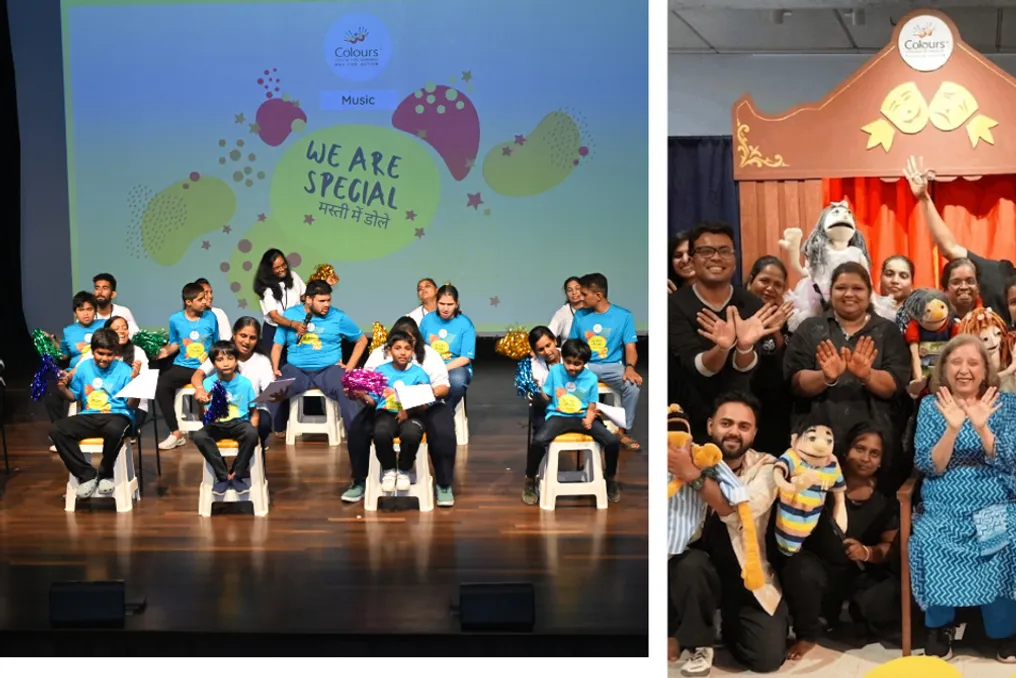
Every day at 9:30 AM, the doors of the Colours Learning Center open not with the sound of a bell, but with greetings and warm smiles. Students arrive with bags, take their seats, and join educators for prayers, games, and the day's lessons. Some engage in drawing next to a teacher, others clap to music, practice dialogues during snack time, or prepare for a game of cricket.
Even routine actions, such as holding a spoon, carrying a water bottle, or waiting for one's turn during a game, are used to develop confidence, independence, and social skills. While it may look like any busy classroom at first glance, the Colours Learning Center, located in Indiranagar, Bengaluru, aims to change autism support methods.
For founder Bela Joshi, every small interaction between a child and an educator holds significance far beyond the classroom. It embodies the hope she once could not find for her own son.
The Mother's Journey to Creating Colours
Before becoming a special educator, Bela worked as an engineer. Her life changed after her son was diagnosed with autism at the age of one. He is now 27 years old. Looking back, Bela recalls feeling unprepared despite her education and determination to find the best support for him.
She shares: 'I had a very difficult journey with him. He was a gifted child with autism. He started reading independently at a year and a half, understood math and swimming well, and learned many new things just by observing. But as a parent, I didn't know what to do next.'
Over the next 17 years, Bela moved between various therapeutic centers searching for answers that never seemed complete. Eventually, she left several institutions after witnessing practices she felt violated her son's dignity.
The turning point came 11 years ago when her son was asked to leave a reputable autism center. 'It wasn't his fault,' she says. 'They wanted us to pay an extra 1 lakh rupees. My husband and I decided not to give up because if we agreed to it once, we didn't know how they would treat us later.'
Suddenly, he had nowhere else to go. Instead of continuing the search, Bela and her husband decided to build a place they believed should exist forever. It started modestly, with computers, art classes, and one simple promise: 'We wanted to give them dignity, love, respect, and space to grow.' This promise eventually became the Colours Learning Center.
Learning Doesn't Stop After Therapy Ends
Over the years, Bela realized that one of the biggest gaps in autism support is not just access, but how the support itself is delivered. Interventions often occurred in isolated sessions: a child might attend speech therapy for 45 minutes, occupational therapy at another center, and behavioral sessions somewhere else. Learning could become fragmented.
Colours chose a different approach. Its internal Dynamic Behavior Transformation (DBT) program integrates therapy into daily activities instead of limiting it to separate clinical sessions. Communication happens during lunch. Communication practice occurs during games. Motor skills are developed through painting, pottery, and sports. Music and cooking classes allow students to express themselves, mastering skills that will help them become more independent.
Instead of following a fixed schedule for each student, the program adapts to individual needs. Bela explains: 'We don't move from one lesson to the next just because the calendar says so. We only move when the child has mastered that skill. It is a skills-based program, not a time-bound one.'
Educators document their observations after sessions. These daily feedback loops help the team adjust goals, teaching strategies, and activities. Bela emphasizes: 'There is no magic. The miracle happens when you work hard.'
The center reports having supported over 100 individuals with autism, conducted over 8000 hours of intervention, and counseled over 290 families. Today, every student receives subsidized support.
Building Confidence, One Small Victory at a Time
For Sneha, Director of Programs and Development, progress is often visible in moments that families might overlook. She has worked at Colours for almost ten years and grew up with a younger brother who has autism, giving her insight into how challenging this path can be for families.
'Parents are often told what their child cannot do,' she says. 'We want them to see what their child is capable of doing.'
The center accepts students aged four and older, with no upper age limit. This allows students to continue receiving support even after adolescence. During the day, students switch between individual lessons and group activities. Lessons are offered in English and Math, sports, music, yoga, drama, computer courses, STEM projects, pottery, and art.
However, every activity is aimed at one overarching goal: helping students communicate, participate, and gain independence. Sneha explains: 'We constantly talk to the students. Whether they are eating an apple or building something, every moment becomes an opportunity for communication and learning.'
Students visit museums, parks, and shopping malls not just for recreation, but to practice navigating public spaces with greater confidence. Parents often join these outings. Sneha wonders: 'If children only sit in therapy rooms, how will they be able to participate in society? We want families to feel confident taking them anywhere.'
Art teacher Radhika has observed these changes over nearly a decade. She notes that the first lesson begins long before the child picks up a brush. 'When a child enters Colours, we first ensure they feel safe. Only then can learning begin.'
This welcoming atmosphere extends to parents. For Radhika, a smile can be the first step toward restoring confidence after many years of uncertainty. Every achievement—whether staying in a session for five minutes, learning to hold a pencil, or making eye contact—is noted. 'We do not compare them to anyone else. Every child develops in their own way.'
Progress That Changes Entire Families
For Sonia, a resident of Bengaluru whose 13-year-old son started attending Colours five years ago, the difference was noticeable from the beginning. Before finding the center, her son underwent numerous therapy sessions, struggling with serious behavioral issues and self-harm. Everything changed after she found Colours online.
'The first thing we felt was safety,' she says. 'My son loved coming here from the start.'
Another factor strengthened this trust. Unlike therapy centers where parents might wait outside closed rooms, Colours adheres to an open-door policy. Parents can observe the lessons, understand the teaching methods, and apply these practices at home. 'That was the best thing for me,' says Sonia. 'If I know what they are doing here, I can do the same at home.'
Improvements came gradually. Her son remains non-verbal but has begun communicating through sounds and gestures, which helps him express his needs. Group classes have also helped him learn to share, wait his turn, and participate with others. Field trips introduced him to public places that previously caused him anxiety. One memory remains vivid for Sonia. For almost three years, her son refused to eat lunch at school. Today, he finishes his lunch independently, even sitting with other children. 'As parents of children with autism,' says Sonia, 'even the smallest improvements make us very happy.'
Dreams of a More Accepting India
Despite Colours' achievements over the last decade, Bela believes some of the biggest challenges still lie outside the classroom. She notes that awareness remains limited, and families continue to face judgment instead of understanding. Her dream is to see a society where people with autism are welcomed without stigma and supported with dignity.
'The day society opens its arms to autism, these children will surprise us,' she says. After years of searching for answers as a mother, Bela now dedicates her days to helping other families begin their journey with less fear. And every morning, when the echo of 'Good morning' rings out in the classrooms, the Colours Learning Center reminds us that progress does not always come in giant leaps. Sometimes it looks like carrying your own school bag, saying a new word, sharing a toy with a friend, or simply entering a place where you are accepted.