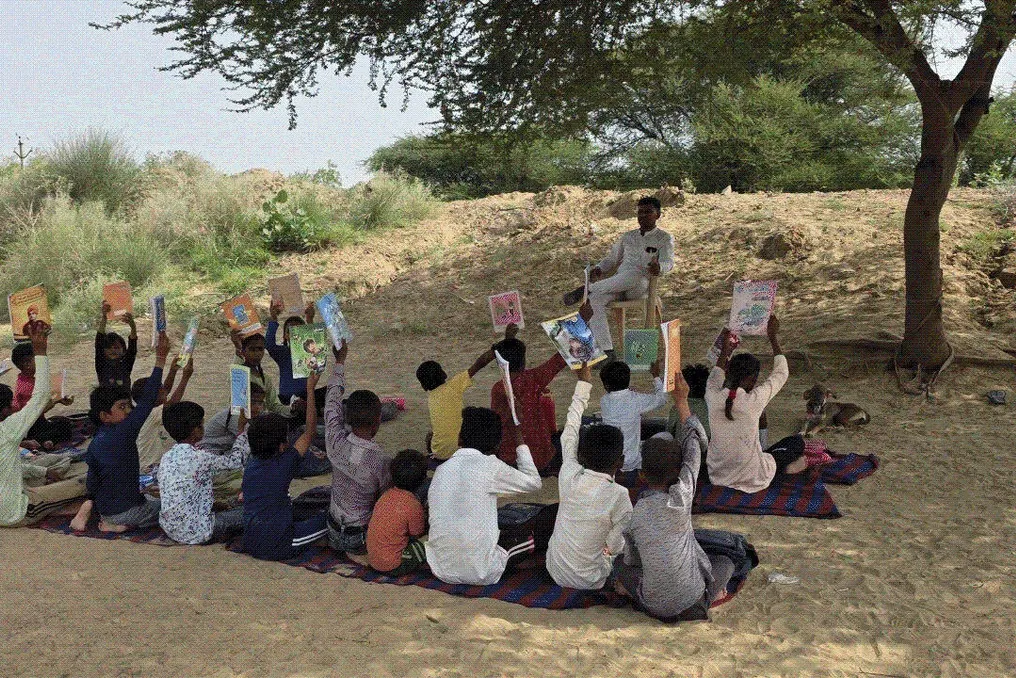
TOI reporters visited government schools in six districts of Rajasthan following disputes related to campus inspections by CJP volunteers. Their findings, spanning from the educational center of Kota to desolate villages and the affected Piplodi, revealed a system where children study under metal awnings, are crowded into unsafe premises, and sometimes find that the school is closed.
In Kota, where a primary school with 78 students is located, classes take place on municipal parking kiosks and under metal awnings. Three teachers work at the school on temporary assignment, and permanent teaching positions have not been approved. According to a PWD survey, 61 school buildings in the district are in dilapidated condition, and hundreds of classrooms have been deemed unsafe.
In the districts of Barmer, Jaisalmer, and Balotra, some schools lack buildings, and staff transfers have resulted in senior classes having no teachers. In Piplodi, Jawalare, where a roof collapse killed seven children in July 2025, lessons continue to be held in a farmer's two-room apartment while a new school is being built.
In the education minister's constituency of Sanganera, 404 students in one school were forced to occupy four rooms after the second building was declared unfit for use.
According to assembly data, 611 government schools do not have their own buildings; 2047 schools lack toilets, and 1049 schools suffer from a shortage of drinking water. Furthermore, 3768 buildings and 83783 classrooms are classified as completely dilapidated. Rajasthan also operates 7200 schools with only one teacher, and there are 150,000 vacant teaching positions.
In Kota, specifically at the Government Primary School on MBS Road, established in 2023, there is no dedicated building. Children gather under small metal awnings erected near municipal parking kiosks. Despite its proximity to renowned training centers where India's brightest talents study, these students have to travel long distances.
The success of Kota's higher education, which relies entirely on the private sector, is not accompanied by the development of the city's own public education system. Although this district represents Rajasthan's Education Minister Madan Dilawar, it has had little impact on many children who attend school on sidewalks, are crowded into rented rooms, or study under metal awnings in the state with extreme temperatures.
Last week, a delegation from the Cockroach Janta Party (CJP) led by Ashutosh Ranki was chased away by a crowd after attempting to inspect a government school in Jaipur. However, the situation regarding the condition of primary schools in Kota is more transparent. Within one day of this unconducted inspection, the Rajasthan government, headed by Chief Minister Bhajan Lal Sharma, promised to allocate 12,000 crore rupees for schools over three years.
Shobana Gupta, responsible for the primary school on MBS Road in Ward 33, reported that they operate from six municipal kiosks and under a metal awning. She clarified that adequate facilities for drinking water, electricity, and basic toilets are available on site, but permanent teacher positions have not yet been approved, and currently, three teachers are working on a temporary basis.
At the Government Middle School in Vigyan Nagar, a center for JEE and NEET, the school is located in a dilapidated building of the Rajasthan Housing Board. Nine classes require major renovation, two are unusable, but funds for demolition or repair have not yet been allocated. Mold has affected the walls of functional classrooms and the school's 'smart classroom,' and part of the fencing has collapsed. Thieves stole plumbing taps and CCTV cameras worth 70,000 rupees. Director Anita Sharma is still awaiting funding.
In Shiv Nagar, the Government Primary Sanskrit School has been operating for eight years in one rented room, accessible via a muddy road impassable during rains. Enrollment has dropped to 8-10 students under one teacher in a population area of about 60,000 people. Former district council member Dhanraj Gurjar Chechi noted that he has repeatedly submitted memorandums, but a permanent building has never been approved, despite Dilawar publicly supporting the study of Sanskrit as part of India's cultural heritage.
At the Government Upper Primary School in Devripuni, Dharampur, in the constituency of BJP MP Kalpana Devi, approximately 10 km from Dilawar's residence, over 130 enrolled students share three classrooms built decades ago under the Rajiv Gandhi Swarn Jyanti Pathshala scheme. The school was upgraded to upper primary status in 2021, but the promised expansion of classrooms never materialized. On full attendance days, children sit under trees, on the veranda, or on open ground. Drinking water is supplied via a temporary line from a neighboring field. Director Chandra Prakash Mina appealed to both the MP and the minister. A few days prior, 27 students fell ill after consuming the midday meal.
A Public Works Department survey in the Kota district among 1088 government schools showed that 61 buildings are completely destroyed and marked for demolition, and each of the 318 buildings has two unsafe classrooms marked, while another 98 have one classroom marked. Currently, only 41 complete buildings and 29 partial structures have been demolished. District Collector Piyush Samaria's office has no records of personal visits to any government school, and he declined to comment.
At the Government Primary School in Bojiyawas, there are toilets, but they lack water. The water tank is cracked and covered in thick cobwebs, indicating long disuse. The school shares space with a health sub-center where medicines are moldy, and chairs and registers show signs of water damage. An employee reported that open defecation has become common. He consciously tries to restrain himself from using the toilet. There are 10 students in the school, in grades 1 to 5, under one teacher.
The Government Middle School in Kalyandpur appears tidy externally, but it turns out that one of the two buildings is closed due to safety concerns, forcing 404 students from grades 1–12 to squeeze into four rooms. The school operates in two shifts, from 7:00 AM to 12:00 PM and from 12:30 PM to 6:00 PM, and some students in the second shift sit under a metal awning outside because the classrooms cannot accommodate them. Grade 12 students reported that the restrooms lack regular water supply and are cleaned only twice a month. Due to the absence of a guard and a broken low fence, the campus has been subjected to repeated thefts, so every classroom door is equipped with three bolts and three separate locks.
At the Government Upper Primary Sanskrit School in Hasampur Basdi, 85 students from grades 1 to 8 study in four classrooms, one of which is designated for a BO staff member for special intensive revision (SIR). Teacher Rajendra Verma presented letters he sent requesting a sports field, perimeter fencing, and a well. He reported that the school has been relying on tanker water for almost a year.
At the Government Primary School in Hasampur, no one needed to be interviewed about the school's condition: the gates were locked at 9:30 AM on a weekday. Former district council member Ram Singh Choudhary stated that he has been writing to the government for three years about the lack of amenities at the school.
In several desert border districts of Rajasthan, some schools lack buildings. In the Panchayat Ramsar, Barmer, the Government Upper Primary School Azad Nagar was included in the budget for 2022–23 and began classes in March 2023, but its 37 students study in a locally built hut or under trees. A fifth-grade student noted: 'Regardless of rain, storms, or intense heat, we must study under the trees.'
The land for the school was only allotted in 2024, and construction funds are pending approval. At the Government Senior School in Majal village, Samdari block (Balotra district), students and parents locked the school gates after nine teachers were transferred simultaneously, leaving the arts, science, and agriculture senior classes without instructors. One student asked: 'How will we study if there are no lecturers in the school? How can second-grade teachers perform the duties of lecturers?' The protest ended after educational officials agreed to assign three teachers on a temporary basis.
Assembly data obtained from UDISE 2025-26 indicators shows that both districts have schools without buildings: 36 in Barmer and 25 in Jaisalmer. Jaisalmer is also among the districts most affected by supply disruptions—a shortage of dry milk required for the state's Pannadhay Bal Gopal Yojana program.
On the morning of July 25, 2025, the roof of the Government Upper Primary School in Piplodi, a tribal village in Jawalare, collapsed during classes. Seven children died, and 21 were injured. A year later, Piplodi has changed significantly—roads have improved, more electricity connections have appeared, regular medical check-ups are conducted, and enrollment is rising, but the only thing still missing is a functioning school building. Classes at the school since last August have been held in the two-room house of a 60-year-old farmer and shepherd, Mora Singh, who vacated his home so the children would not lose another academic year.
The new school building—eight classrooms, an Anganwadi center, and a kitchen—is under construction, originally scheduled for completion on July 24, 2026. It has been delayed since residents expressed concerns about the quality of construction when work began last November. Officials demolished the substandard work and resumed construction. Jawalare Collector Ajay Singh stated: 'The construction of the school is taking longer than expected because residents raised concerns about the quality of construction,' adding that surprise inspections are now conducted every few weeks, and the building should be ready by October.
Among the blocks of Rajasthan, Jawalare has the highest concentration of government schools without buildings. Overall in the district, 81 schools lack toilets. Assembly data shows that 611 government schools across the state do not have their own buildings, 2047 schools have buildings but lack toilets, and 1049 schools lack drinking water.
Despite the government spending on education, Rajasthan's budget for 2026–27 allocates 64,205 crore rupees for school and college education. About 75% of this amount goes towards staff salaries, and only 10–15% goes to infrastructure. The state employs the second-largest number of teachers in the country—7.93 lakh, second only to Uttar Pradesh. Nevertheless, it has 7200 government schools with one teacher serving over 1.5 lakh students. Approximately 1.5 lakh approved teaching positions remain vacant.
The state's internal infrastructure data demonstrates the scale of the problem: 3768 school buildings, 83783 classrooms, and 16765 toilets are classified as completely dilapidated, while another 219902 classrooms and 29753 toilets require repair. Over the past two years, the government claims to have spent 2723 crore rupees on constructing 179 new school buildings and 7945 new classrooms to replace dilapidated ones. Since government funds are limited, government schools increasingly rely on voluntary and community donations. Philanthropic donations for school development across the state amounted to 138 crore rupees in 2024 and 140 crore rupees in 2025. In the Pali campaign, led by donors, 'Aao Gaon Chalen,' migrants and philanthropists are connected with their native villages, aiming to raise 300 crore rupees for infrastructure work.