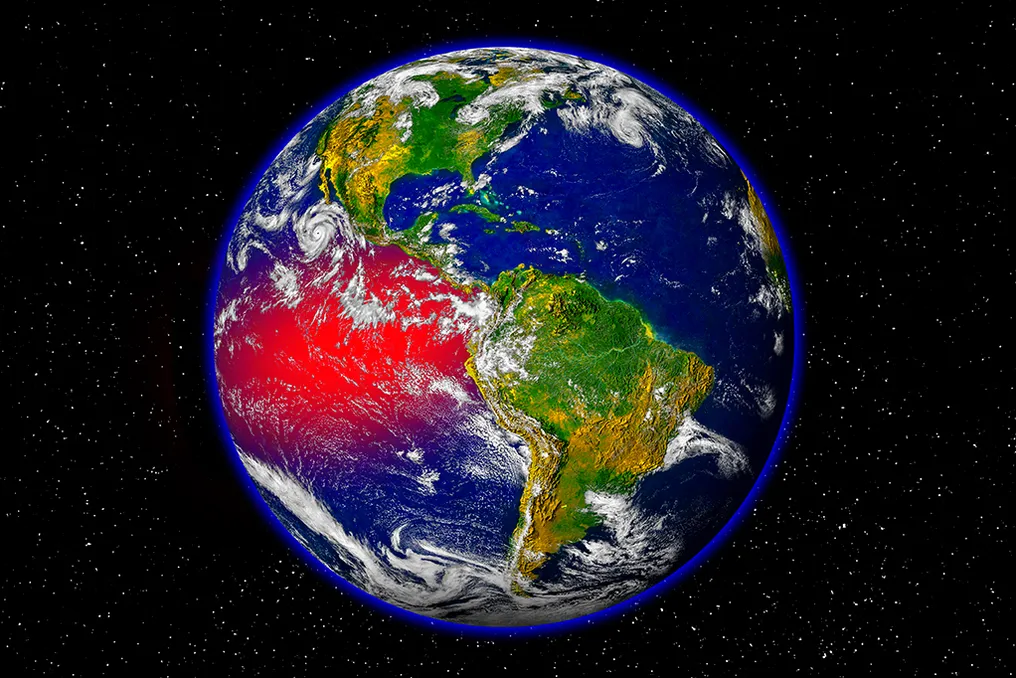
Study shows El Niño events have intensified by almost 40% over the last four decades
Read more
Super Abril
super.abril.com.br

Study shows El Niño events have intensified by almost 40% over the last four decades

A historical magnitude El Niño event is developing in the Pacific Ocean since the beginning of June this year, with the potential to cause extreme weather conditions in various global regions, such as floods and storms.

This scenario is partially attributed to the intensification of the phenomenon, as shown by a study published in the journal Science. The research indicates that El Niño events have become almost 40% more intense in the last 40 years compared to the pre-industrial period. The authors suggest that global warming is the probable factor behind this change.

According to the article, the El Niños recorded in the last four decades have surpassed the strength of any occurrence documented in the thousand years prior to 1850, the time when human activity began to influence the climate due to greenhouse gas emissions.

El Niño Intensification

El Niño constitutes a natural climatic phenomenon that has occurred for thousands of years. It manifests through modifications in oceanic and atmospheric circulation in the equatorial Pacific, resulting in a minimum increase of 0.5 °C in the average surface water temperature for several consecutive months.

The intensity of the phenomenon is directly linked to the increase in Pacific water temperature. When this rise exceeds 2 °C, the National Oceanic and Atmospheric Administration (NOAA), an American climate agency, classifies it as 'very strong', and it can be informally called a 'Super El Niño'.

In these cases, the probability of natural disasters increases, such as floods, wildfires, landslides, and severe storms.

In 2026, a 'Super El Niño' is forming. Julia Cole, a professor at the University of Michigan and co-author of the study, states that 'the question is not whether it will occur, but what its severity and the extent of the impacts will be.'

Historical Record

To find historical evidence of each El Niño episode, the team of researchers analyzed samples from 13 corals located in the Galapagos Islands. These samples, called 'witnesses', function as 'climate archives' or 'ocean black boxes', providing environmental records and terrestrial climate variations over centuries, as they are composed of progressively accumulating layers.

The analysis of the chemical composition of these coral layers allows for the recording of the sea water temperature where the corals developed. The result revealed a history of temperature fluctuations in Galapagos—the location chosen by Cole due to the greater impact of El Niño there. It was observed that intense El Niño events occurred in the last 40 to 50 years, while periods prior to this interval exhibited a 'rather consistent pattern of lower intensity El Niños.'

Cole concludes that these findings reinforce the urgency of reducing global warming. She expresses the belief that global warming is intensifying El Niño, which implies more severe climatic extremes, increasing ecological, human, and infrastructure losses. According to her, no country has sufficient resources to fully protect itself from these effects, which justifies the need to abandon fossil fuels, considered the origin of the problem.
Similar stories

Study shows that more intense El Niño in 40 years increases climate alert
Read more
olhardigital.com.br

Study shows that more intense El Niño in 40 years increases climate alert

A study conducted by the University of Michigan reveals that El Niño events have become nearly 40% more intense over the last four decades. This conclusion was reached by analyzing corals found in the Galapagos Islands, which serve as records of ocean temperatures with a history of up to a thousand years.

The work, published in the journal Science, demonstrates that recent El Niño episodes have surpassed the strength of any previous record before 1850. Furthermore, scientists identified a direct correlation between the greater intensity of this phenomenon and the rise in global temperature.

To obtain these results, the team investigated samples from 13 Galapagos corals, covering both active colonies and ancient fragments. As these organisms grow, they deposit layers of calcium carbonate, each preserving data on the water conditions of that specific period.

The specialists examined the concentration of calcium and strontium in the coral skeletons, as well as certain oxygen isotopes. These two analytical methodologies allowed for the precise estimation of water temperature.

The findings were notable for their consistency; while records prior to the last fifty or forty years indicated relatively smaller magnitude El Niños, the most recent events showed a constant prominence. There are no historical precedents where El Niños have reached the strength observed currently.

Julia Cole, a professor and head of the Department of Earth and Environmental Sciences at the University of Michigan and the study's lead author, commented on the discovery.

The El Niño phenomenon occurs when tropical Pacific waters warm above normal levels. Normally, trade winds transport warm water from South America to the region of Australia. When these winds weaken, some of this water returns eastward toward South America, causing changes in atmospheric circulation and altering rainfall distribution.

Although originating in the Pacific, El Niño can affect the climate in various parts of the globe. Among the possible consequences are several environmental impacts.

The team also used climate models to verify whether natural factors could justify this change. The simulations took into account data on volcanic eruptions and fluctuations in solar activity over millennia.

Analysis of natural factors

None of the tested variables, such as volcanic eruptions or solar variations, managed to replicate an intensity change comparable to that seen in recent El Niños.

For Cole, this strengthens the theory that global warming is contributing to the intensification of the phenomenon. The researcher stated that 'El Niño is a major source of climate extremes, and if it is getting stronger, the impacts will too.'

The current El Niño manifests itself on an already warmed planet due to the increase in greenhouse gases. This combination has the potential to further raise temperatures and worsen effects on ecosystems, infrastructure, and the population.

For the researchers, this result serves as additional reinforcement to the urgency of controlling global warming and reducing dependence on fossil fuels.

Popular