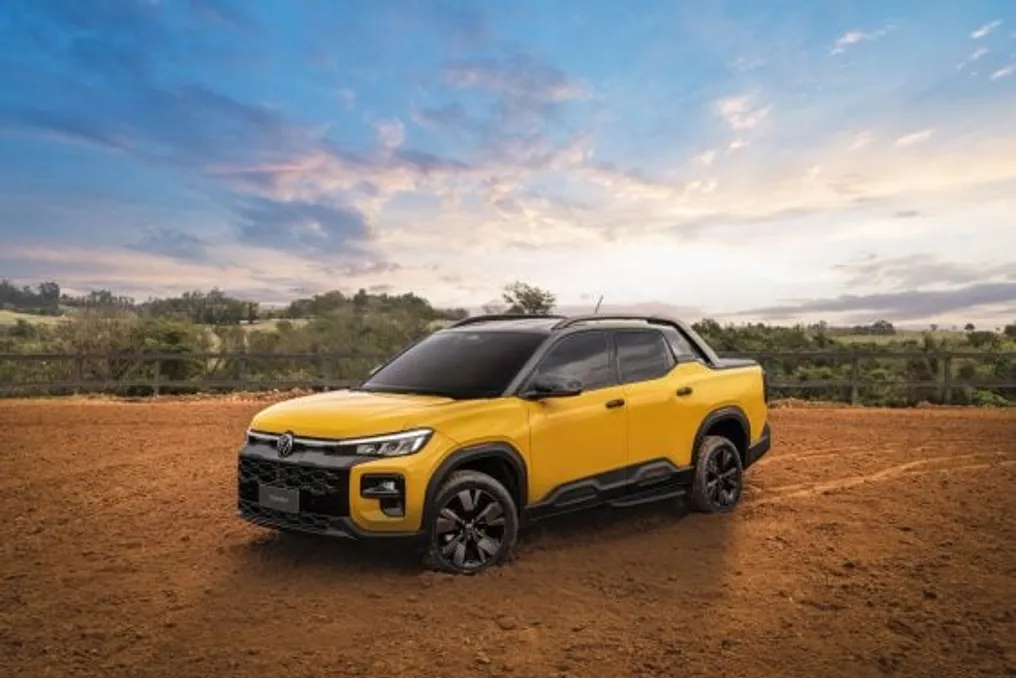
At an event held at the Festa do Peão de Barretos in São Paulo, Volkswagen unveiled glimpses of the Tukan and the new Amarok, both camouflaged. The event, considered the largest rodeo festival in Latin America, served as a stage for the anticipation of the models.
The Tukan was designed to compete directly with the Strada, which has dominated the Brazilian market for light vehicles, SUVs, and commercial vehicles for five years. The compact pickup from Fiat has maintained its leadership since 1998.
Tukan Details
To face its main competitor, the new Tukan will offer single and double cabin versions, focusing on a robust design, high front end, and prominent wheel arches. It will have a load capacity exceeding 700 kg and is scheduled to debut in the first half of 2027. The vehicle will feature a rigid rear axle and single-leaf semi-elliptic springs, a configuration considered more durable by buyers, similar to that used in the Strada and Montana.
The single-cabin version, shown for the first time, will retain the Robust name, come equipped with drum rear brakes, two roof bars, and six auxiliary handles in the bed, which appears larger than the current one. The double-cabin version, named Extreme, will feature four doors, unlike the two-door limitation of the Saveiro, and offer more interior space.
There are two engine options available: a 1.0 turbo engine with 116 hp (which may receive tax incentives) and a 1.5 turbo engine with 150 hp, which will introduce the 48V semi-hybrid system, more efficient than the 12V one. The Tukan thus represents a strategic response from Volkswagen to the successful formula found by Fiat, seeking to increase its market share in a growing sector.
Amarok Presentation and Tasman's Arrival
Also in Barretos, the new Amarok, arriving from Argentina in 2027, was shown completely camouflaged. VW confirmed that this model will have hybridization and will be the most powerful ever produced, after reaching 800,000 units since 2010.
The pickup segment has established competitors such as Hilux, Ranger, S10, Frontier, and Triton. The Tasman, from Kia, enters this scenario with rectangular lines and a distinct front end, aiming to capture market share. Its size is comparable to the Hilux, featuring a length of 5,410 mm, a wheelbase of 3,270 mm, a width of 1,930 mm, and a height of 1,870 mm, in addition to a 1,173-liter bed, about 20% larger than the Toyota manufactured in Argentina.
The Tasman is equipped with a 2,151 cm³ turbodiesel engine, generating 210 hp and 45 kgfm, an eight-speed epicyclic automatic transmission, and 4x4 with low range. It accelerates from 0 to 100 km/h in 9.7 seconds and offers driving modes such as Normal, Eco, Sport, and Smart, in addition to specific settings for mud, sand, and snow. Its off-road capabilities include 231 mm of ground clearance, a 28.9-degree approach angle, a 25-degree departure angle, and a 23.7-degree ramp angle, with an immersion capacity of 800 mm. Its body is monocoque, different from the traditional ladder chassis, and its standard Inmetro consumption is 9.5 km/l in the city and 10.9 km/l on the highway, with an 80-liter tank.
The first contact with the Tasman occurred in Cabreúva (SP), on a track adapted to test different conditions, such as dirt, potholes, obstacles, and ramps. Despite its size, the vehicle is easy to drive and provides a good driving position. The front suspension is not McPherson, as informed by Kia, but the suspension system operates well, even with a relatively small travel, which is only noticeable on very uneven terrain or when passing large obstacles.
Although the engine and gearbox combination is not exceptional, the Tasman, weighing 2,248 kg, fulfills its functions. The descent control is an effective feature, allowing the pickup to maintain speed on steep slopes without requiring constant braking, providing security in low-adhesion situations. The announced price for the model is R$ 249,990.