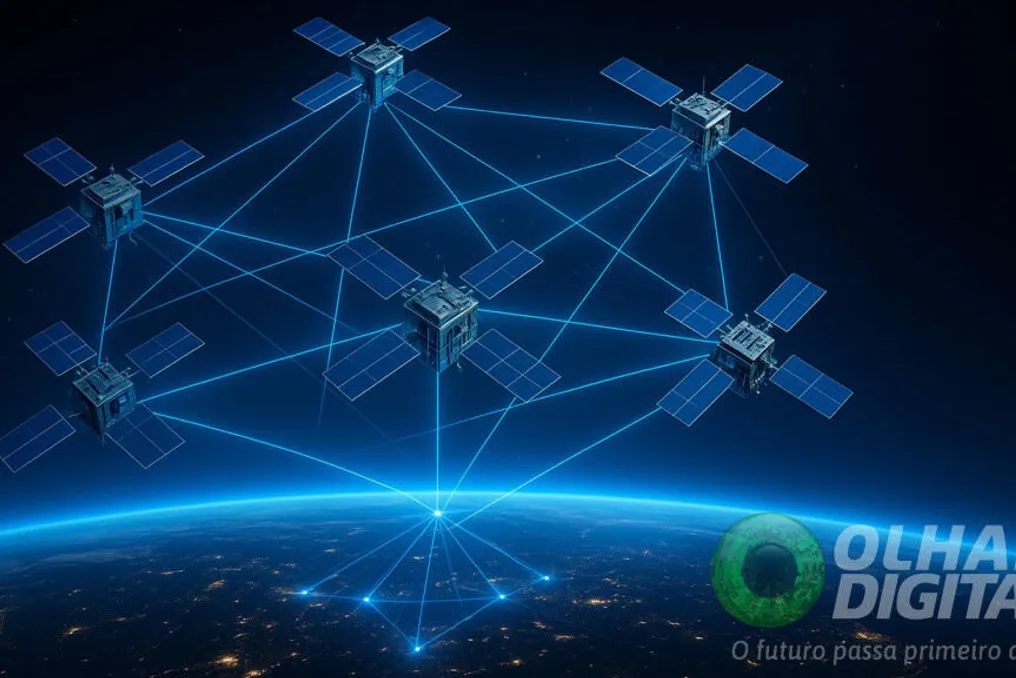
Low Earth orbit is becoming increasingly congested. According to The Wall Street Journal, the region orbits over 34 thousand satellites and fragments of debris, which intensifies concerns about collisions capable of damaging or destroying spacecraft.
SpaceX is one of the main contributors to this growth, possessing more than 10 thousand devices linked to Starlink in orbit. This company employs autonomous systems to avoid other equipment when there is an imminent risk of collision.
Low Earth orbit covers altitudes between 160 and 1,930 kilometers. In this range, objects travel at high speeds, reaching about 28 thousand km/h (17,500 mph), completing a trip around the planet in an interval of 90 to 120 minutes.
Most of the more than 10 thousand items associated with Starlink consist of active satellites, used by SpaceX to provide high-speed internet services. These devices transmit location data to the company, which continuously shares this information with military forces and other operators while assessing possible approaches.
A Starlink satellite can autonomously change its route when the chance of collision exceeds three in ten million, using onboard propulsion and collision avoidance software.
Projections indicate that the amount of equipment could grow significantly in the coming years. It is estimated that between 2026 and 2034, at least 41 thousand new satellites will be launched into low orbit, with about two-thirds belonging to SpaceX, Amazon, and Chinese companies.
A new area of concern arises with orbital data centers, which aim to position clusters of satellites equipped with artificial intelligence processors in space. For analyst Dallas Kasaboski of Analysys Mason, this sector could raise the total number of satellites to approximately 1.5 million.
Key points of attention
Although collisions are still considered rare, the European Space Agency has recorded four incidents involving cataloged objects. A notable event occurred in 2009, when an Iridium Communications satellite collided with an inactive Russian communications satellite, generating about 1,800 fragments of at least 10 centimeters.
Smaller debris also poses a risk. Radars can track debris the size of a softball or larger, but tiny particles can go unnoticed. Mark Matney, a planetary scientist from NASA's orbital debris program, warned that even a fragment the size of an ink particle can damage a satellite due to the extremely high speed.
Jonny Dyer, CEO of Muon Space, argues that the volume of objects is not the primary risk. He states: 'For me, the risk is not the number. It is whether there are malicious actors doing bad things on purpose or being negligent.'
SpaceX itself acknowledges this concern. In a document related to its public offering, the company stated: 'As the number of satellites and other objects in Low Earth Orbit continues to grow, the probability of accidental collisions, fragmentation events, or other incidents in orbit increases.'
Jonathan McDowell, an astrophysicist, told The Wall Street Journal that the current operation is at the maximum limit of safe density.
The competition for space in low orbit shows no signs of slowing down. With the forecast of at least 41 thousand new satellites by 2034 and the possibility of the total reaching 1.5 million with future orbital data centers, the future challenge lies not only in putting more equipment into space but in ensuring that they can coexist in an increasingly saturated region without a collision triggering a chain reaction of new debris.