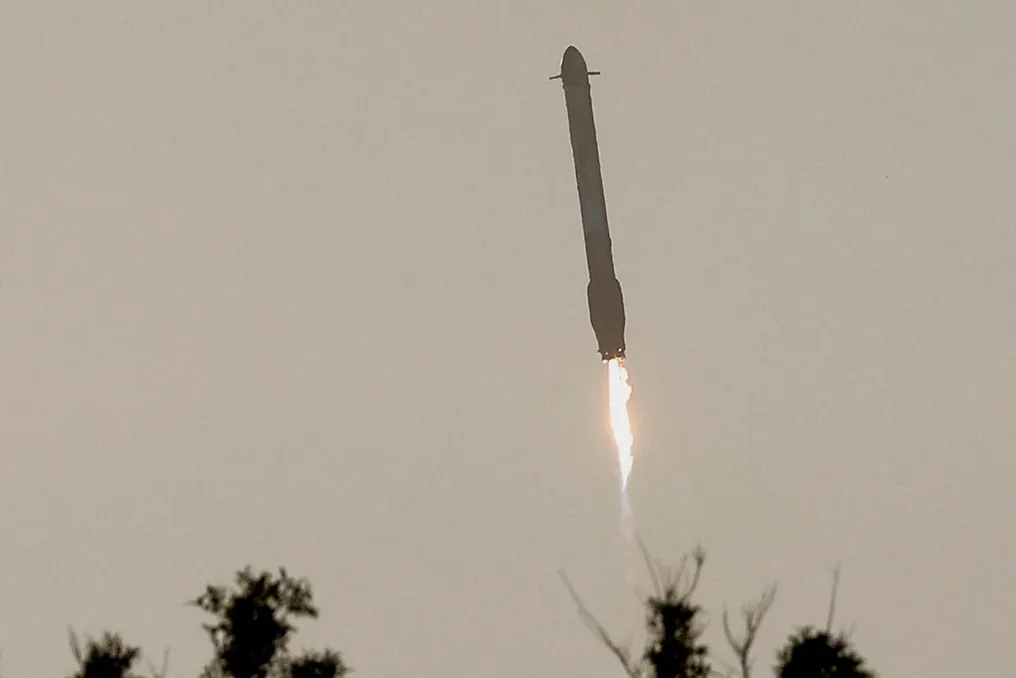
The Nancy Grace Roman Space Telescope was launched from Florida on Sunday to study some of the most significant mysteries in astrophysics and cosmology. This project, valued at approximately $4 billion USD, launched at 7:26 AM local time from Launch Complex 39A at the NASA Kennedy Space Center on a SpaceX Falcon Heavy rocket. Despite initial weather concerns, the rocket successfully delivered the telescope through clear skies.
The telescope is designed to investigate cosmic mysteries such as dark energy and dark matter, as well as to test gravity on a massive scale and search for exoplanets—planets outside our solar system. Roman will move toward Lagrange point 2, located about 1.6 million kilometers from Earth. The mission is planned to last five years, although NASA has stated it may have enough fuel for another five years.
The telescope is named after Nancy Grace Roman, NASA's first chief astronomer and driving force behind the agency's Great Observatories program. She is often called the 'Mother of Hubble' because she advocated for space telescopes capable of seeing through Earth's hazy atmosphere and for open access to data for researchers. The observatory is equipped with a 2.4-meter primary mirror, similar in size to the Hubble mirror.
Nicola Fox, head of NASA's Science Missions Directorate, told reporters on Saturday: 'It will be like Hubble and James Webb peering into the Universe through a keyhole, and Nancy Grace Roman kicking down the door.'
Wide field of view and zoom
Julie McEnery, a senior scientist on the Roman project at NASA's Goddard Space Flight Center in Maryland, noted that 'Roman has overall the same sensitivity and visual acuity as Hubble, but we are surveying the sky much faster.' She specified that one month of Roman observations will allow the study of the entire Milky Way Galaxy, whereas Hubble would require about a century for such an survey.
The Webb Telescope, launched in 2021, changed the understanding of the early Universe by discovering, among other things, that primordial galaxies formed earlier and were larger than previously thought. Because light takes time to travel, it can view vast distances and look back into the deep past. In contrast, Roman focuses on panoramic images. NASA compares Roman to a wide-angle camera lens, and Webb to a zoom lens.
According to McEnery, Webb is designed for deep probing of the Universe with exceptional sensitivity, allowing it to find rare objects in the early Universe, while Roman offers a 'big picture that complements the deep views provided by Webb.' Roman will help in understanding dark energy and dark matter by creating the most complete three-dimensional map of the Universe to date. Its main investigation, which will take over a year, will cover more than two billion galaxies.
The Universe began approximately 13.8 billion years ago with the Big Bang and has been expanding ever since. In 1998, scientists discovered that this expansion is accelerating, and the hypothetical cause is an invisible force called dark energy. Ordinary matter—stars, planets, gas, dust, and everything familiar to us on Earth—makes up only about 5% of the Universe's content. Dark matter, detected by its gravitational influence on galaxies and stars, may account for about 27%, and dark energy for about 68%.
According to NASA, using Roman to measure the pull of dark matter and the push of dark energy across the Universe will bring scientists closer to solving both mysteries. Furthermore, Roman will conduct one of the most comprehensive searches for exoplanets. It is expected to discover thousands of such planets and provide the first statistical assessment of planetary systems similar to ours.
Cosmologist Mustafa Ishaq from the University of Texas at Dallas, a member of the Roman scientific team, told Reuters: 'One of the most exciting aspects of Roman is its potential for discovery. Historically, the most important astronomical breakthroughs from major observatories have often occurred in areas that scientists did not foresee before launch.'
Roman joins an era when ground-based astronomy faces increasing pressure from space. Radio astronomers in South Africa warned that the legal protection of the Karoo reserve, which protects the MeerKAT and SKA-Mid telescopes under construction, ends at ground level and does not extend to satellites transmitting signals into that area. The administration of US President Donald Trump attempted to cut or eliminate funding for Roman during both of his terms, but Congress maintained it. According to NASA, the launch occurred nine months ahead of schedule.