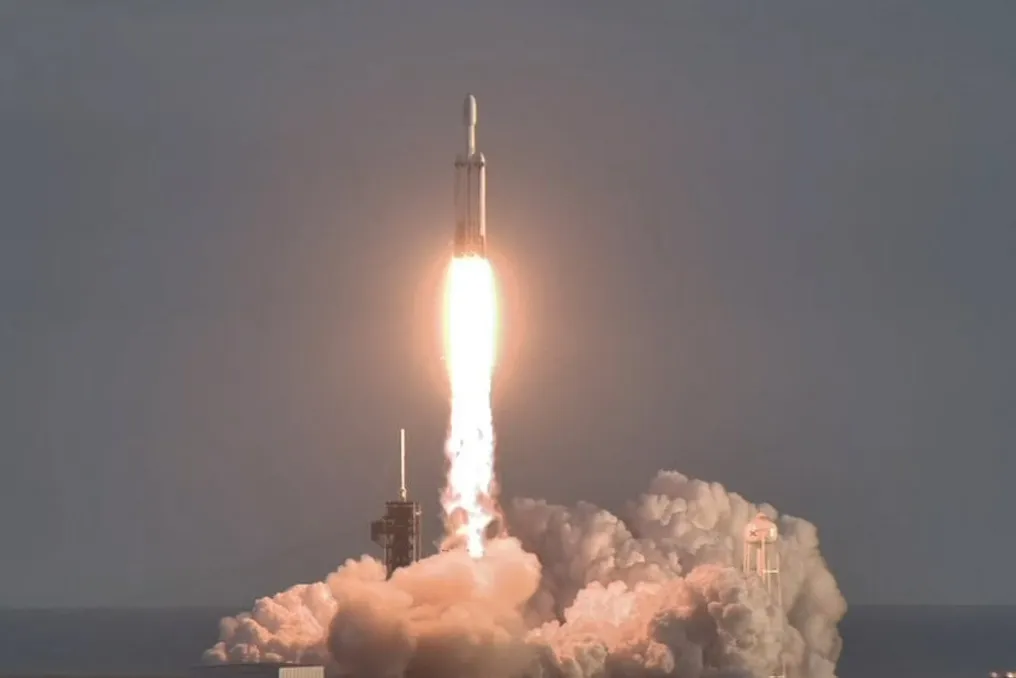
The Nancy Grace Roman Space Telescope was successfully launched on Sunday morning (30) by NASA. This innovative instrument has the capability to examine vast expanses of the sky, allowing for the investigation of some of the Universe's greatest enigmas.
The launch occurred at 8:26 AM, following a SpaceX Falcon Heavy rocket from Launch Complex 39A at the Kennedy Space Center in Florida. The live broadcast was provided by Olhar Digital. Minutes after liftoff, Roman established contact with Earth via a tracking and data relay satellite operated by NASA itself.
Currently, mission teams are monitoring the telescope as it heads toward its orbit around the Sun-Earth L2 Lagrange point, located approximately 1.6 million kilometers from Earth. Initially, during the launch and early orbit, the Roman satellite used ground stations and Near Space Network relay satellites to exchange telemetry, command, and tracking data with ground operators. After about 70 minutes, communication was taken over by the Deep Space Network, which began guiding the telescope to its final destination.
NASA representatives attended a press conference in the Kennedy Press Center auditorium to detail the mission and the telescope's next steps. Jared Isaacman emphasized that the launch transcends the start of a new scientific endeavor, as the project consolidated planning, investment, and team effort over more than a decade. He stated: 'Roman is exactly the kind of success story we want to see across all of NASA.' Furthermore, he mentioned that the observatory was delivered within budget and ahead of schedule.
Nicky Fox assessed that the combination of wide field of view and observation speed will give Roman the ability to study large portions of the sky in an unprecedented manner. This functionality is expected to substantially increase the scope of research, aiding in the revelation of still unknown phenomena. She stated that 'Roman will be a machine of discovery that brings us closer than ever to answers to humanity's deepest questions about our cosmic history,' adding that the telescope should also 'make the invisible visible,' supporting the search for signs of life outside the Solar System.
The journey to L2 still involves multiple phases. The first phase will be dedicated to preparing the observatory to operate far from Earth. Subsequent tasks include opening the high-capacity communication antenna and the movable shield covering the instruments' light intake. Another component to be activated is the coronagraph, whose function is to test a technique to block the intense light of a star, enabling the visualization of much fainter objects around it. This technology may be improved in future missions focused on searching for Earth-like planets.
Subsequently, the observatory's main scientific apparatus will become operational. The Wide Field Imager (WFI) is an infrared camera equipped with 18 detectors and a resolution of 300 megapixels. With this instrument, it will be possible to capture much larger areas of the sky in each recording, accelerating the creation of Universe maps. NASA projects that the equipment will be able to conduct celestial surveys up to a thousand times faster than Hubble. However, in the first three months, scientists will need to calibrate the instruments and validate their performance before beginning regular scientific observations.
The volume of generated data will also be considerable, estimated at about 1.4 terabytes per day. To manage this amount, the analysis will be supported by artificial intelligence, machine learning, and the collaboration of citizen scientists. The first images from Roman are expected to be released in early 2027. Until then, the team will have a series of procedures to complete to convert the newly launched observatory into a fully functional scientific tool. Julie McEnery commented: 'There is no way to predict what else we will know and have seen by next year.'
Named in honor of astronomer Nancy Grace Roman, considered the 'mother' of the Hubble Space Telescope, the observatory will conduct an extensive mapping of the sky, allowing for the tracking of galaxy formation and transformation throughout cosmic history. The vast amount of data will also be used to study dark matter and dark energy, which remain among astronomy's main mysteries. A crucial front will be the search for exoplanets, including worlds that may possess conditions favorable to life. By integrating these different lines of research, Roman will provide new data on the evolution of the Universe and the diversity of planetary systems beyond our own.
The mission will also prioritize exoplanets. Using methods such as coronagraphy and gravitational microlensing, the telescope will be able to identify and study various types of worlds outside the Solar System, helping to define those worthy of future investigation. Although it is not capable of directly detecting signs of life on Earth-like planets, Roman will assist in developing essential knowledge and technologies for future missions dedicated to searching for habitable environments.
Roman's Mapping Scale Unprecedented in Space Exploration History
NASA anticipates an operational period of at least five years, during which the observatory is expected to generate approximately 20 petabytes of data. This will allow Roman to significantly expand the understanding of the Universe and pave the way for the next generation of space telescopes. The project is managed by NASA's Goddard Space Flight Center, with participation from the Jet Propulsion Laboratory (JPL), the California Institute of Technology, and the Caltech/IPAC Infrared Processing and Analysis Center. The Space Telescope Science Institute (STScI) and scientists from various research institutions are also part of this initiative. The mission receives contributions from the European Space Agency (ESA), the Japan Aerospace Exploration Agency (JAXA), the French National Centre for Space Studies (CNES), and the Max Planck Institute for Astronomy in Germany.