Not every vacation needs to be built around creating a detailed itinerary to see as many sights as possible. Sometimes the best reason for a trip is much simpler: you love something so much that you are willing to follow it anywhere.
This could mean traveling to Karoo to admire the Milky Way away from city lights. Perhaps you are willing to wake up before dawn to visit a bird hide, spend an entire weekend chasing waves, or plan a road trip through vineyards, cameras, and good light. These passion-driven trips are shaped not so much by where you want to go, but by what you genuinely love doing. This travel style is particularly suited to South Africa, as few countries offer such a wide spectrum of landscapes and experiences within relatively easy reach—from the tidal flats of the West Coast to the dark skies of Karoo and the historic vineyards of Cape Town.
Here are several destinations in South Africa worth planning around your hobbies.
Bird Watching Travel
Bird watching requires a special quality of patience. You learn to sit still, notice movement where there seems to be none at first glance, and feel a strange delight at a silhouette on a distant branch. The West Coast National Park, near Langebaan, is one place where this patience can pay off. The park surrounds the Langebaan Lagoon, which is an internationally recognized Ramsar wetland, and SANParks records over 250 bird species annually in the park. This lagoon is especially important for migratory shorebirds, some of which travel vast distances between the Northern Hemisphere and South Africa.
The history of this landscape is as interesting as its fauna. The Langebaan Lagoon was declared a marine reserve in 1973 and later became the West Coast National Park in 1985. It was subsequently renamed the West Coast National Park, and nature conservation expanded beyond the lagoon to include surrounding terrestrial ecosystems. For bird lovers in the park, there are convenient viewing points, and Geelbek is particularly useful for observing lagoon shorebirds. Tides and ebbs can create favorable conditions for viewing. However, this place is not exclusively for people with binoculars; between birdwatching stops, there are opportunities for hiking and cycling, picnic spots around Kraalbaai, and exploring the rocky coast in Caesarsbank.
Stargazing in Karoo
Some places make you look around, but Sutherland makes you look up. Located high in the Karoo, this town has become synonymous with astronomy in South Africa. Its significance as an observatory is closely linked to what most city dwellers try to escape—light pollution. The modern South African Astronomical Observatory was established in 1972 by merging the Cape Royal Observatory and the University Observatory in Johannesburg. Sutherland was chosen as the new observation site due to its dark skies and favorable conditions for astronomical observation. The astronomical station was launched in 1973.
Today, astronomy remains central to the town's identity. The facility in Sutherland hosts major astronomical installations, including the South African Large Telescope, while the surrounding Karoo landscape offers the darkness that makes even an ordinary night significant. A passion-driven trip here is not about rushing between sights, but about embracing the silence. Spend a day exploring the small town, enjoying the vast Karoo landscape, or simply slowing down at your accommodation before nightfall. Then, as the temperature drops and the sky begins to dominate, the reason for the visit becomes clear.
Wine Tourism
A wine trip has the ability to make a vacation wonderfully unhurried. There is always another tasting to linger over, another lunch that lasts longer than expected, and another drive through vineyards worth taking just because it looks beautiful. The history of South African winemaking is very deep. The first recorded fermentation of grapes grown in the Cape dates back to 1659, and Simon van der Stel founded his estate Constantia in 1685. The arrival of French Huguenots in 1688 also helped shape the young wine industry, especially in areas that later became associated with Stellenbosch and Franschhoek.
For travelers interested in the history behind the glass, Groot Constantia is a particularly compelling starting point. The farm has existed since 1685 and is among the oldest commercial wine farms in the country. However, the estate's history is not limited to vineyards and famous wines. The museum and historical interpretation of the estate also touch upon the role of slavery in the development of the farm and the broader Cape wine economy. This complexity makes a wine-focused trip more than just a tasting. Visit the historic estate, explore its museum spaces and cellar, and then continue your journey through the wider Constantia Valley or further into the Wine Lands. Stellenbosch and Franschhoek offer their own histories, landscapes, and gastronomic experiences, making it easy to turn a tasting weekend into a longer road trip.
Whale Watching
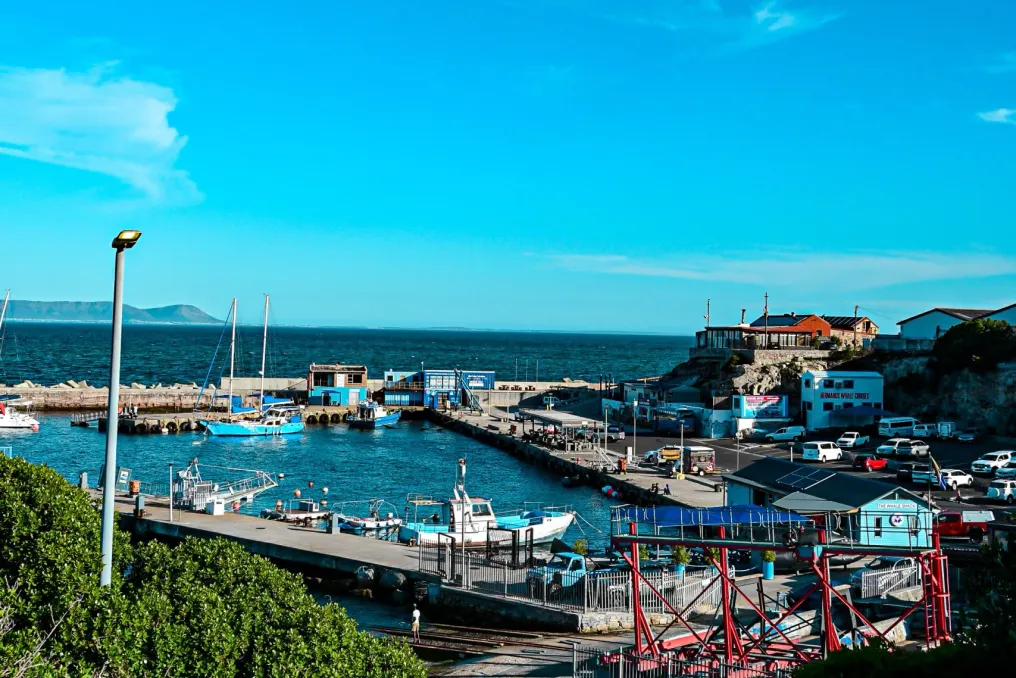
For some travelers, seeing a whale is enough to justify an entire road trip. Fortunately, South Africa provides them with numerous coastlines to choose from. Every year, Southern Right Whales migrate to the coastal waters of the Western Cape to give birth and nurse their young. They can usually be seen from June to November, while Humpback whales migrate through the region from May to December. Hermanus remains one of the most famous whale watching spots in the country, but the experience is not limited to one town. South African tourism highlights the viewing opportunities along stretches of coastline, including the Cape Peninsula, False Bay, Arniston, Mossel Bay, Wilderness, Knysna, and Plettenberg Bay. The charm of a whale-focused road trip is that the journey itself can be as rewarding as the sightings. Drive slowly along the coast, stop at viewpoints, and walk along sections of the shoreline. Spend time in small towns rather than treating them as mere transit points. And remember that whale watching is still wildlife viewing. There are no guarantees, and that is part of the appeal. You can plan a trip around the season, select a promising stretch of coast, and still be surprised by what appears over the waves.
Photography as a Hobby
It is easy to photograph South Africa poorly. Not because it lacks beauty, but because it often has too much. A photographic trip is a good excuse to let go of the desire to see everything. Choose one landscape and give yourself enough time to understand it. This might mean the changing light of the Karoo, the early morning silence of the national park, the wildflowers of the West Coast, or a coastal road where the weather changes every few kilometers. The West Coast National Park is particularly well-suited for photographers who love wildlife and landscapes, as it combines birds, the Langebaan Lagoon, fynbos, dunes, and rocky coast in one protected area. For wildlife photographers, the experience can be built on patience rather than a tight schedule. For landscape photographers, the goal might simply be to return to the same spot at different times of day and watch how dramatically the light changes the scene. The camera gives you a reason to look closer, but it can also be a reminder to put it down sometimes. Not every good travel moment needs to become a photograph.
A photographic trip changes the pace of travel. Instead of asking 'what's next?', you start asking 'what if I stay?'. Perhaps this is the true appeal of passion-driven trips. They don't necessarily have to involve a recognized tourist trend or an impressive level of skill. You don't need to be an expert ornithologist to enjoy the birds, own expensive camera equipment to travel for photography, or know the difference between all grape varieties to spend a weekend in a wine country. The essence is giving yourself permission to build a trip around what brings you joy. South Africa has long offered travelers a wide range of experiences: from hiking and surfing to fishing, wildlife viewing, and stargazing. What changes is how many travelers choose to structure their time away from home: less around visiting famous landmarks and more around personal experiences.
This might mean a trip for waves, birds, stars, or wine. Or it might mean following something much more specific: a love for old railway stations, roadside diners, wildflowers, mountain passes, or small-town museums. The destination, of course, still matters. But sometimes the best trips begin with a different question. Not 'where do I want to go?', but 'what do I love enough to travel for?'