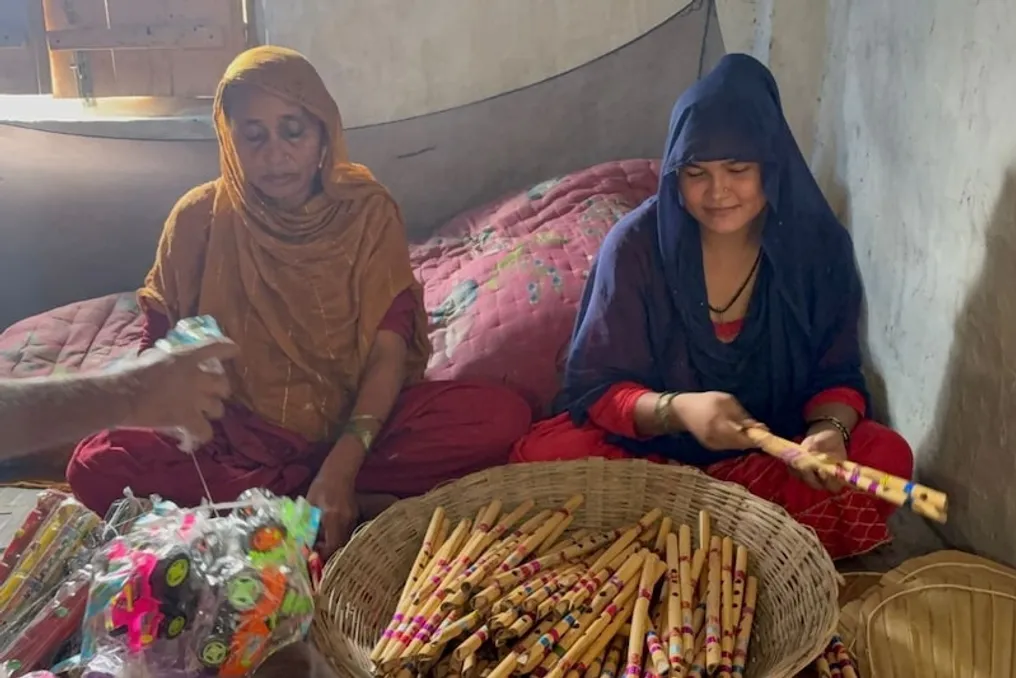
The connection between Lord Krishna and the flute has existed for many centuries. As the festival of Janmashtami approaches, the demand for flutes, as well as statues and clothing for Krishna, increases. Due to this demand, an age-old craft thrives in the village of Murgayachak, located in Muzaffarpur, actively supported today by the participation of women from the families.
Murgayachak, which is part of the village of Bada Sumera in the Kudni block of Muzaffarpur district, is known as a village of flute makers. About 80 Muslim families here have been engaged in this craft for several generations. The festive season provides these artisans with an opportunity to increase their income and earn extra earnings.
Before the festivals of Janmashtami and Dussehra, work on producing flutes intensifies in every household. Women are involved in making flutes and other traditional items at home, while the men from the families transport the finished products to markets and other cities. Thus, this traditional craft has become a source of employment for women in the family.
Thanks to financial assistance of 10 thousand rupees received under the Women's Employment Plan, this craft has gained new momentum. Many women used the government funds not for personal needs but for developing their businesses. This money is used to purchase bamboo and other necessary raw materials, which helps increase production volumes.
Artisan Akhtar Khatun said that previously, lack of funds was a serious obstacle to business expansion. After receiving government support, it became easier to purchase materials not only for flutes but also for making toys and fans. The women prepare these items at home, and the men transport them for sale in various markets.
Ridwan Khatun noted that his family has been making flutes since long ago. The funds received through this program gave them a chance to develop this traditional trade. Now, the family is trying to increase production using its own small capital without incurring debt. The financial participation of women has also supported the home business.
The oldest artisan in the village, Mohammed Alam, who has been making flutes for about forty years, learned this craft from his father. His father, in turn, learned the art of flute making from an external master. Thus, this craft has been passed down from generation to generation.
According to Alam, when he started this work, the flute market was very good. People bought flutes both as children and adults at fairs and local markets. He himself traveled to remote areas for sales. At that time, there was high demand for traditional toys and bamboo products.
With the changing times, the face of the market has changed. Plastic toys have begun to displace traditional items, which has affected the flute business. Despite the decline in demand, the village artisans have not abandoned their ancestral craft. Today, about 80 families continue to earn a living from this trade.
The festival of Janmashtami holds special significance for these families. A few days before the festival, work on making flutes picks up pace. Artisans report that goods worth thousands of rupees are prepared for this occasion. Then, the finished flutes are sent for sale in the markets of neighboring blocks and other cities.
Besides Muzaffarpur, the made flutes are delivered to Samastipur, Rosada, Jainagar, Rajnagar, Hajhauli, Sasampur, and Musriharari. Artisans use reeds and bamboo for their traditional making. Since the size and cost of the flutes vary, their price ranges approximately from 10 to 50 rupees.
The growing demand during festivals becomes an important source of income for these families. Besides Janmashtami, the business is also stimulated by Dussehra. Production continues for several days to prepare enough goods according to market needs.
Although the flute market has not reached its former scale, the arrival of Janmashtami again causes a surge in demand. For these families, the flute is not only a symbol of faith associated with Lord Krishna but also an important means of livelihood. Financial support under the Women's Employment Plan has strengthened the role of women in this business. Now, women assist in production and utilize accessible capital to purchase raw materials. This has given the families the opportunity to develop their traditional trade without additional loans.
Before Janmashtami in Murgayachak, the sounds of flutes are heard again. The artisans hope that sales will be better this time, and the festival will bring prosperity to their homes. This age-old craft has found new hope thanks to the participation of women and state support.