After two decades of development by NASA, a mission capable of examining vast portions of the sky and unraveling great mysteries of the Universe has entered a new crucial phase.
On Sunday (30th), at 8:26 AM (Brasília time), the Nancy Grace Roman Space Telescope was launched using a Falcon Heavy rocket provided by SpaceX. The launch took place from Launch Complex 39A, located at the Kennedy Space Center in Florida.
Less than two minutes after beginning its ascent, the rocket passed through the phase known as MaxQ, a critical moment where the combination of speed and atmospheric resistance imposes the greatest mechanical stress on the vehicle's structure. After overcoming this stage, the engines of the two side boosters were shut down, and they separated from the main body at two minutes and twenty-seven seconds.
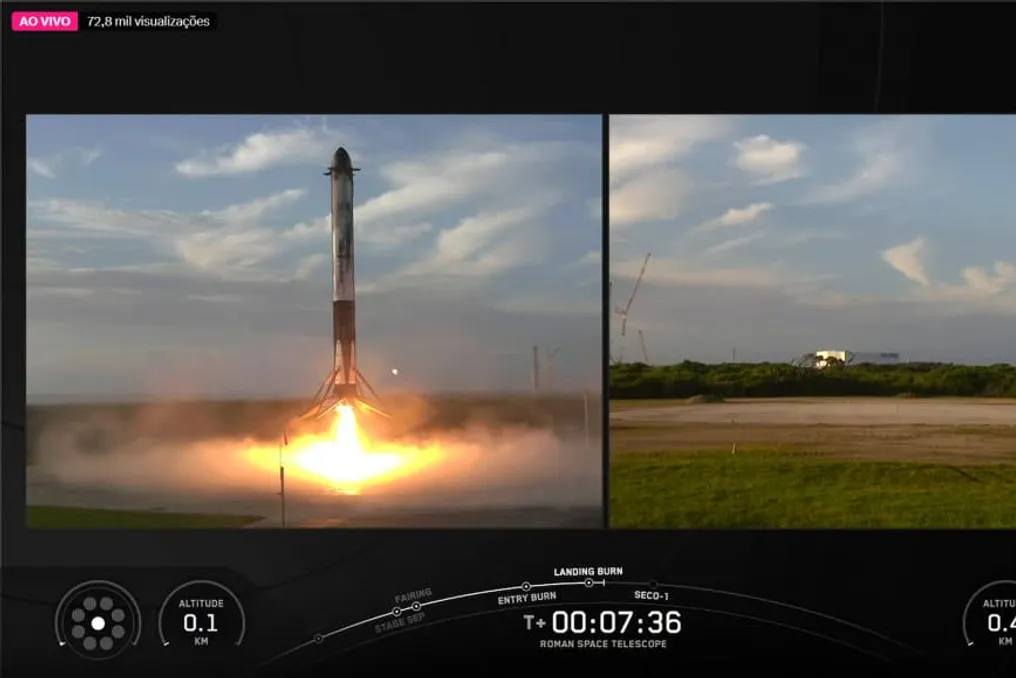
Subsequently, these side boosters rotated in the air and ignited their engines to perform a trajectory inversion maneuver, returning to base, while the main structure continued its course toward space. The stage separation occurred at three minutes and fifty-four seconds, immediately triggering the second stage engine.
At four minutes and fifteen seconds, the fairing was discarded, exposing the telescope to the vacuum, already outside the Earth's atmosphere. As the payload headed toward orbit, the side boosters began their descent, firing their engines for ten seconds to reduce speed and withstand the heat of atmospheric reentry. The final braking ensured a smooth vertical landing, scheduled for about seven minutes and forty seconds, at Landing Zones 2 and 40 (LZ-2 and LZ-40) in Cape Canaveral.