Co-founder and CEO of Ather, Tarun Mehta, told Business Standard that the company expects demand for its electric scooters to continue exceeding production capacity for another three to four quarters, despite increasing production at the new plant in Aurangabad.
Currently, the company's monthly demand exceeds 50,000 units, while current production capacity is around 35,000 scooters per month. The launch of the new Konarc scooter is expected to further widen this gap.
The company plans to increase its production capacity to a maximum of 77,000 units per month after commissioning Phase 1 of the Aurangabad facility, alongside the existing Hosur plant. Mehta clarified that Phase 1 should be operational by the end of 2026, followed by about two quarters to reach maximum output.
During an interview held against the backdrop of the Konarc launch on Saturday, Mehta noted that dealer inventories are in a state of constant shortage, and this situation will persist for another three to four quarters, as even after launching Phase 1 in Aurangabad, demand is expected to outpace supply for about another year, according to him. He emphasized that demand remains high.
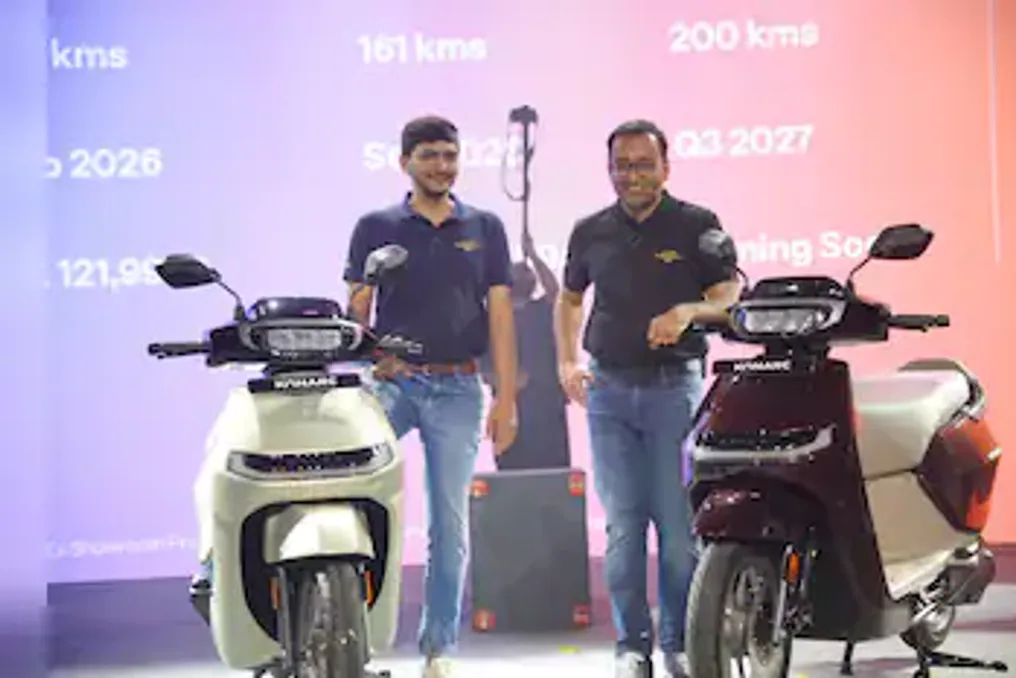
Konarc is Ather's first mass-market scooter developed on the new EL platform. With this move, the company has entered the segment of mass-market electric two-wheelers. This family scooter, starting at a price of ₹99,999 with an ex-showroom price in Bengaluru, is positioned below Ather's existing portfolio and will be available in various variants, with a range of 100 km to 200 km in a future version.
Mehta also stated that Ather has slowed down the opening of new dealerships to avoid encouraging dealers to invest in sales points that the company cannot supply with sufficient product. The priority at the moment is maintaining the profitability of existing dealers. Once additional production capacity becomes available, the company intends to accelerate the expansion of its store network.
He added that even last quarter, demand was over 50,000 units per month, and this was before the opening of additional stores and the arrival of Konarc, so he believes demand will exceed supply in the foreseeable future.
Structurally, Konarc differs from previous Ather models because its new architecture replaces the aluminum frame used in the 450 and Rizta models with a steel frame, and the belt transmission with a closed gearbox. Mehta explained that these changes make the new platform more scalable and provide a better cost structure.
Ather has integrated the motor controller and charger into one unit, and the new plant will have greater vertical integration, meaning more manufacturing operations will be performed in-house. Planned in-house operations include painting, gearbox assembly, and electronic box manufacturing.
Mehta explained that Konarc was primarily conceived to convince owners of petrol scooters to switch to electric vehicles, rather than just attracting customers already considering an electric scooter. He estimates that electric scooters account for about 25 percent of the scooter market, leaving a much larger customer base in petrol engines that Ather aims to capture.
On Saturday, the company also announced an extension of the battery warranty to 10 years with a 70 percent range guarantee for all its scooters and variants. Previously, Ather's maximum warranty was eight years. Mehta noted that the longer warranty aims to alleviate concerns among petrol scooter buyers regarding battery lifespan, which is one of the barriers to electrification.
The new model may also change Ather's sales structure. Mehta expects Rizta to remain the company's best-selling product in the coming months since its production capacity is already established. However, as Konarc production grows, it could match or surpass Rizta's sales volumes, as it will target lower price segments.
Ather anticipates some cannibalization, meaning customers switching from one Ather model to another, especially concerning Rizta. Mehta predicted significant cannibalization but could not assess its scale. He believes Konarc will capture a larger share in North India, while Rizta will maintain strong positions in the southern and western markets.
Mehta linked the company's pricing strategy to the government's PM E-DRIVE scheme, which provides incentives for purchasing electric two-wheelers. This program has been extended until March 2028. He noted that the ₹5,000 incentive provides an important buffer for manufacturers amid sharp increases in raw material prices. He stressed that commodity inflation has affected electric vehicles more severely than petrol cars. Without this incentive, companies would have to pass most of these costs on to consumers, which could make electric scooters significantly more expensive and slow down their adoption.
Mehta stated that the ₹5,000 subsidy, although not very large, provides a crucial cushion so that manufacturers do not have to raise prices. He suggested that if raw material prices begin to decline in a year, it would be a good transition from the PM E-DRIVE program to a scenario without it.
He expected raw material prices to remain high for a couple more quarters but believes they are near their peak. He forecasts that some materials will become cheaper next year, specifically rubber, plastic, aluminum, and lithium hydroxide. Copper, he said, has become expensive, and microchip prices face more structural growth and may decline for longer.
[