
Sunil Gavaskar proposed fining bowlers instead of granting free hits for no-balls
Read more
Aaj Tak
www.aajtak.in

Sunil Gavaskar proposed fining bowlers instead of granting free hits for no-balls

The issue of no-balls among Indian bowlers during the tour in Sri Lanka has drawn the attention of veteran batsman Sunil Gavaskar. After Ravindra Jadeja repeatedly made the error of stepping over the line, the former captain of India suggested a unique solution to prevent this mistake.

According to Gavaskar, instead of granting a free hit after a no-ball in Test cricket, a financial penalty should be imposed on the bowler, and the fine should double for each subsequent error. He wrote about this in his mid-day column, arguing that crossing the front foot line is an error the bowler can fully control, so players should bear economic responsibility for frequent misses.

During two Test matches against Sri Lanka, Ravindra Jadeja committed numerous no-balls. Furthermore, Saransh Jain, who debuted in the Colombo match, also struggled with the front-foot line issue in the latter half of the game. Gavaskar called this a problem requiring immediate attention from the teams, believing that bowlers could significantly reduce the probability of this error by measuring their run-up and practicing regularly.

Gavaskar disagreed with the opinion of Sai Raja Wutule, the Indian team's spin coach, who jokingly noted that the free hit rule after a no-ball might force bowlers to avoid stepping over the line. Gavaskar rejected this idea, arguing that giving an advantage to the batsman after a no-ball in Test cricket should not grant him excessive benefit.

He noted that in the current era, scoring runs for batsmen has become easier, and therefore, providing an extra advantage after a no-ball does not align with the balance of the game. Instead, Sunil Gavaskar proposed a system involving a fixed fine for the first no-ball, followed by doubling the amount for each subsequent error. For example, the first fine would be 1000 rupees, the second 2000, and the third 4000 rupees. This way, the financial losses from constant no-balls would quickly increase, putting pressure on the bowler.

He also suggested that half of the fine should be levied on the bowling coach so that the entire bowling group takes this error seriously. According to Gavaskar, the collected funds could be used for the team's farewell dinner. Moreover, Sunil Gavaskar extended this idea beyond just no-balls. He wrote that a penalty system could be created for other field indiscretions, such as late arrival for support during a delivery. In his view, the team could collectively decide whether to impose a fine for such an error, which could enhance player accountability and team spirit.

Sunil Gavaskar's comments came at a time when India missed a chance to win the match in Colombo against Sri Lanka. After India gained a lead of 213 runs in the first innings and declared follow-on, Sri Lanka managed to draw thanks to Sonal Dinusha's unbeaten 133 runs.
Similar stories

Sri Lanka levels the test after follow-on, thanks to Sonal Dinusha's unyielding play
Read more
www.aajtak.in

Sri Lanka levels the test after follow-on, thanks to Sonal Dinusha's unyielding play

In Colombo, the Sri Lankan team managed to create such an impenetrable defense against India that the Indian bowlers could not break it even on the last day of the match. Thanks to the relentless performance of Sonal Dinusha, who scored 133 invaluable runs, Sri Lanka avoided defeat in the second and final Test, drawing the match. Despite the pitch weariness on the fifth day, the pressure of the follow-on, and muscle spasms, Dinusha maintained his resilience throughout the day. Ultimately, India failed to secure four wickets, and the game ended in a draw.

Nevertheless, India won the two-match series by 1-0. In the first Test, held in Galle, the Indian side won convincingly by 165 runs. However, the persistence shown by the hosts at the SSC ground in Colombo was an equally significant achievement for the home team.

Dinusha spent 420 minutes at the crease, facing 264 balls, and scored 133 runs without getting out. This marked his third century in this series and his fourth score over 50 in four matches. Across the two Tests, he played a total of 722 balls and batted for 1139 minutes.

At just 25 years old, Dinusha set another unique record: he became the third player in the world to score two centuries in a single match following a follow-on in Test matches. Before him, this feat was achieved by Vijay Hazare from India and Andy Flower from Zimbabwe.

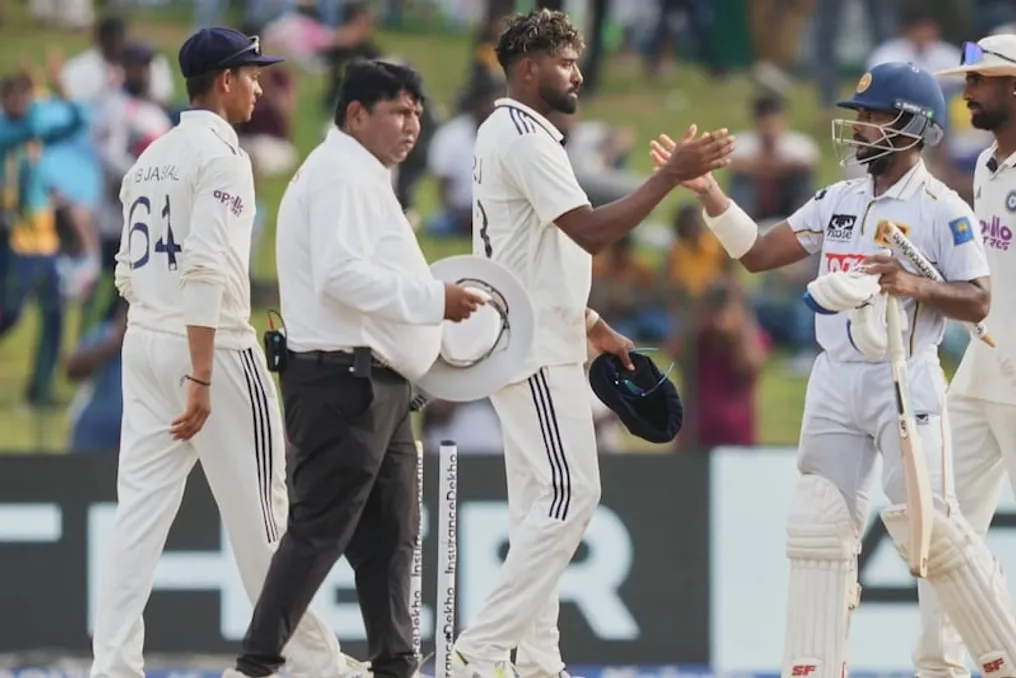
Thanks to this tenacious batting, Sri Lanka declared the second innings with a total of 429/9, giving them a lead of 216 runs. After this, both teams shook hands, and the match was declared a draw.

Sri Lanka started the fifth day with a score of 229/6, holding only a slight advantage of 16 runs. It seemed that the Indian bowlers would soon finish the game. However, Dinusha and Kesara Nuwanda completely changed the course of events. They added 112 runs off 246 balls, during which Sri Lanka went through the first session without losing any wicket. Dinusha completed his century after 196 balls, starting to undermine India's hopes of victory.

After the lunch break, the first successful attack against India was made by Manav Sutara, who dismissed Nuwanda, and Dhruv Jurel caught a fine catch in the slap zone. Then Dinusha added 25 runs along with Prabath Jayasuriya. Ravindra Jadeja dismissed Jayasuriya when Jurel caught him in the second slap zone.

Even the lower-order batsmen did not give up hope. India thought victory was close, but Dinusha gained another determined partner—Lahiru Kumar. Together they added 47 runs off 170 balls for the eighth wicket. Kumar troubled the Indian bowlers, scoring 12 runs off 90 balls. Jadeja eventually sent Kumar to the pavilion, but Asitha Fernando did not leave Dinusha. Dinusha finished the game without being dismissed with 133 runs, securing safety for Sri Lanka.

There is an inherent appeal to Dinusha's game. His preferred shots are drives and pulls, but on the fifth day, what he needed was not beauty, but sheer defense. He skillfully neutralized the spin bowlers by retreating backward and held his ground well behind the ball against fast bowlers.

India also put in effort. They tried to keep Dinusha away from the strike using short and leg-side deliveries to bring the lower-order batsmen onto the field against spinners. This tactic worked partially, but Nuwanda and Kumar showed restraint instead of playing aggressively.

Fast bowler Mohammed Siraj could not inject the necessary sharpness into Dinusha's game. Captain Shubman Gill also did not exert much influence at the moment when the game slipped away from India. At one point, he even headed to the dressing room to consult with the coaching staff.

However, by that time, Dinusha and the lower-order batsmen of Sri Lanka managed to slow down the onslaught of the Indian bowling.

A positive aspect for India was that it was conducting its first Test series on foreign soil after defeating West Indies in July 2023. This was also its first win in a foreign Test series under Shubman Gill's captaincy. But the fifth day in Colombo left many questions for the Indian team, despite the series win. The inability to quickly dismiss four wickets in the lower order will cost them dearly. Although the team can cite the pitch weakness on the fifth day and the need to bowl across two innings, internally the team realizes that the old weakness in Test cricket—the inability to quickly get rid of lower-order batsmen—is still not fully addressed.

For Sri Lanka, this draw felt like a victory, and its hero was Sonal Dinusha, who created a wall between India and defeat that no Indian bowler could ultimately overcome.

Despite the victory in Galle, India must avoid mistakes in the remaining eight tests to maintain chances in the WTC
Read more
www.aajtak.in

Despite the victory in Galle, India must avoid mistakes in the remaining eight tests to maintain chances in the WTC

India defeated Sri Lanka in the first match of the two-match series in Galle, winning by a margin of 165 runs, thereby increasing its score to 1-0. Before this victory, the Indian team held fifth place in the World Test Championship (WTC) 2025-27 table, with 48.15% of points after 9 matches.

After the win in the Galle match, the Indian team's percentage of points rose to 53.33%, but it still holds fifth place. The second and final match of this series is scheduled for August 23 at the SSC ground in Colombo. India aims to win this series 2-0.

In the WTC standings, India is still behind Bangladesh, which is in fourth place with 66.67% of points after 5 matches, having secured 3 wins. India has 8 test matches left to play, but the probability of making a mistake is extremely low.

If the Indian team wins all remaining matches, its percentage of points will reach 74.07%, which could almost guarantee it a spot in the WTC final. However, even a single defeat could drastically change the entire situation.

With one loss, India's percentage of points will drop to 68.52%; with two losses, it will fall to 62.96%; and after three losses, it will be 57.41%. If India wins 5 out of 8 matches and draws 2, its PCT will be 61.11%.

After the visit to Sri Lanka, the Indian team will travel to New Zealand, where it is set to play two test matches. This tour does not promise to be easy, as New Zealand has previously presented serious challenges to India.

Subsequently, the Indian team will participate in the Border-Gavaskar Trophy between India and Australia, which will last for five matches. Australia also poses a serious threat to India, so these matches cannot be considered simple either. An Indian victory over Australia with a score of 4-1 or 3-1 would put the team in a very strong position.

Currently, Australia leads the table with 77.78% of points, while South Africa has 75%, New Zealand has 72.22%, and Bangladesh has 66.67%, ahead of India. Therefore, India needs not only to win its matches but also to monitor the results of other teams. In the WTC, 12 points are awarded for every test victory, 4 for a draw, and zero for a loss, meaning that every defeat has a significant impact on the percentage of points.

Sri Lanka team faces three problems after defeat to India, including player injuries
Read more
www.aajtak.in

Sri Lanka team faces three problems after defeat to India, including player injuries

Following a heavy defeat to India in the Galle match, the Sri Lankan team is facing serious difficulties. To level the series, the team needs to win the second Test match. Otherwise, if there is a draw or another loss, India will secure the series victory.

The second match is scheduled for August 23 and will take place at the Singlish Sports Club stadium in Colombo. Before this match, the problems of the Sri Lankan team have worsened even further.

Kusala Mendis and Dinesh Chandimal are out of the squad for the second Test, and the participation of Pathum Nissanka remains uncertain. The head coach of the Sri Lankan team, Gary Kirsten, provided updated information on player injuries after the Galle match. He specified that Kusala Mendis' hamstring injury is serious, and he will not be able to participate in the games for now.

Gary Kirsten stated: 'Kusala Mendis has suffered a serious hamstring injury. He will be unavailable for some time.'

The biggest blow for Sri Lanka was the absence of Dinesh Chandimal. During the Galle match, he sustained a neck and shoulder injury while fielding. He was replaced by Pasindu Suriyabandara, who came on as a substitute with a concussion, but was removed from the game after the first ball without scoring any runs.

Furthermore, Pathum Nissanka is recovering from wrist surgery. According to Kirsten's statement, he also will not be able to play in the next Test. Consequently, Sri Lanka will have to make significant changes to its main squad. Niroshan Dickvella was included in the Test team in place of Kusala Mendis, who took advantage of the opportunity in Galle and scored 80 runs in the first half of the match.

Kirsten noted that Sri Lanka's starting lineup was the main weakness in Galle. In the first half of the match, the team lost five players, having only 99 runs. Nevertheless, thanks to the fight from the lower and middle order players, the hosts managed to extend the game to the fifth day. Kirsten admitted that the failures of the starting lineup in both halves of the match worked against the team, but he also highlighted the positive aspect of the players' fight under difficult conditions.

Sri Lanka has lost its last two Tests. In June, the team lost to West Indies in North Sound by 217 runs and one innings. Now they face a heavy defeat to India. Gary Kirsten believes that the team is gradually adapting to the demands of this format through regular Test matches. He also thinks that the absence of experienced batsmen could be a good opportunity for young players who consistently score runs in domestic cricket. Before the match in Colombo, the main task for the Sri Lankan management is to form a strong batting lineup. The absence of key batsmen has significantly increased the pressure on the opposing team, India, as the series is at stake.

Popular