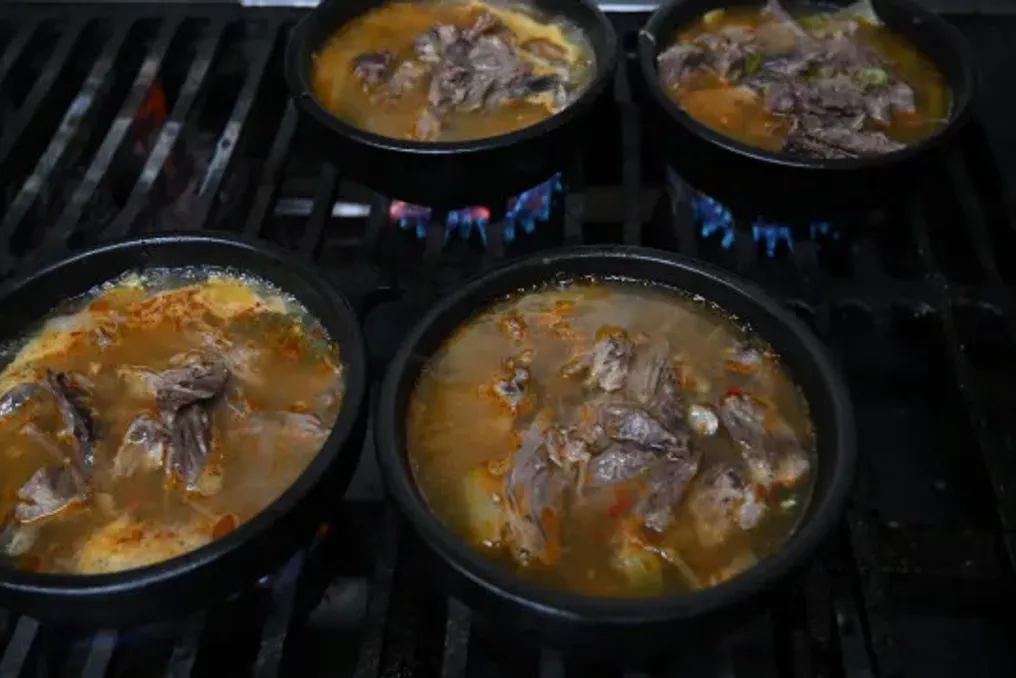
The practice of consuming dog meat soup, a tradition recorded since the Joseon Dynasty (1392-1910), will come to an end in February of next year. This deadline marks the end of the tolerance period established by the law approved in 2024, which aims to prohibit the breeding, slaughter, distribution, or sale of dogs intended for meat consumption.
The new legislation provides for severe penalties for anyone who slaughters a dog for consumption purposes, potentially facing up to three years in prison or a fine of up to 30 million won, equivalent to approximately 19 thousand euros.
The consumption of soups such as 'bosintang,' which literally means 'nourishing soup for the body,' is historically linked to 'boknal,' the three days considered the peak of heat in Korean summer. However, the commercial decline of this practice is noticeable in the 'bosintang' alley of the Sinjin market, located in downtown Seoul, where only two establishments remain.
Lee, an elderly restaurant owner, expressed her difficulty with the imminent change, stating: 'It is clear that it is difficult. Next year, I will no longer be able to continue a business I have dedicated myself to for over 40 years. How can I know if another business will succeed or not?' She also questioned South Korean policy, asking: 'What kind of policy is this in South Korea, that next year will take away citizens' livelihoods? What country prohibits a food by law? Then why are cows, pigs, or chickens slaughtered for consumption?'
Data provided by the South Korean Food and Drug Administration indicates that, after the legislation was approved in 2024, 2,352 restaurants across the country serving dog meat dishes were identified. Of these, 1,902 announced their intention to change their menu or switch business lines, while 450 opted to close their operations.
The atmosphere of apprehension regarding dog meat consumption is palpable in the capital's market. The two customers present in the restaurants refused to allow photos of the dishes, and the owners explicitly requested that the customers' faces not be exposed.
Animal rights movements have long denounced the poor conditions found in clandestine kennels, which operate under uncertain regulations. In these locations, animals are confined in small wire cages, exposed to extremes of cold and heat, and suffer from untreated wounds or infections.
A report from the Ministry of Agriculture revealed that, in May, 272 clandestine kennels remained, representing an 82% reduction compared to the 1,537 registered in 2014. Despite this, Lee Sang-kyung, a representative of the NGO Humane World for Animals Korea, warned that the conditions in the intensive farming of remaining dogs remain deplorable.
The activist added that the dogs on these farms continue to suffer from 'skin diseases, eye problems, malnutrition, and paw deformities,' and the bitches continue to give birth to puppies who will face 'a miserable life,' even with the industry's decline.
According to government data cited in March by the local newspaper Bridge Economy, of the 393,857 dogs accounted for in closed facilities, nearly 97% were sent to slaughterhouses. Lee criticized the authorities, stating: 'Government statistics show, unsurprisingly, that the majority of dogs in the facilities during the three-year gradual deactivation period were sent for slaughter,' and pointed out the lack of solutions for 'rescue, rehabilitation, or adoption.'