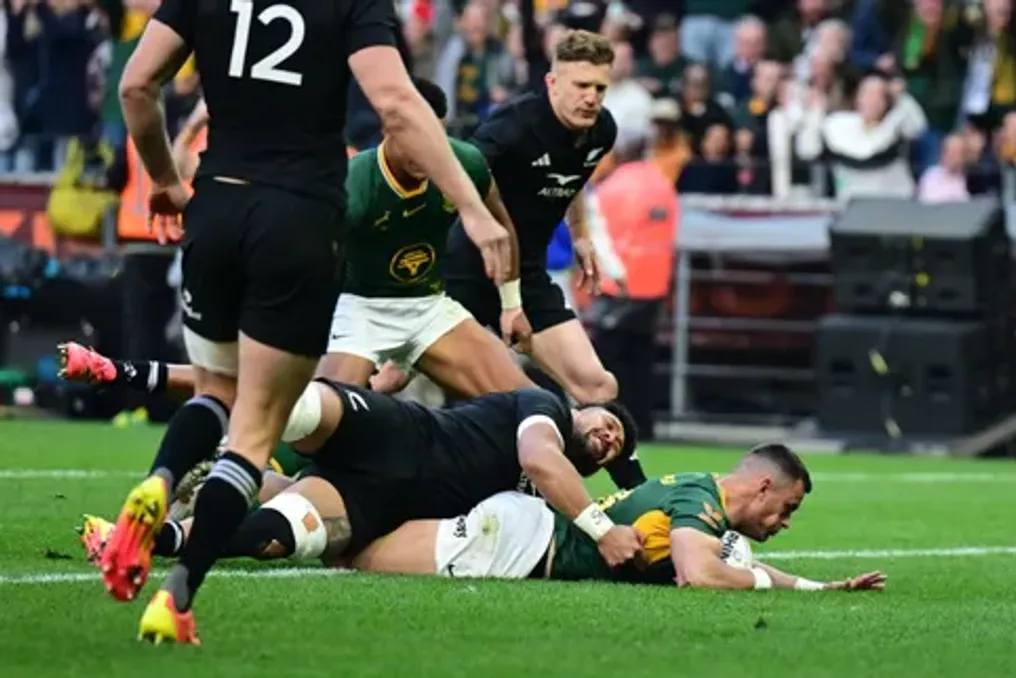
Rassie Erasmus's tactics and Cheslin Kolbe's mastery helped Springboks defeat All Blacks
Read more
IOL
iol.co.za

Rassie Erasmus's tactics and Cheslin Kolbe's mastery helped Springboks defeat All Blacks

The Springboks resumed their campaign in the rivalry dubbed 'The Greatest Rugby Rivalry' in an exciting match at the DHL Stadium. They secured a convincing 33–26 victory over the All Blacks, leveling the four-match series at 1–1.

Recovering from a disappointing loss in Ellis Park, South Africa combined early physical intensity with refined tactical ingenuity to take control of the game from the visitors. This set the stage for the third test in Soweto.

This review presents five key moments from the memorable evening in Cape Town, including bold coaching decisions and individual outstanding performances.

Siya Kolisi's return restored attacking dominance

Siya Kolisi's return to the defensive line provided the Springboks with the necessary physical power and authority in the tackle contest in attack that they lacked in Ellis Park. His presence allowed them to neutralize New Zealand's destabilizing tactics, giving the hosts cleaner ball and a much stronger foundation.

The flanker captain demonstrated his impact by scoring the decisive try shortly before halftime, confirming that his leadership qualities and work rate are absolutely indispensable in high-stakes matches.

Rassie Erasmus's genius front-line plan

Rassie Erasmus once again demonstrated a masterful coaching move by starting the game with Deon Fourie, Gerhard Steenkamp, and Thomas du Toit to absorb the initial onslaught from the opposition. Then, in the 35th minute, he made the bold decision to bring Malcolm Marx and Ox Nche on before halftime. This gamble paid immediate dividends as the fresh, world-renowned pair won a penalty scrum inside the All Blacks' 22-meter zone, directly leading to Kolisi's try and decisively changing the momentum before the break.

Cheslin Kolbe's flawless kicking proved decisive

In a classic test match decided by narrow margins, Cheslin Kolbe's metronomic accuracy in goal-kicking became the determining factor. Playing as the primary goal-kicker playmaker, the winger proved to be man of the match, scoring three conversions and four penalties, totaling 18 points. His perfect percentage allowed the Springboks to punish New Zealand's errors and maintain the scoreline, reducing the significance of Handre Pollard's late absence.

Springbok defense was exposed in the wide areas

The experienced combination of centers Jesse Kriel and Damian de Allende showed immense strength, each scoring a crucial try in the first half. However, their play was not flawless. These two Springboks players conceded two tackles from Will Jordan, leading to an All Blacks attempt. The visitors enjoyed themselves on the flanks, overcoming the Bok defense's pressure and scoring points.

Slow start doomed resilient All Blacks

For the second week in a row, the pace of the game was dictated by an early start, but this time New Zealand found themselves trailing. A conceded try in the first two minutes forced the visitors into a chasing mode in Cape Town. Although goals in the second half from Leroy Carter and Ardie Savea demonstrated their relentless fighting spirit, the All Blacks ultimately set too high a bar against the determined defense of the Springboks.
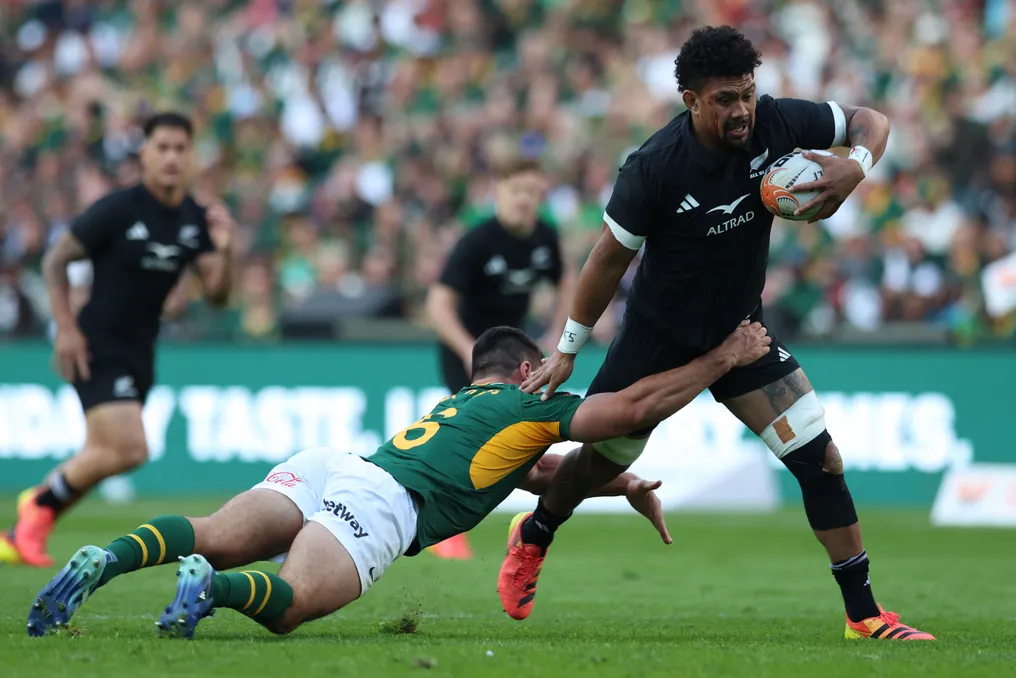

Similar stories

Website Access Blocked by Security System
Read more
www.dailymaverick.co.za

Website Access Blocked by Security System

The website uses a security service to protect against cyberattacks. The action you performed triggered this protective system.

There are several actions that can lead to such a block, including entering a specific word or phrase, executing an SQL command, or submitting incorrect data.

Users are advised to contact the website owner to report the block. When contacting them, they should specify what actions were being performed when this page appeared, and also provide the Cloudflare Ray ID, which is located at the bottom of the page.

Rassie Erasmus: The series of matches between the Springboks and All Blacks is a marathon, but the Springboks aim to land the first blow
Read more
iol.co.za

Rassie Erasmus: The series of matches between the Springboks and All Blacks is a marathon, but the Springboks aim to land the first blow

Rassie Erasmus admitted to feeling nervous ahead of the upcoming clash between the Springboks and the All Blacks, but emphasized that both teams will play at their maximum capacity at Ellis Park stadium.

Before the start of the first test match in this greatest rugby rivalry, Erasmus stated that the Boks team does not intend to slow down, even knowing that the series in Johannesburg will not be decided by a single match. He noted that no member of the management, players, coaching staff, physiotherapist, or medical staff wishes to lose the first match, so they will certainly put forth all their efforts to win.

Nevertheless, the Boks coach understands that a defeat at the beginning of the series is not fatal. Previously, the Boks lost the first match of the British and Irish Lions series in 2021, but then won the next two. They also recovered from a loss to New Zealand in the group stage of the 2019 World Cup to win the Webb Ellis Cup. A similar situation occurred in the 2023 World Cup when they lost a group match against Ireland.

Erasmus predicts that the fate of the entire series will only be determined in the third match. He suggested that one could lose the first match and win the next two, or lose the first and win the second, and the third match might not be decisive, with the fourth match in Baltimore becoming the deciding factor. He added that there will always be time to return to the series, but winning the first match is always preferable, and both teams will fight for it with full power.

Furthermore, Erasmus realizes that this test match is only the beginning of a physically demanding campaign, and believes that player management could be a decisive factor. The Boks deliberately kept their players in better condition compared to their New Zealand counterparts during preparation. Over the last six weeks, New Zealand averaged 200 minutes per player, while the Boks used about 130 minutes per player. He stressed that players' form cannot be judged by matches played before this period, as they do not reflect current readiness for play, and that the main focus is on maintaining squad freshness.

Erasmus expects injuries to play a significant role as the series progresses. He is one hundred percent sure that by the third round, which could be the most important, there will be another six or seven injuries in each camp. This is why managing player playing time is of enormous importance.

Despite the series being a marathon, Erasmus knows the psychological value of an early advantage. He stated that if they manage to strike the first blow in the first match, it will be a huge achievement.

The Boks coach was also asked whether the All Blacks are the team South Africa most wants to beat in world rugby. His answer reflected both the history between the two countries and his personal experience of feeling underestimated when the Boks were recovering. Erasmus assured that he would answer honestly, as he always tries to respect other countries. He recalled times when the Boks were ranked sixth in the world, and the All Blacks, England, and Ireland only discussed major world teams, which caused unpleasant feelings.

However, he did not hide what the rivalry with the All Blacks means to him, nor the pressure it creates. Erasmus admitted that the preparation is not without nervousness: 'If I say that this preparation is not causing nervousness, I will be lying. Sitting here, I am nervous. I am not going to pretend that I am not nervous. The team is nervous. I think the fans are nervous too. But I am almost sure that on the other side it is the same. We can look calm, we can say that we are completely in control of the situation, but no, it is colossal.' In this rivalry, which needs no exaggeration, Erasmus agreed that the Springbok versus All Black match is at the very top of the rugby hierarchy. He concluded that if it is not the greatest rivalry, it is only slightly below that title, and it is a very emotional and proud thing to be part of it.

Team Lineups for Ellis Park:

The Springboks squad includes: 15 Damian Willemse, 14 Cheslin Kolbe, 13 Jesse Kriel, 12 Damian de Allende, 11 Kurt-Lee Arendse, 10 Sasha Feynberg-Mngomezulu, 9 Grant Williams, 8 Jasper Wiese, 7 Pieter-Steph du Toit (captain), 6 Paul de Villiers, 5 Juan Nortje, 4 Eben Etzebeth, 3 Wilko Lou, 2 Malcolm Marx, 1 Ox Nche. Reserves: 16 Jan-Hendrik Vessels, 17 Gerhard Steenkamp, 18 Zachary Porten, 19 Kobus Wiese, 20 Andre Estherhoizen, 21 Marco van Staden, 22 Kobus Reinhans, 23 Mani Libbok.

The All Blacks squad includes: 15 Damian McKenzie, 14 Will Jordan, 13 Quinn Tupaea, 12 Jordie Barrett, 11 Josh Murphy, 10 Ruben Law, 9 Cam Roigard, 8 Ardie Savea (captain), 7 Luke Jakobson, 6 Tupou Va'a, 5 Fabian Holland, 4 Josh Lord, 3 Tyrel Lomax, 2 Cody Taylor, 1 Ethan de Groot. Reserves: 16 Asafu Amua, 17 George Bower, 18 Fletcher Newell, 19 Anton Segner, 20 Peter Lakai, 21 Kyle Preston, 22 Anton Lienert-Brown, 23 Leroy Carter.

Springboks vs. All Blacks rivalry remains the greatest in rugby after 105 years
Read more
iol.co.za

Springboks vs. All Blacks rivalry remains the greatest in rugby after 105 years

After 105 years, the rivalry between the Springboks and the All Blacks continues to be considered the most significant in world rugby. When the 'Greatest Rugby Rivalry' tour between New Zealand and South Africa was first announced, some critics dismissed the title as arrogant. However, it is difficult to surpass the unending drama that has existed between these two teams for over a century.

Although there are long-standing and exciting confrontations, such as England versus France or New Zealand versus Australia, the uniqueness of the All Blacks and Springboks matches lies in the fact that since their first meeting in 1921, both teams have regularly competed for the title of world champion—first unofficially, and then officially.

History of the Rivalry

When the Springboks first visited New Zealand in 1921, the series of three matches ended with one win and one draw. Since then, both teams have consistently been among the world's best, often occupying the No. 1 or No. 2 positions in world rankings. As early as 1928, series in South Africa were positioned as a contest to determine the best team in the world. This was true in subsequent series in 1937, 1949, 1956, 1960, 1965, 1970, 1976, and 1981. Even the Cavaliers sporting tour from New Zealand to South Africa in 1986 pitted the two strongest teams in the world against each other.

After South Africa emerged from international isolation in 1992, the countries played 37 matches since 1921. The Springboks won 20, the All Blacks won 15, with two draws. Then came the era of the World Cup, which began in 1987 and was created to determine the best rugby team on the planet.

The All Blacks won the first World Cup, but the Springboks did not participate due to South Africa's sporting isolation. When the Boks finally entered the tournament in 1995, they won the Webb Ellis Cup in their first appearance. Over the past 10 World Cups since 1987, Australia has won twice, England once, and the remaining titles have been shared by the Springboks (four) and the All Blacks (three).

Recent Dynamics of the Rivalry

There were only one or two periods when the balance of power in this rivalry could be reasonably questioned. Between 2001 and 2006, New Zealand defeated South Africa eight times in a row. Later, in 2016 and 2017, the All Blacks scored 57 points against the Boks twice. However, after Rassie Erasmus started working with the Springboks, the balance of power changed drastically. South Africa won five of the last six encounters, including the epic 2023 World Cup final in Paris. And in the latest match in 2025, the rugby world was stunned by how the Springboks defeated the All Blacks 43–10 on home soil in Wellington.

Interestingly, throughout the entire 105-year history of this confrontation, New Zealand traditionally held an advantage when visiting South Africa. However, the situation is changing this year. For the first time, the Springboks are playing a series against the All Blacks at home as clear favorites, expecting four matches as part of the 'Greatest Rugby Rivalry' tour.

Preparation for the first match at Ellis Park next Saturday, August 22nd, promises to be thrilling. Questions arise: can the tight five of the All Blacks withstand the fierce physical power of the Springboks? Does New Zealand possess sufficient squad depth to remain competitive over four matches, especially considering expected injuries? Can the All Blacks find a way to overcome the suffocating defensive system of the Boks? And can South Africa cope with the high-tempo attack presented by New Zealand's athletic backline?

These questions will soon receive answers. The opening chapter of a new era is set to be written into the folklore of a rivalry that has defined the highest standards of international rugby for over a century. Calling it arrogance is your right. But the history of 105 years proves that the title of 'Greatest Rugby Rivalry' between the Springboks and All Blacks is deserved.

Popular