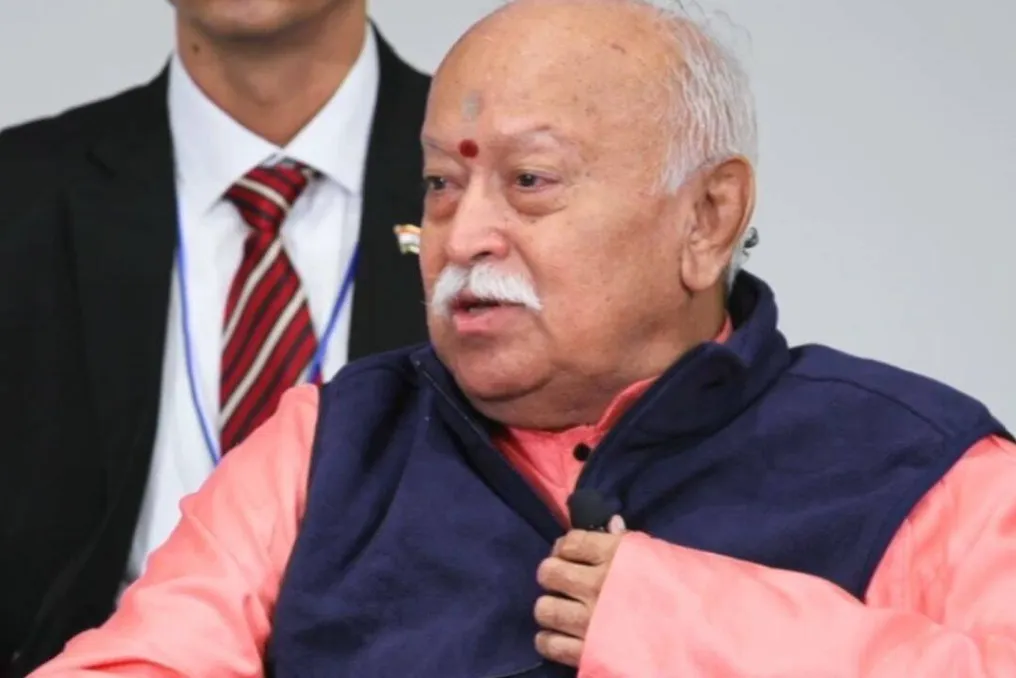
Mohan Bhagwat states that excluding Muslims contradicts Hindu thought
Read more
The times of India
timesofindia.indiatimes.com

Mohan Bhagwat states that excluding Muslims contradicts Hindu thought

RSS chief Mohan Bhagwat delivered a speech on Saturday at Madison Square Garden, emphasizing the inclusivity of Hinduism and the societal changes being initiated. He stated that an Indian who wishes to see India without Muslims 'will no longer be Hindu.'

Bhagwat asserted that public opinion, rather than political power, should be the starting point for long-term transformations. He stressed that Hindu thought implies recognizing that different paths can lead to the same truth, and that every individual possesses equal dignity.

Similar stories

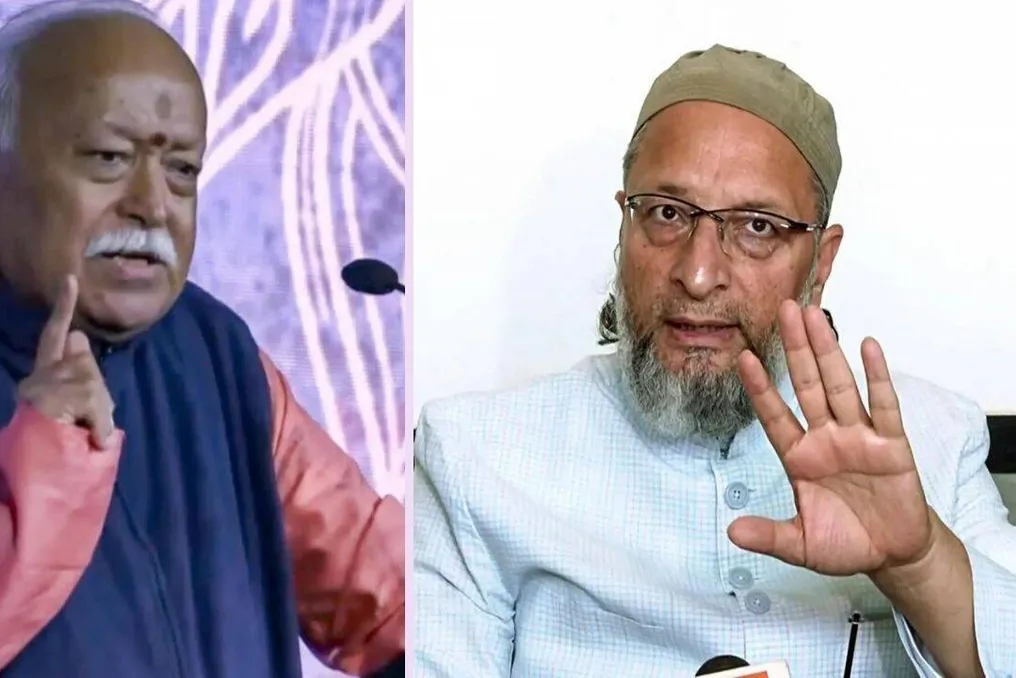
Asaduddin Owaisi criticizes Mohan Bhagwat over statements on Hindu-Muslim unity
Read more
timesofindia.indiatimes.com

Asaduddin Owaisi criticizes Mohan Bhagwat over statements on Hindu-Muslim unity

AIMIM President Asaduddin Owaisi criticized RSS chief Mohan Bhagwat on Sunday regarding his statements about the unity of Hindus and Muslims. Owaisi asserted that the RSS presents one image to the world, while the works of its key thinkers reflect a different perspective on minorities.

These remarks by Owaisi came a day after Bhagwat stated at an event in New York that a Hindu who believes Muslims should not live in India would no longer be considered a Hindu.

Responding to these words, Owaisi stated: 'This is the oldest trick in the RSS arsenal: some words are intended for the world, and others for its own members. The RSS has never distanced itself from its key thinkers and authors. What do they say about Muslims and other minorities?'

The AIMIM chief also referenced the biography of RSS founder K. Hedgewar, published by the RSS itself, to show that Hedgewar opposed the Congress's emphasis on Hindu-Muslim unity. Quoting this biography, Owaisi noted: 'Gandhiji constantly worked with the aim of Hindu-Muslim unity... But Doctorji felt danger in this step. In fact, he did not even welcome the fashionable slogan of 'Hindu-Muslim Unity'. '

Furthermore, the AIMIM chief mentioned the works of former RSS chief M.S. Golwalkar, referencing his book 'Bunch of Thoughts' and a chapter titled 'Internal Threats.' Owaisi stated: 'In Golwalkar's 'Bunch of Thoughts,' there is a long chapter called 'Internal Threats,' in which Muslim and Christian citizens of India are described as threats number one and number two, respectively.'

He also mentioned Golwalkar's statement that the Sangh 'is inspired by one flag (saffron), one leader, and one ideology.' Owaisi accused the RSS of having no contribution to the fight for India's freedom and claimed that Hedgewar left the Congress due to disagreement with the participation of various religious communities in the anti-British movement led by Mahatma Gandhi.

Owaisi also raised the issue of the 2002 Gujarat riots, criticizing the RSS and asking: 'Should we forget what happened to the Muslims of Gujarat under the proxy rule of the RSS?' He argued that Muslims and Christians continue to face discrimination, and Muslims are subjected to Hindu law under the pretext of a Uniform Civil Code, while Christians become targets due to 'draconian' anti-conversion laws.

The AIMIM chief also expressed concern over the alleged misuse of laws such as the Unlawful Activities Prevention Act (UAPA).

Earlier, on Saturday, speaking at the 'One World—One Humanity' event in New York, Bhagwat stated that different religions can follow their own paths, but humanity and truth remain united. He emphasized: 'We come from a society that believes in the unity of humanity.'

He added: 'If any Hindu believes that a Muslim should not be in Bharat, he will not remain a Hindu. If you want to call yourself a Hindu, you must believe that all paths lead to one goal, and that every person has dignity. There are no differences between people.'

Bhagwat also used this opportunity to discuss the perception of the RSS. He noted that the organization is often viewed through narratives that, in his opinion, do not reflect its ground-level work. He added: 'There are many perceptions created by erroneous narratives. But when you come and see us from the inside, all of this will be refuted in a day.'

The RSS chief was in New York as part of a tripartite global tour covering the USA, Canada, and the UK. This trip was organized to mark the centenary of the organization following invitations from local foreign organizations.

Mohan Bhagwat states that any Hindu who believes Muslims should not be in India is not a Hindu
Read more
timesofindia.indiatimes.com

Mohan Bhagwat states that any Hindu who believes Muslims should not be in India is not a Hindu

The head of the RSS, Mohan Bhagwat, stated on Saturday that Hinduism believes in the unity of humanity, emphasizing: 'If any Hindu believes that there should be no Muslims in India, then he is not a Hindu.'

Speaking at the 'One World, One Humanity' event in New York, Bhagwat noted that different religions can follow their own paths, but humanity and truth remain unified.

The RSS chief reiterated his point, stating: 'We come from a society that believes humanity is one. If any Hindu believes that there should be no Muslims in India, then he is not a Hindu...' He added that to call oneself a Hindu, a person must believe that all paths lead to one goal, and that every person possesses dignity, without allowing distinctions between people.

Bhagwat emphasized the need to protect diversity while simultaneously stressing the importance of unity. He said that 'Diversity must be protected because it is the law of nature, and unity is a universal truth.'

Stressing that he is not a religious scholar or authority, Bhagwat explained that he works in a society that traditionally asserts that religions can differ, but humanity is one, and the truth is singular, and humanity is a product of this truth. Thus, humanity is one.

He also noted that although the truth is one, it can be described in different ways depending on a person's perception. 'This truth is one truth, but it is described in many ways depending on who describes it. Because as humans, we are prisoners of programs created in our heads,' he observed.

Bhagwat continued that there are many religions, and in the modern world, they are largely defined by rituals. He added that adherence to religious discipline and understanding this path to divinity requires the discipline of rituals themselves.

The event was organized by the American organization American Hindus for Engagement and Dialogue (AHEAD) and was titled 'a landmark gathering in honor of Raksha Bandhan.' The organization stated that the event carries an eternal and universal message: 'The world is one family.' It calls on people to look beyond artificial divisions and differences, recognize the bonds that unite humanity, and embrace the spirit of mutual respect, harmony, and unity.

The program included cultural performances and keynote speeches dedicated to universal unity and the Hindu philosophy of 'Vasudhaiva Kutumbakam,' which means 'the world is one family.'

Bhagwat arrived in the USA earlier this week as part of a global outreach program conducted by the RSS in celebration of the organization's centenary, which also includes visits to Canada and the United Kingdom. During his visit, he met with representatives of the Indian diaspora, Indo-American businessmen, and public figures.

Before his speech at Madison Square Garden, images of Bhagwat were displayed on billboards in Times Square in New York with the inscription 'Resolve, Harmony, and Dialogue.' Bhagwat also visited the Bhakti Center and the ISKCON temple in New York. At the temple, he participated in a food distribution initiative for the homeless and spoke about the role of Krishna consciousness in resolving conflicts and divisions. Previously, the RSS announced that the event at Madison Square Garden was organized in the spirit of open dialogue and invited 'anyone interested' in learning more about the organization to participate.
Inspector Durga Shakti Nagpal's complaint against Judge Shabina Khan: High Court deems incident administrative interference
Read more
www.aajtak.in

Inspector Durga Shakti Nagpal's complaint against Judge Shabina Khan: High Court deems incident administrative interference

A dispute has arisen between the Commissioner of Devipatan District, Durga Shakti Nagpal, and the Senior Civil Judge, Gonda Shabina Khan, concerning a long-standing land case. Commissioner Nagpal is accused of attempting to pressure Civil Judge Shabina Khan through phone calls, as well as making inappropriate remarks and abusing official authority.

As a result of these events, the Allahabad High Court bench recognized the matter as subject to consideration for criminal contempt of court via the judgment of Judge Saied Kamar Hasan Rizvi and ordered that necessary directions be sought from the Chief and Senior Judges.

Conflict over 30-year-old land case

This conflict relates to the case of 'Jyoti Vidya Mandir versus Municipal Council' in Gonda city, which has been pending in court since 1997. The core of the case involves valuable government land (Nazul) on which a private school continues to operate despite its patent being annulled in 1985.

While the civil judge Shabina Khan was hearing the stay of this suit, on August 4, 2026, Civil Judge Shabina Khan sent a letter to the District Judge of Gonda, leveling serious accusations against Commissioner Durga Shakti Nagpal for exerting undue pressure.

Details of phone calls and the dispute

According to Judge Shabina Khan, on July 15, 2026, she received a call from an unknown number, answered by her seven-year-old son. The calling woman requested personal information from the child. During a subsequent call, the conversation took place directly with Commissioner Durga Shakti Nagpal, who asked about her vacation and the ongoing court case. When the dispute escalated, the commissioner's secretary contacted the court, leading to a heated dialogue.

The judge claims that the commissioner questioned her manners, threatened to file a complaint, and used the influence of her position. In response to the escalation, Commissioner Durga Shakti Nagpal issued an official statement. She stated that her objective was merely to preserve government land and ascertain the position regarding the effective handling of the case. She emphasized that no merits or demerits of the case were discussed over the phone, nor were any decisions or names mentioned. She only clarified information regarding the presiding judge's return from leave. Furthermore, the commissioner's office refuted the mention of '27 years of service' in the letter, stating that they fully respect the independence and dignity of the judicial system.

Strict stance of the High Court and next steps

After reviewing the letters and facts from both sides, the Lucknow Bench of the High Court adopted a strict stance. Citing previous Supreme Court rulings, the court ruled that the entire situation constitutes administrative interference in the functioning of the court. Consequently, due to this strict action taken by the High Court, the case is being referred to the relevant committee on criminal contempt of court before the Chief Judge for further directions, which has complicated the commissioner's legal difficulties.

According to reports, the first call came at 13:26, which was answered by the judge's seven-year-old son. The calling woman asked about the judge and requested her name, age, and information about siblings, but refused to give her own name. During the second call, which occurred at 14:32, Durga Shakti Nagpal introduced herself and asked to speak with the judge about her vacation and the current court case. The judge hung up due to suspicion of a fake call. After contact through the secretary, the commissioner stated that the judge lacked tact when speaking with a high-ranking official and mentioned filing a complaint with the High Court, thereby questioning the judge's conduct and official status. The judge replied that she was not obligated to provide vacation information or discuss the case over the phone because lawyers were present for the state party. In response, the commissioner suggested transferring the case.

Popular