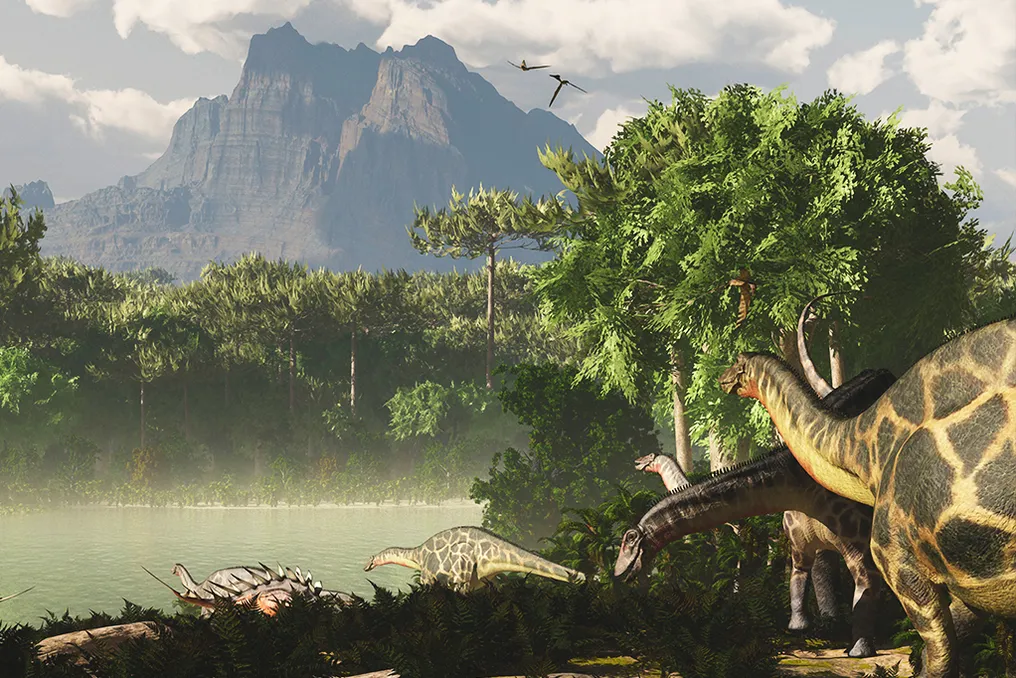
The combination of advanced technology and fossil evidence allows scientists to reconstruct with great accuracy how and where creatures from millions of years ago lived, although the soundtrack of this period remains a mystery.
Unlike what is portrayed in cinema, science cannot precisely determine the noises emitted by animals such as dinosaurs. For example, the famous roar of the Tyrannosaurus rex in Jurassic Park (Steven Spielberg, 1993) was created without scientific basis, based only on the slowing down of a dog's bark.
Thirty years later, the American filmmaker sought closer alignment with science. In the Netflix miniseries titled 'The Dinosaurs,' produced by Spielberg, the goal was to go further and attempt to recreate the sounds of the forests of the Jurassic era, which occurred between 145 and 201 million years ago.
Since sound does not fossilize, the adopted strategy was to analyze fossilized wings and use them in experiments with live insects, complemented by computer simulations, to imitate the sounds of Jurassic insects. Using laser technology, researchers were able to measure the vibration, mechanics, and resonance of these wings.
From this, it was concluded that the acoustic environment of that time was 'extremely busy' and reached frequencies so low they would be imperceptible to the human ear. Many of these sounds had a restricted frequency range, which specialists call a pure tone; to the human ear, they would be comparable to sharp and clear whistles, far from the buzzing of current insects.
This sonic characteristic could have helped the species communicate in noisy environments while simultaneously making it difficult for predators to locate their exact position. The findings of these studies were published in the series, in the journal Proceedings of the National Academy of Sciences, and in a specific video.
In the study, researchers examined 20 fossils belonging to nine ancestral species of crickets and katydids (known as 'hopefuls'), which inhabited the same area where Inner Mongolia, China, is located today. This allowed for the reconstruction of a group of animals that shared the same Jurassic ecosystem.
Initially, the team tested its models on contemporary crickets, hopefuls, and close relatives, measuring the vibration of their wings with lasers. Subsequently, these models were applied to fossilized wings, and the results were cross-referenced with the predicted sound frequencies of live insects. Computer simulations helped estimate the flight speed of the extinct insects.
One of these reconstructions may have led to an evolutionary discovery: bats may not be the first animals to use ultrasound communication. In these encounters, animals use high-frequency sound waves, above the limit of human hearing (20,000 Hz), to exchange information. It was precisely this ultrasound communication that was identified in one of the examples from the Jurassic forests.
The researchers indicate a relative of the katydid, Sigmaboilus peregrinu, as the oldest animal to communicate via ultrasound. According to their calculations, this species emitted sounds between 20,000 and 22,000 hertz.
However, the researchers acknowledge limitations in the reconstruction. Although the fossil reveals the tone and basic sound produced by the insect, it does not allow deducing the cadence or rhythm of the sound, elements crucial to the communication of these animals, as this rhythm depends on the nervous system and wing movement, which are not preserved in the fossils.