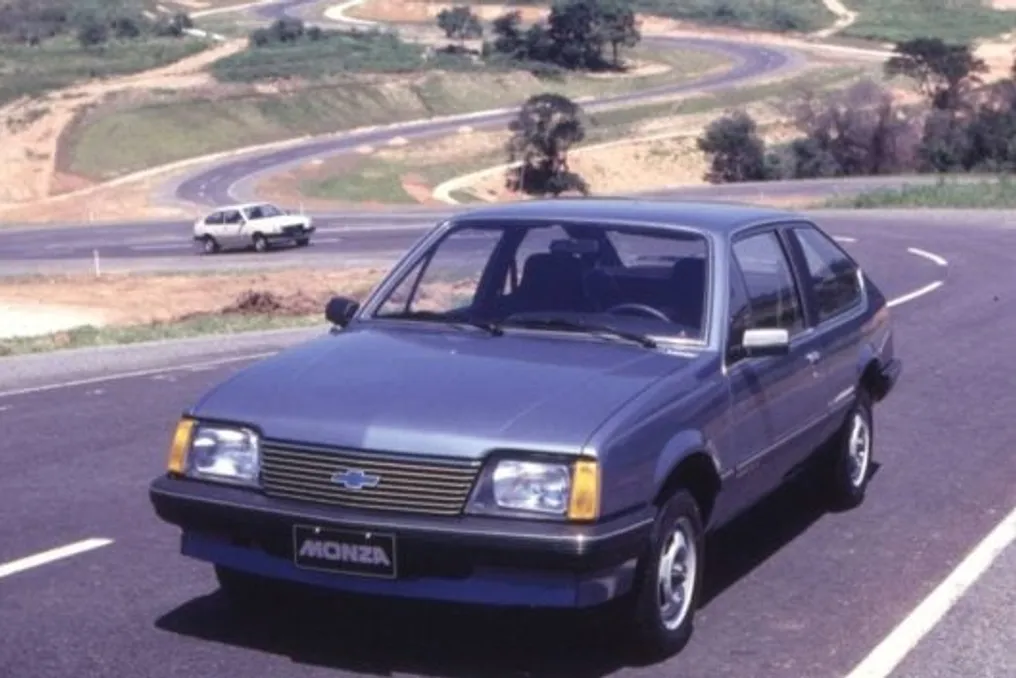
In the early 1980s, the German manufacturer Opel introduced the Ascona C model in Europe in 1981, which was later launched in Brazil in 1982 under the name Chevrolet Monza Hatch. This vehicle featured significant innovations for its time, such as the transverse layout of the engine and transmission, an enveloping instrument panel, and a large trunk with a capacity close to 450 liters, suitable for middle-class families.
The new Monza represented a drastic change from the vehicles produced by General Motors in Brazil up to that point. Previous models, such as Opala, Caravan, Chevette, and Veraneio, used longitudinally mounted engines and rear-wheel drive, following a more conventional design. The Monza, however, adopted a transverse engine, front-wheel drive, and a modern European platform, aligned with global trends of that period.
Initial performance and criticism
However, the launch of the Monza Hatch initially only came with 1.6 engines. The gasoline variant offered about 75 horsepower and 12.8 mkgf of torque, while the alcohol-powered version produced approximately 72 hp. These figures were considered modest for a car weighing over one ton at standstill. In practice, the performance fell short of the expectations generated by the sophisticated appearance and modern proposal of the vehicle.
This limitation forced drivers to demand intense acceleration to achieve minimal responses, which considerably increased fuel consumption and caused dissatisfaction among owners. The core of the problem lay in the inadequacy of the engine for the size and weight of the car, and not necessarily in the robustness of the engine or transmission.
Criticism spread quickly, as consumers noticed the car's difficulty in regaining speed and the strain during trips with cargo. On inclines, especially with passengers and luggage, the performance was even more compromised. Thus, the perception of the Monza 1.6 became that of a modern car, but lacking the performance its design promised.
GM's solution and market shift
Fortunately for General Motors, an alternative was already available: the version equipped with the 1.8 Family II engine, which arrived shortly after. Depending on the configuration and fuel type, this engine achieved power close to 90 hp, along with substantially more torque than the 1.6. The difference in driving experience was noticeable, and the new setup met the vehicle's characteristics much better.
GM quickly realized the mistake of launching the Monza only with the 1.6 engine. The introduction of the 1.8 drastically altered the model's commercial trajectory, causing the Monza to be seen as a comfortable, contemporary automobile with sufficient power for the standard of the time.
Additionally, the hatchback body never fully captured the Brazilian public, despite its practicality. The national market maintained a strong inclination towards sedan models. When the two- and four-door sedan versions were made available, the Monza finally found its niche. Sales soared, and the model established itself as one of the biggest successes in the national automotive industry, dominating the market for much of the 1980s decade.
The Hatch version remained in production until 1986, being gradually discontinued, although it survived for an additional time in the SR sports version. The Monza consolidated its success thanks to the combination of more appropriate mechanics and a body style that resonated much more with the taste of the Brazilian consumer.