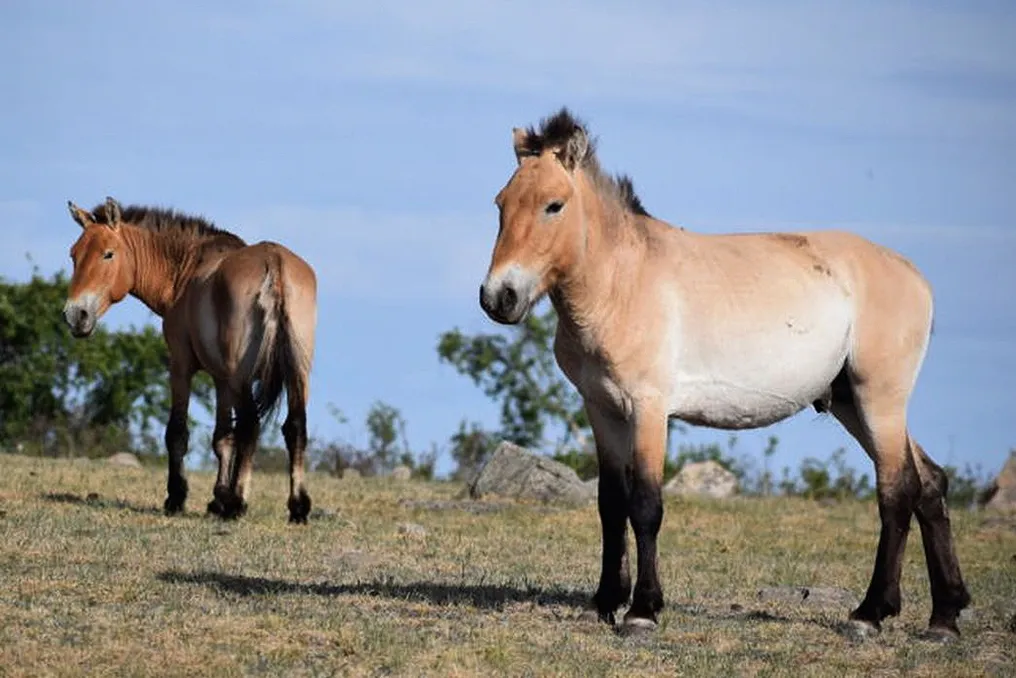
In Khustai National Park, Mongolia, 354 wild Takhi horses graze freely across the hills and steppes. This animal species was nearly extinct in the wild for almost three decades, but it managed to return to Mongolian lands thanks to a restoration project involving local and international researchers.
The horse is one of the main symbols of the country. It can be seen in clothing, soft toys, painted on walls, and in advertising brands. The park director, Tserendeleg Dashpurev, notes that the return of the Takhi to the territory signifies the return of a source of national pride.
Tserendeleg stated that 'Takhi means respect and adoration. It speaks of a free spirit and resistance. These are very special animals for the Mongols' and reported this to the Brazilian Agency.
Internationally known as the Przewalski's horse, this species received its name after Russian researcher Nikolai Przewalski sent samples found in Central Asia to European scientists in the late 19th century.
The Takhi is considered the only truly wild horse that has survived to this day. Other animals called wild horses are actually descendants of domesticated horses that returned to the wild.
Genetically, the Takhi also differs from the domestic horse: it has 66 chromosomes compared to 64 in domesticated animals. It is slightly smaller, has a lighter muzzle, and a less dense tail.
The discovery of this animal by Europeans quickly aroused the interest of collectors and zoos. Between 1897 and 1903, expeditions captured 88 horses in Mongolia. Only 54 of them reached their destination alive, and only 12 were able to reproduce.
Meanwhile, the wild population continued to decline. The last Takhi was sighted in Mongolia in 1968. No further records followed, and the species was declared extinct in the wild. Survival then depended on offspring kept outside their natural habitat.
In the 1970s, an organization founded by Dutch conservationists began a breeding program to reorganize and increase the captive population. The animals were moved to reserves with conditions closer to the wild, and scientists began planning their return to Mongolia in partnership with the Mongolian Association for Nature and Environment Conservation.
On June 5, 1992, 15 horses arrived in Mongolia to begin reintroduction in Khustai. By 2000, five transport operations had delivered 84 animals to the country. Before being released permanently, the horses underwent a period of adaptation in fenced areas.
The director noted: 'They spent several generations in Europe and elsewhere in a much milder climate and practically forgot everything: what snow is, what a wolf is.' He added: 'If they had been released directly into nature, they would not have survived.'
The adaptation process proved successful. The population grew and began to breed freely in the steppes. In addition to more than 300 animals living in the national park, there are two reintroduced populations in other protected areas of Mongolia, increasing the total number in the country to approximately 800 animals.
According to Dashpurev Tserendeleg, this case demonstrates that international cooperation can prevent the complete extinction of a species. The park, established around the reintroduction project, is today home to one of the three populations of this animal in the country.
The director emphasized: 'This is our greatest success. This is what we are very proud of: the Mongolian people and our international colleagues were able to save this large mammal from complete extinction and give it a good future.'
Khustai, covering 50 thousand hectares, is one of Mongolia's smallest national parks. It is managed by a non-governmental organization that does not receive regular government subsidies. About 90% of its income comes from tourism.
The conservation of the Takhi in the coming decades is directly linked to the protection of the steppes, which are increasingly under pressure from climate change and the growing number of domestic animals, putting strain on already degrading soils.
According to the 2025 census of the National Statistics Office, there are currently about 58 million domestic animals in Mongolia. These mainly include sheep, goats, cows, and horses. The excess of animals in certain areas, combined with droughts and extreme winters, leads to pasture degradation.
Land protection and restoration are central themes of the 17th United Nations Conference on Desertification (COP17), which is taking place in Ulaanbaatar, the capital of the country. The event gathers governments to discuss ways to combat desertification, restore degraded lands, and strengthen drought resilience.
Around the park, the strategy involves attempting to create economic alternatives for nomadic families, reducing dependence solely on livestock farming and, consequently, pressure on herd size. The park supports initiatives such as ecotourism, greenhouse farming, and crafts.
Tserendeleg explained: 'If herders have other sources of income, they will not have to increase the number of animals so much.' He added: 'If nature is well protected, the park will also be better protected.'