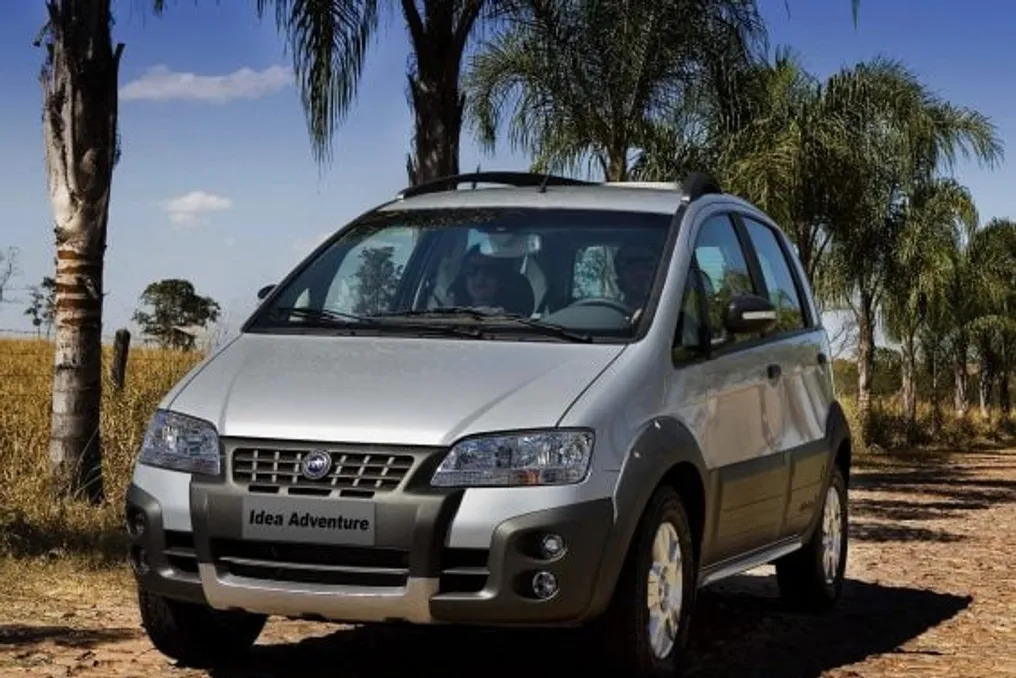
Approximately fifteen years ago, the Brazilian automotive market experienced a period of great popularity for minivans. This trend allowed for the emergence of off-road appeal versions for these family vehicles, such as the Fiat Idea Adventure.
Developed from the platform of the first-generation Palio, this compact minivan was distinguished by its high driving position and optimized interior space. One year after the launch of the Fiat Idea, its Adventure variant appeared, using the same engineering base employed in other models from the Italian automaker.
For those considering purchasing a Fiat Idea Adventure, ten relevant facts about the model have been listed. The Fiat Idea arrived in the national market in 2005, competing directly with the Chevrolet Meriva and offering a more affordable option compared to mid-sized minivans like the Citroën Xsara Picasso, Chevrolet Zafira, and Renault Scénic.
Initially, the minivan was offered with 1.4 Fire and 1.8 engines (the latter being GM-sourced). In 2006, Fiat introduced the Idea Adventure exclusively with the larger displacement engine. In 2009, the minivan began offering the Dualogic automated transmission option, which has generated various criticisms to this day.
The vehicle received an aesthetic overhaul in 2010, when new versions and the 1.6 and 1.8 E.torQ engines were introduced. Minor grille adjustments occurred in 2014, but production ended in Betim (MG) in 2016, as part of the manufacturer's line renewal cycle.
In total, Fiat registered the sale of over 250,000 Idea units over more than ten years of production in Brazil.
Off-Road Features of the Adventure Version
The pseudo-off-road feature option was launched in September 2006. The Idea Adventure followed the principles of the 'adventurer' package already used by Fiat in other models, such as the Palio Weekend station wagon, the Strada pickup, and the Doblò multivan.
Specifically for the minivan, a raised suspension and reinforced shock absorbers were implemented, lifting the Idea Adventure by 3.5 cm compared to other versions. This resulted in a ground clearance of 18.5 cm, higher than the 15 cm of the rest of the line. The vehicle also has good angles, presenting 29 degrees of approach and generous 48 degrees of departure. Mechanical modifications include a sump guard and all-terrain 205/70 R15 tires, accompanied by exclusive alloy wheels.
In terms of external appearance, the car features long-range headlights, bumper guards, a chrome grille, plastic wheel arch moldings, roof rails, and the characteristic off-road emblem: the spare tire mounted on the rear door. Inside, there is a compass and inclinometer, as well as storage compartments in the trunk floor with differentiated finishes.
It is noteworthy that, despite being more expensive than the standard Idea, the Adventure version accounted for between 40% and 50% of the minivan's total sales in the country for several years.
Additional Features and Performance
In 2008, the Fiat Adventure family incorporated the Locker feature. This electromagnetic mechanism serves to lock the front differential under certain circumstances. Although it does not qualify the Idea Adventure for severe trails, it assists in low-grip situations or when a front tire starts to slip.
The Locker operates when the vehicle is stationary or traveling at speeds up to 20 km/h. By activating the button on the dashboard, the system prevents power distribution in the front, ensuring both front wheels receive equal torque.
The Fiat Idea Adventure started life with the Family I engine, sourced from General Motors. The 1.8 8V engine produces 114 hp on ethanol and 112 hp on gasoline, offering satisfactory, though not extraordinary, acceleration, reaching 100 km/h in about 12 seconds. Its main advantage lies in its pull-out capability, as the maximum torque of 18.5/17.8 kgfm is reached at 2,800 rpm. However, this powertrain is characterized by a rougher ride, significant vibration, and high consumption.
The replacement with the 1.8 16V E.torQ engine provided a subtle improvement in performance, reducing the 0 to 100 km/h time to about 11 seconds. This engine delivers 132 hp on ethanol and 130 hp on gasoline, with a torque of 18.9/18.4 kgfm. Although the ride remains rough, it is considerably more comfortable and less fuel-consuming than its predecessor. A significant advantage is its good performance at medium revs and the need for fewer shifts in the five-speed manual transmission.
Ergonomics is a positive point, as the driver enjoys a high driving position typical of minivans, and the Idea Adventure allows height adjustments for both the seat and the steering wheel.
However, the rear space is compact, limiting leg and knee room for passengers, making it more suitable for two adults and one child. The trunk holds a reasonable 380 liters. The interior finish needs improvement, showing an excess of plastic parts and imprecise fittings. The acoustic insulation is only moderate, and the suspension, although having an interesting calibration that absorbs irregularities well without excessive bouncing, does not make the car ideal for sporty highway driving due to its height and narrowness, which causes greater body roll in curves and greater dive during hard braking.
The spare tire mount on the trunk lid, which adds 30 cm to the total length of the vehicle (totaling 4.20 meters), requires manual unlocking before opening the luggage compartment. It is advisable to leave at least 50 cm of additional space behind the vehicle in parking spots or garages to ensure the full opening of the trunk.
Models and Equipment
Considering the 2014 Fiat Idea Adventure with a manual transmission, the minivan already had the latest visual update and came equipped with front airbags and ABS brakes, as required by legislation. The list of standard items was modest, including air conditioning, front windows and electric locks, sound system with CD player, wiper, defroster, and rear window washer, headrests for all occupants, adjustable height for the driver's seat and steering wheel, as well as lights in the trunk and glove compartment.
As options, the 2014 Idea Adventure could be equipped with side airbags, reverse sensors, electrochromic rearview mirror, leather-upholstered seats, rear electric windows, rain and light sensors, as well as USB ports and Bluetooth connectivity for the audio system.
Although the Idea had several special editions, the Adventure Extreme series, launched in 2016, shortly before the end of production, is recommended. The main difference in this edition is the cabin, which includes a multimedia center with a 6.2-inch screen, integrating a reverse camera, digital TV, GPS, Bluetooth, AM/FM radio, DVD player, CD Player, USB and auxiliary inputs, and steering wheel controls.
Aesthetically, the Fiat Idea Adventure Extreme features distinct alloy wheels, a front grille and bumper molding with exclusive paint jobs, and darkened headlight lenses. Additionally, it comes with a reverse sensor, electric rear windows, a storage net in the trunk, and exclusive floor mats.
Regarding maintenance, the 1.8 E.torQ engine is slightly more expensive and complex to maintain than the 1.4 Fire, but it is not a serious problem, given that the parts have reasonable prices and are easily found.