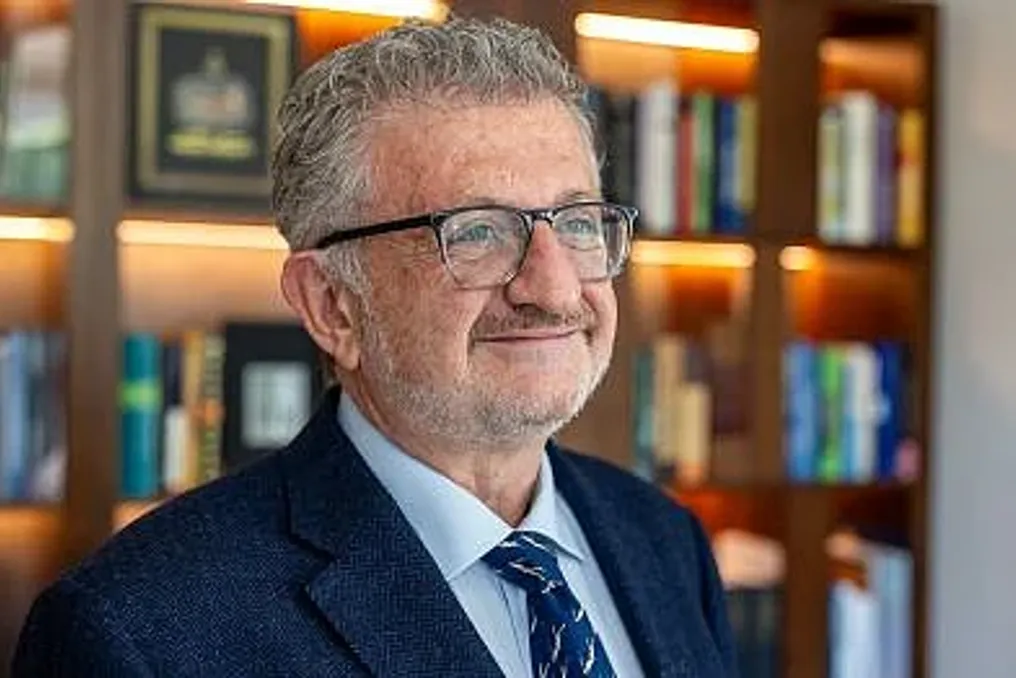
The conversation with Fabio Piano began by discussing his appearance rather than what might be expected—university statistics, genomics, or NYU Abu Dhabi itself. He is a person who helped transform the university from an idea into one of the most significant academic centers in the UAE.
Piano shared that almost all items in his office are related to NYU Abu Dhabi. There, one can see an early sketch of the Saadiyat campus by architect Rafael Winogrand, books by NYUAD faculty next to student work, and reminders of the university's ties to the UAE space program. A special place is occupied by a glass sculpture, the history of which began with seven different colors of sand from seven emirates. This sand was brought to Venice, where an Italian artist turned it into a sculpture, after which it returned to Abu Dhabi as a gift.
Although the tour of the office took only a few minutes, every item points to a much longer history spanning nearly two decades. Before the arrival of students, lecture halls, or the campus on Saadiyat Island, NYU Abu Dhabi was an ambitious concept being shaped between New York and Abu Dhabi.
One of the key moments was an event in 2006 when then-NYU President John Sexton was invited to a majlis by Sheikh Mohammed bin Zayed Al Nahyan, the then-heir apparent to the throne of Abu Dhabi. The meeting, which was supposed to last about fifteen minutes, lasted significantly longer. Khalid Al Mubarak later recalled that at a critical stage, these two men needed to sit together to determine if they shared the same vision.
As a result, another foreign educational institution under the brand of an American university was not created. By October 2007, NYU and Abu Dhabi announced plans to establish a full-fledged residential research university, with the first students expected in 2010. Sexton's words from that time seem particularly important now: NYU should remain rooted in New York but also become 'global and local.' Furthermore, he emphasized that the university was coming to Abu Dhabi not just for education, but with the expectation that it would be 'educated and changed in response.'
At the time, Fabio was known primarily as a molecular biologist. This scientist, born in Italy, spent most of his academic life at NYU, where he earned four degrees. His career developed during a period of rapid changes in molecular biology, developmental biology, and genomics, when achievements like the Human Genome Project transformed how scientists studied life. Later, he helped establish the NYU Center for Genomics and Systems Biology in New York. His research concerned not only individual genes but also the networks and mechanisms through which genes interact and living systems function.
Then, his attention was drawn to the project in Abu Dhabi. Fabio participated in early discussions about what the new university could become. Some people, as he recalled in the NYUAD oral history, came with preconceived notions about what was possible in the region and what was not.
In January 2010, he organized a genomics conference in Abu Dhabi. A couple of weeks after returning to New York, founding Vice Chancellor Alfred Bloom asked him to meet. Fabio was preparing to report on the conference, but Bloom meant something else. According to the NYUAD oral history, Bloom told him: 'We are looking for a provost, and I would like you to be a candidate.'
Fabio initially misunderstood the offer, thinking Bloom was asking him to join the committee for selecting the university provost. Bloom clarified: he wanted Fabio specifically. The decision was not easy. Piano was helping to build the genomics center in New York, whose new building had just been completed. His laboratory, research, and life were centered there, and he had strong reasons to stay. However, after several months of discussion—including a talk with NYU President John Sexton, who appealed to his sense of responsibility to the university—Fabio eventually agreed to move to Abu Dhabi in the summer of 2010.
'I thought I would do it for one year,' Piano recalled later. 'Of course, I became completely absorbed once it started.'
What Fabio considered a one-year mission stretched into ten years. During these years, he watched Abu Dhabi transform around him, especially Saadiyat Island. 'When I first arrived, there was no bridge to Saadiyat Island, nor the island itself,' he recounted.
In those early days, getting to where the permanent NYU Abu Dhabi campus would eventually be located meant taking a boat. The university's first undergraduate students began their studies in 2010 at a temporary campus in downtown Abu Dhabi. Several years later, the Saadiyat campus opened. Fabio remembers both versions of the university—the smaller operation forming in the city and the much larger institution that eventually appeared on the island. He watched Saadiyat grow alongside him, with homes, museums, cultural institutions, and entire neighborhoods appearing around the campus.
Today, Piano lives there. 'I have been here for 16 years. It has been one of the joys to be here.'
He partially grew up in Singapore and London but remains resolutely Italian. Nevertheless, Abu Dhabi gave him a feeling he did not expect. 'Coming to this part of the world felt like coming home.'
He speaks of the familiarity he found in hospitality and human relationships, as well as Abu Dhabi's ability to rapidly move toward new industries and technologies without completely abandoning the traditions that underpin them. Nevertheless, while helping to build the university, Fabio never stopped being a scientist. In the development of NYUAD, the Public Health Research Center created the UAE Healthy Future Study—a long-term initiative to study how lifestyle, environment, and genetics affect the health of Emiratis. The first phase ultimately enrolled nearly 15,000 UAE citizens, creating one of the most vital resources for public health research in the country. NYUAD claims that this work contributed to the creation of the Emirati Genome Program.
Fabio recalls this connection more specifically. He said that researchers at NYUAD began thinking about sequencing participants from the UAE even before the national genome program was established, and when the program emerged, they contacted G42. 'In a way, we provided the first 5000 samples for the Emirati Genome Project,' Piano stated. The official university record independently confirms the broader contribution of the Healthy Future Study to the creation of the national program, although it does not publicly mention Fabio's account of 5000 samples.
There is another, much more personal genomic story that Piano enjoys telling. He analyzed his own ancestry. 'It seems I cluster with Emiratis,' he said, before clarifying the statement. He meant the Arab world in a broader sense. He suspected his Southern Italian background might explain this link. 'That's what the genome says.'
A few minutes ago, he told me that Abu Dhabi somehow feels like home. Piano did not try to connect these two observations. Neither did I. Piano has an unusual way of conducting interviews: he often answers the question with his own question. When I asked what had changed in the city thanks to NYU Abu Dhabi, he did not immediately talk about the university. Instead, he asked, 'Did I grow up in Abu Dhabi?' I did. So he asked what I saw change.
For a moment, the conversation became less about NYUAD and more about Abu Dhabi as a city—about the city then and the city now, and what place such a university as NYUAD occupies in this history. This instinct to look outward becomes particularly interesting when the topic shifts to criticism that NYU Abu Dhabi is effectively an 'American land' in the UAE. 'I don't like that,' he immediately replied.
Piano acknowledged the institution's American roots. He argued that one of the strengths of American higher education is the intellectual culture in which students are expected to question what they hear, including common ideas and assumptions. For knowledge to advance, he believed people must have the opportunity to prove that something long considered true is actually false. However, in his view, the American educational tradition is different from simply transplanting an American institution abroad. The old international model often assumed that universities opened branches overseas that largely mirrored the culture and practices of the home institution. What NYUAD has become is something more complex. It carries the American style of education. Its students and faculty come from all over the world. But the institution exists because Abu Dhabi invited it, built around it, and allowed it to develop here. 'Talent has no nationality. Talent is talent,' he said.
He then came to a formulation that seemed to hold the most meaning for him. 'We are a product of the UAE. We are a product of Abu Dhabi.'
This is a striking statement given where this story began. In 2007, Sexton publicly promised that NYU did not plan to come to Abu Dhabi unchanged. Nearly two decades later, Piano asserts that the resulting institution is proof that this happened.
He described students from all over the world who risked everything for a university that barely existed; Emirati students able to receive a highly international education without leaving their country; faculty hired in fields relevant to the UAE; and artistic, scientific, and cultural works that gradually became part of Abu Dhabi itself. His personal relationship with NYUAD was never entirely linear. Piano stepped down as provost in 2020 and fully returned to biology and genomics. When Mariet Westerman left the vice-chancellor position in 2024, he was asked again to lead, first as interim head. On August 6 of this year, NYU appointed him to a permanent position, naming him Vice-Chancellor and Chief Executive Officer. Calling it a return is too simple. Piano never truly left the institution, just as the institution seems never to have completely left him.
Near the end of our conversation, the glass sculpture shown at the beginning of the office tour reappeared. The seven shades of Emirati sand were brought to Venice and transformed by an Italian artist before returning to Abu Dhabi. Fabio values what this represents: seven emirates together, as well as openness to the world. The facts themselves carry sufficient symmetry: Emirati material, shaped in Italy, brought back to Abu Dhabi and held by an Italian scientist who once agreed to come here for what he imagined as one year. After sixteen years, he lives on the island that once required a boat ride to reach, now leading the university he helped build there.