The first floor of Conjunto Nacional, located on Avenida Paulista, has been renovated with the opening of Nubank Arte Lab. This new exhibition space covers 2700 m² and features five multifunctional rooms, in addition to the Nuv Gastro Bar dining operation. The architectural project was developed by the firm Jacobsen Arquitetura.
To celebrate the debut of this cultural complex, the exhibition titled O Brasil de Tarsila is on display, presenting over 70 works in interactive environments. The realization of this exhibition is the result of a collaboration between Tarsila do Amaral S.A., responsible for preserving the artist's legacy, and the events agency LIVEIDEA.
The curation of the show was handled by Juliana Miraldi and Paola do Amaral Montenegro, who is Tarsila's great-grandniece. It is important to note that the exhibition does not display original works, but rather replicas and digital versions of the paintings.
The show occupies three of the complex's five modular rooms. These spaces have been transformed into 14 interactive scenarios, each dedicated to a period in the modernist's life and production. The environments are equipped with temperature and lighting control, as well as devices that disperse aromas.
Officially, O Brasil de Tarsila will be available until October 31st, although there are indications that the period may be extended until the end of the year. Afterwards, the exhibition will move to Rio de Janeiro, still without a defined location. In September, the remaining rooms will be used by the exhibition Fronteiras do Imaginário, by French digital artist Maotik.
The guided tour details the immersive experience. The author recounts that Tarsila do Amaral always enchanted her, especially with the unique colors and forms of her paintings.
The first two rooms of the space at Conjunto Nacional function as galleries, displaying replicas of the artist's works in frames, along with informative texts about Tarsila's trajectory. Although this beginning seems conventional, understanding the artist's journey is crucial for what follows, as the show adopts a 'single flow' format, preventing return to previous environments.
The first moment of great impact occurs in the mirror room, which features an 84 m² LED panel. The walls reflect works from the Pau Brasil phase (1924 – 1928), mixing figures from Brazilian Religion (1927) with Manacá flowers (1927) in infinite patterns. The room provokes a long stay for visitors.
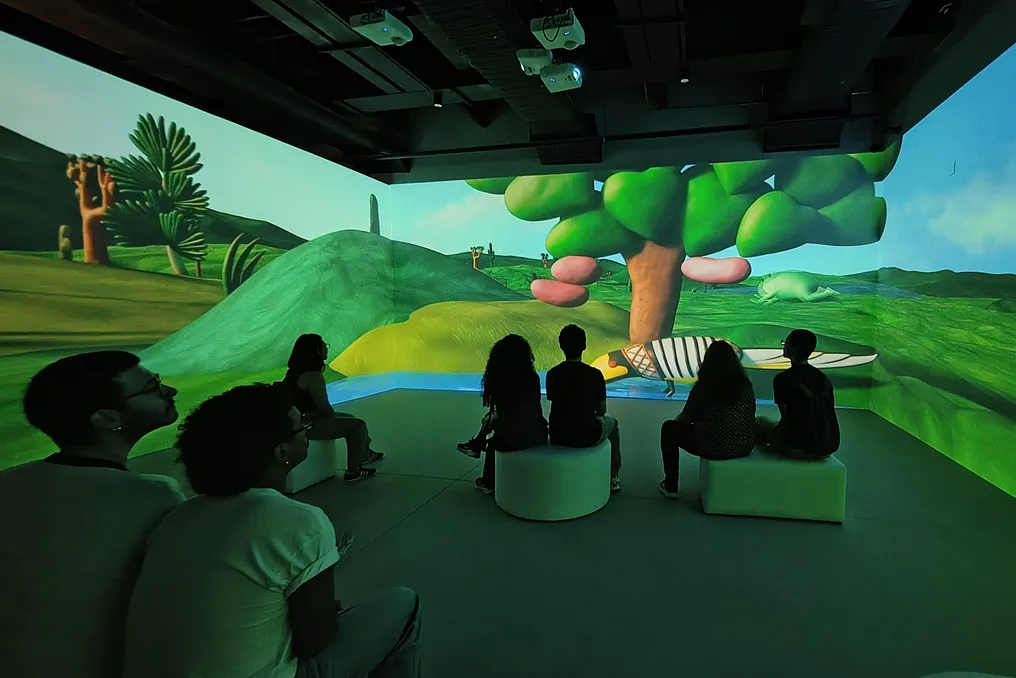
Next, the visitor accesses the Tarsilian Forest, a scenario that combines elements from the Anthropophagic phase (1928 – 1930). The trees from Floresta (1922) integrate with the vegetation from Cartão-Postal (1929) and Idílio (1929). An audio system reproduces sounds of tropical frogs and birds, while sprayers release jasmine aroma. There is also a green ball pit, which pleased both adults and children present.
Passing through a curtain, a train carriage appears, where each window represents a significant destination in Tarsila's life. Artifacts displayed on tables complement a sound system that narrates the artist's travels to places such as Minas Gerais, Paris, and the Soviet Union.
In a seating area, projectors display an animation featuring iconic figures of the modernist, showing the Frog (1928) traveling through a tropical landscape until it meets Cuca (1924) and Abaporu (1928). The giant with large feet and small head continues into a forest, where it joins the figure of the bosom in the Anthropophagy show (1929).
The bright colors give way to the grayish tones of the Social phase, in the room dedicated to Operários (1933). After her return from the Soviet Union in 1931, the works began to depict Brazilian popular life. In this room, one needed to turn a crank for the workers to appear on a curved screen, and the visitor also used an old machine to digitally insert their image into the work.
A corridor featuring the character Composição (Figure Only) (1930), agitated by a gust of wind generated by fans, leads to the Abaporu (1928) hall, a point where the visitor took many photographs. The intensity of the flashes was replaced by the calm of the night, when she immersed herself in the work A Lua (1928), appreciating the moon projected on the wall in stone-molded benches.
The subsequent environment resembles a playground, containing giant puzzles, a slide, and a seesaw, which was highly appreciated by children. The work A Terra (1943) occupies the next space, using fans to create strong winds and provide a moment of rest.
The conclusion of the exhibition is a hall that synthesizes all of Tarsila's phases through an animation projected onto the walls, culminating with A Fazenda com Sete Porquinhos (1943) in the background and Sol Poente (1929) concluding the experience.
The exhibition is located at Conjunto Nacional, Av. Paulista, 2,073, 1st floor, Consolação. Operating hours are Wednesday to Monday, from 10 am to 10 pm, with tickets available starting from R$ 47.50 via the Fever platform, and the show remains on until October 31st.