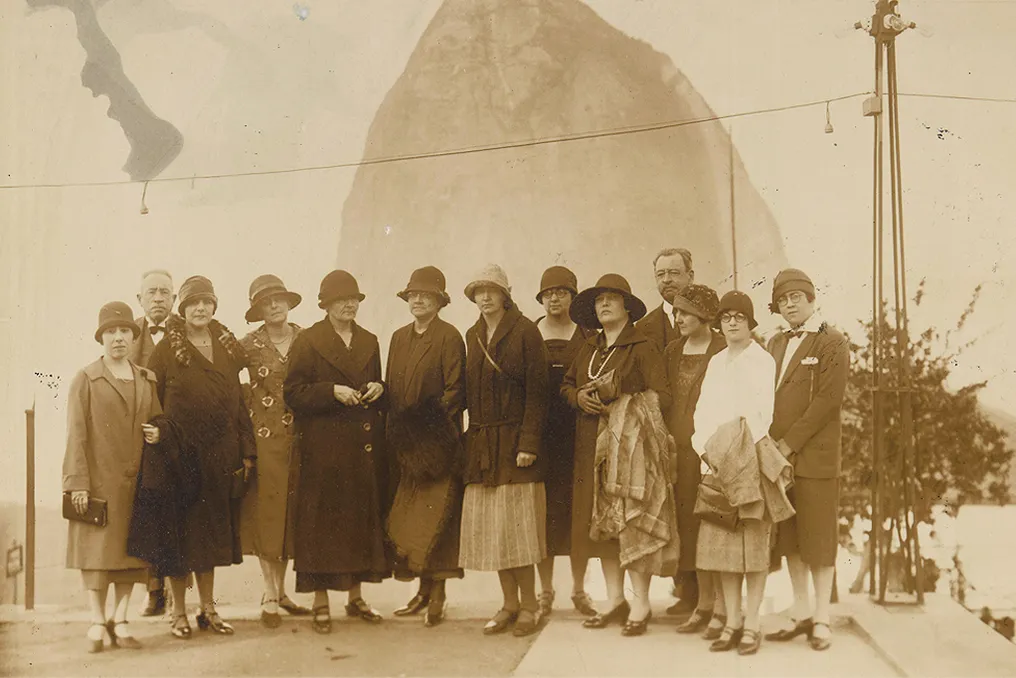
The renowned Franco-Polish scientist Marie Curie, born in 1867 and died in 1934, visited Brazil in 1926. She was invited by the Franco-Brazilian Institute of High Culture to give a series of lectures on her discoveries related to radioactivity.
Internationally recognized and holding two Nobel Prizes, Curie remained in the country for more than forty days. She was accompanied by her daughter, Irène Curie, who was also a researcher.
Marie Curie's arrival took place at the port of Rio de Janeiro on July 15, 1926, generating great anticipation and wide media coverage. The reception included prominent figures from Brazilian science and society, including members of the Brazilian Academy of Sciences and the Brazilian Federation for the Progress of Women, an organization led by the biologist and feminist Bertha Lutz.
Curie's presence stimulated not only the scientific community but also moved an intense scientific, cultural, and social agenda during her stay. She was received by various authorities and visited several institutions dedicated to research, teaching, and culture.
In Rio de Janeiro, she visited the National Museum and the Botanical Garden, among other scientific sites. At the National Museum, she met with Brazilian scientists such as Bertha Lutz and Heloísa Alberto Torres, an event that symbolized the growing participation of women in Brazilian science.
The main focus of the scientific agenda was the Polytechnic School of Rio de Janeiro, where Marie Curie gave eleven lectures on radioactivity. Her daughter, Irène, actively participated in the practical activities. These classes were also broadcast by the Brazilian Society Radio, allowing knowledge to reach a wider audience beyond those present at the conferences.
Besides Rio, Marie Curie gave lectures at the National Academy of Medicine and the Brazilian Academy of Sciences, both in Rio de Janeiro. She also traveled to the Medical Schools in São Paulo and Belo Horizonte. The scientist inspected research centers such as the Butantan Institute in São Paulo and the Radio Institute in Belo Horizonte.
The press meticulously covered almost all events of the trip. Newspapers from various regions published reports, interviews, and accounts of her activities. The periodicals did not limit themselves to the celebrity figure but also publicized the content of the conferences, helping the Brazilian population become familiar with advances in knowledge about radioactivity.
The trip also included leisure time and visits to different places. Marie Curie visited tourist spots in Rio de Janeiro, such as Sugarloaf Mountain. She also toured São Paulo and Minas Gerais, where she was welcomed by researchers and authorities. In Águas de Lindóia, she visited thermal springs, showing interest in the natural radioactivity of these waters.
Marie Curie left Brazil on August 28, 1926. In her farewell, she publicly expressed her gratitude for the hospitality offered by authorities, scientists, journalists, and the public. She also thanked the Brazilian Federation for the Progress of Women, which supported her stay and made the trip more pleasant.
Brazil was one of Marie Curie's few international experiences outside of Europe and represented a chance to connect with the Brazilian scientific community. Her visit helped reinforce scientific exchanges, disseminate knowledge about radioactivity, and boost the development of research and its medical applications in the country.
A tangible legacy of her visit was the donation of radio sources to the Radio Institute in Belo Horizonte, intended for the then nascent field of radiotherapy.
One hundred years after the visit, interest in the scientist's trajectory remains alive. A research group led by Women and Men in Science at the Federal University of Paraná (UFPR) is investigating Marie Curie's passage through Brazil from multiple perspectives, producing studies in the history of Science, scientific education, chemistry and physics teaching, and scientific dissemination.
This work encompasses actions in the cities she visited, in collaboration with teaching, research, museum, and science centers. The objective is to recover the memory of this journey and illustrate its connection to Brazilian scientific history and the participation of women in knowledge production.
Among the actions is the 'Marie Curie Was Here' project. In May 2024, a statue of the scientist was inaugurated at the Municipal Bathing Resort of Águas de Lindóia, accompanied by an exhibition about her passage through the city. Furthermore, a map is being developed that will map the locations visited by Marie Curie, showing what these spaces were like a hundred years ago and what she accomplished in each of them.
To celebrate the centenary of the visit in July 2026, the project organized a recreation of a historical photo taken at Sugarloaf Mountain. Fifty contemporary scientists participated in this initiative, reproducing the record in the same location and date as Marie Curie's passage through Rio de Janeiro. The original 1926 photograph shows Marie and Irène Curie next to important personalities, mostly Brazilian. A century later, the new image updates this record, creating a connection between two generations of researchers.
More than just recalling the passage of a notable scientist, projects like this allow revisiting a crucial milestone in Brazilian scientific history. Marie Curie's trip demonstrates how the international circulation of researchers, scientific dissemination, and institutional cooperation already played a relevant role in the formation of science in Brazil. Furthermore, the presence of a world-renowned woman helped increase the visibility of women in science.