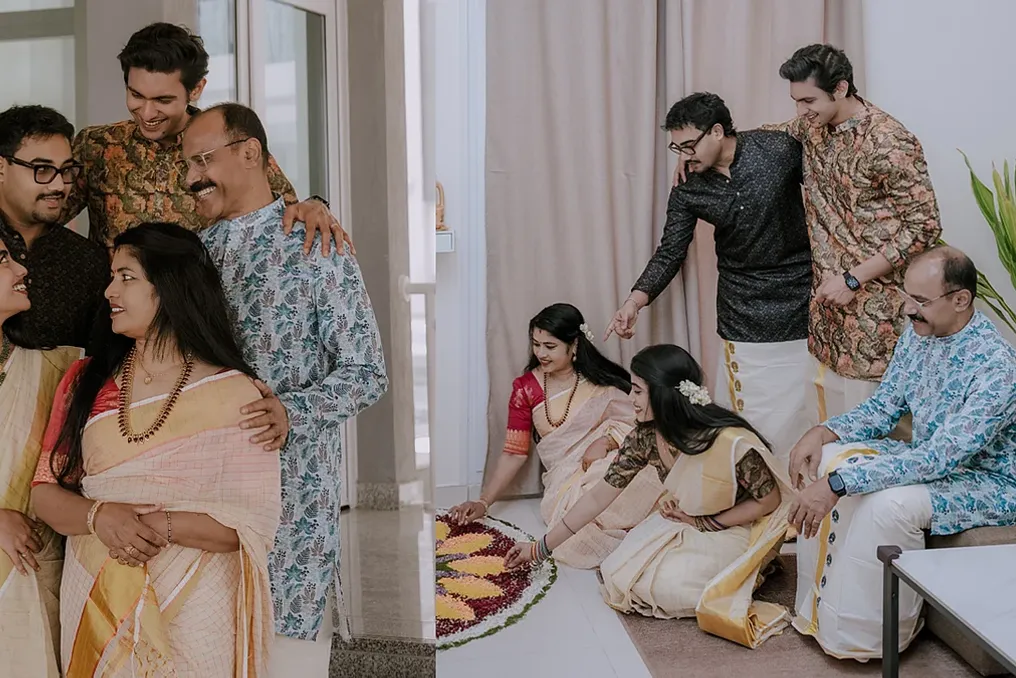
Even some time after the celebration of Onam, tailoring workshops remain busy among Keralites in the United Arab Emirates (UAE) due to the constant demand for traditional attire from Kerala. For many people, this harvest festival lasts not just one day, but represents a season during which the dressing process continues long after the actual date of the festival.
At Al Jismi Tailoring Shop in Bur Dubai, there is a steady stream of clients wishing to have traditional Kerala outfits made. Jaber, an employee at this shop, noted that customers come not only during Onam itself but also afterward. Some pick up orders placed weeks ago, while others are already preparing for next year's celebration.
He also emphasized that the clientele includes not only adults. 'We make traditional clothes for Onam and for children. These little outfits are very cute,' he added.
Clients purchase fabrics either in Dubai or they arrive from Kerala in their suitcases before visiting the local tailor. Then, blouses and other elements are sewn together to complete the festive look, adding another stage to the already intense preparation.
Anu Vidhu, founder of Jiwa Couture boutique in Dubai, considers Onam one of the most significant seasons for her business, with preparations beginning months before the event. However, the demand does not cease on Thiruvonam.
'Onam is one of our most important seasons, so we start preparing months in advance, starting from selecting fabrics and color combinations to developing the entire collection,' she shared. 'This year, we created our own prints and designs, working with handwoven Kerala fabrics, kasavu, and tissue.'
While ivory, cream, and gold remain favorite festive shades, Vidhu observed that buyers are increasingly willing to experiment with new styles. 'Tissue fabrics, handwoven textures, statement blouses, delicate handwork, and Kerala-style prints are gaining a lot of interest,' she reported, adding that custom-made outfits and harmonious looks for couples and families are also popular.
Nevertheless, according to Vidhu, the desire for experimentation has not diminished the appeal of tradition. 'The love for Kerala handloom and kasavu definitely remains. What has changed is that clients don't necessarily want to look conventionally the same every year. They still value tradition, but they also want something that feels individual.'
For the couple Rahul Krishna and Pratisheksha Prathip from Dubai, their Onam outfits carry another tradition—their families often choose them. Pratisheksha shared: 'Every Onam, our parents buy something for both of us, and that itself has become a special part of the celebration. It's less about choosing the perfect outfit yourself and more about wearing what our families chose for us with love.'
Pratisheksha, born and raised in Dubai where she has lived for 28 years, noted that celebrating Onam has always been part of her life in the UAE. She added that finding traditional outfits locally is no longer difficult: 'New collections always appear in Dubai, so we have many options here.'
For Lakshmi Sadhasivan, a resident of the UAE, the unexpected move from Kerala strengthened her attachment to Onam traditions. She admitted: 'When I lived in Kerala, I never particularly cared about wearing a Kerala saree for Onam. But over the years, after moving to the UAE, I have started looking forward to this festival much more.'
She now tries to follow traditions, including preparing sadhya and making pookalam, as, she says, 'it helps me feel closer to my roots.' This year, Lakshmi plans to wear a Kerala saree she brought from home while purchasing outfits for her family in the UAE. She noted that local options have significantly expanded, offering styles similar to those available in Kerala, in traditional textile shops, small businesses, and online retailers.
For Malayalis living far from Kerala, clothing for Onam continues to be significant. Borders may change, but traditional weaving can be combined with a statement blouse. The younger generation may interpret kasavu differently. However, Vidhu believes that the underlying emotion remains unchanged. 'Onam fashion is very emotional. Trends may change, but the feeling associated with wearing a kasavu saree, mundu, or something reminiscent of Kerala essentially does not change.'
She concluded that 'when you live far from Kerala, traditional Onam attire helps you feel connected to home, family, and your roots.' Although styles may change every year, for many Malayalis in the UAE, the tradition they represent seems to remain constant.