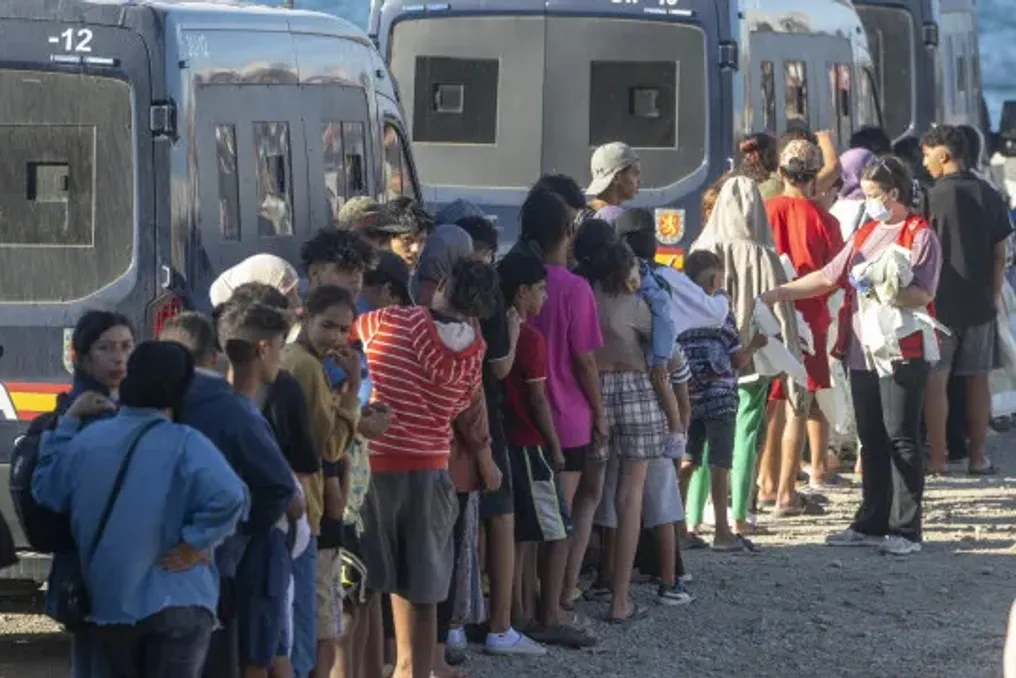
Monica Garcia stated this assessment in an interview with elDiario.es, published today. She calculated that 3800 people are currently housed and reported that another thousand places will be available next week.
Responding to the question about the Government's schedule for resolving the crisis, the Minister of Health emphasized the need to first develop a 'relocation schedule.' The Minister expects that within the next 'two or three weeks,' the issue of providing people with 'shelter, water, decent conditions, and protection of basic rights' can be resolved.
Garcia specifically noted that 'nothing will happen without relocations,' stressing in the same interview that it is impossible to conduct registration, family reunification, or epidemiological surveys on the beach.
According to the Minister, the Government does not have the capacity to quickly relocate all migrants 'without the consent and yielding of spaces' from the city of Ceuta. The city of Ceuta itself has changed its position and is now cooperating by agreeing to create 'safe places' for these activities.
Garcia compared the situation to 2021, noting the greater promptness in removing people from the streets then, which is not observed now, and insisted on adhering to legislation and human rights when proposing deportations.
She added: 'We are accused of being late, but we will never carry out illegal deportations, nor against human rights.'
Regarding what happened, she considered it an attack on Spanish sovereignty with the 'aim of destabilizing' the Government. In her opinion, this problem goes beyond the border itself, and 'Morocco has responsibility' in it, as well as links to the international far-right wing, including '(Donald) Trump and (Benjamin) Netanyahu.'
Most migrants who reached the territory by swimming have already returned to Morocco. Spanish authorities estimate that between 3000 and 5000 migrants remain in the Spanish enclave, many of whom are unaccompanied minors.