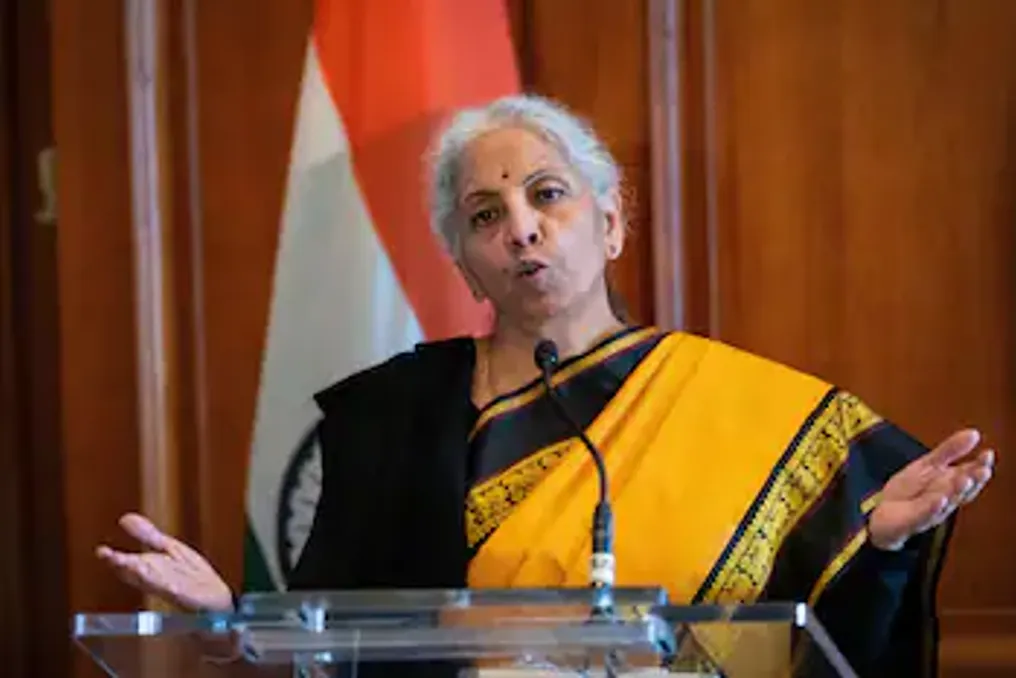
Finance Minister Nirmala Sitharaman has invited international investors to establish manufacturing bases, as well as technology and innovation centers in India, urging them to utilize existing talent and opportunities to create products for the global market.
Speaking at a high-level Business Roundtable with leading investors and business leaders in Chicago on Friday, Sitharaman highlighted India's broad growth, the pace of reforms, and expanding prospects for long-term investment.
Sitharaman emphasized that India's appeal for investment is not based on any single sector, but on a combination of scale, growth, availability of talent, infrastructure, technology, and sustained reforms implemented over the last decade.
At the roundtable, organized by the Consulate General of India in Chicago in collaboration with the US-India Strategic Partnership Forum, she stated: 'The political environment is increasingly geared towards ensuring opportunities for businesses to invest, manufacture, innovate, and expand.'
The Finance Minister called upon global partners to jointly develop, co-manufacture, and create products for world markets. She strongly recommended viewing India not merely as a sales market, but as a platform for building global businesses—be it a manufacturing base, a technology and innovation center, a consumer market, or a location for long-term infrastructure investments, leveraging India's engineering talent, manufacturing scale, and technological ecosystem.
The main theme of the meeting was 'Manufacturing in India—for India and for the World,' covering areas such as manufacturing, artificial intelligence, and digital technologies, financial services, infrastructure, food processing, defense, and advanced technologies.
Sitharaman noted that as global companies review supply chains and capital allocation, India offers not only market scale but also growing depth as a long-term investment and operational platform.
The Minister reported that India's Digital Public Infrastructure, including Aadhaar, UPI, DigiLocker, ONDC, and India Stack, has created platforms covering the entire population. She added that the next phase involves creating higher-value enterprises in AI, engineering, analytics, product development, semiconductors, and electronics, as India's Global Centers of Excellence become increasingly global innovation hubs.
Furthermore, Sitharaman mentioned that GIFT City is developing as an international financial center connecting global capital with Indian opportunities. She pointed out that as of June 2026, 1250 organizations offering opportunities in banking, fund management, reinsurance, aircraft and vessel leasing, sustainable finance, and other cross-border services are registered there, and invited global institutions to explore GIFT City as a gateway to India's financial ecosystem.
According to her, amid the reconfiguration of global supply chains, India possesses a compelling combination of a large domestic market and competitive manufacturing capabilities on the world stage. The focus is shifting from simple assembly to deeper component manufacturing, engineering, and advanced technologies, supported by targeted policy measures, including production-linked incentives.
Sitharaman also discussed that the development of India's infrastructure—from dedicated freight corridors and railway modernization to electrification and high-speed corridors—opens up opportunities in engineering, technology, materials, specialized equipment, and long-term institutional capital. She mentioned that the National Infrastructure Investment Fund provides a commercially oriented platform for global investors to participate in this opportunity.
In agriculture, due to rising incomes and changing consumption patterns, India is creating opportunities in food processing, automation, packaging, logistics, and cold chain, with the potential to create enterprises serving both Indian and global markets. The Finance Minister stressed that through initiatives like Atmanirbhar Bharat and iDEX, India is building internal capabilities in drones, autonomous systems, and other advanced technologies.
As part of her six-day visit to the US, Sitharaman plans to attend the G-20 Finance Ministers meeting in Asheville, North Carolina, as well as in New York.