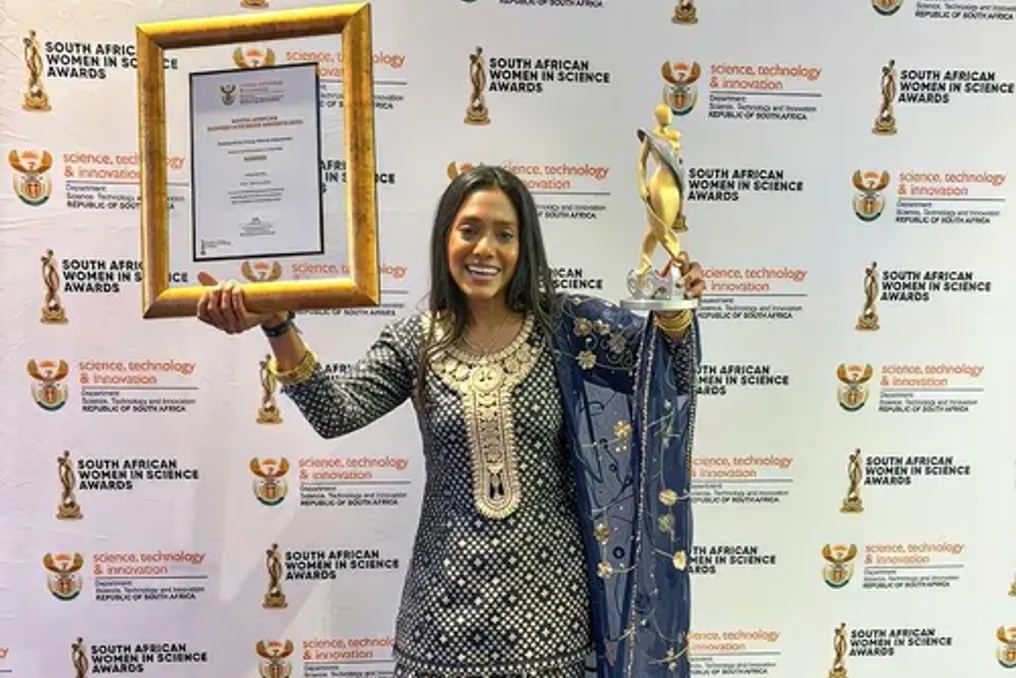
Professor Trisha Naiker's research helps find new ways to preserve the effectiveness of vital antibiotics while motivating young women to believe in their place in science.
Professor Trisha Naiker received the 'Outstanding Young Researcher in Natural and Engineering Sciences' award at the 23rd South African Women in Science Awards ceremony. The ceremony took place on August 20th at the NH Hotel Sandton in Johannesburg.
Naiker's journey from a curious schoolgirl in Chatsworth to an award recipient is recognized nationally. Her scientific work contributes to solving one of growing global problems—antibiotic resistance.
The 41-year-old Director of the Department of Catalysis and Peptide Research at the University of KwaZulu-Natal (UKZN) was honored with the Outstanding Young Researcher in Natural and Engineering Sciences award at the 23rd SAWiSA ceremony. These awards, presented by the Department of Science, Technology and Innovation under the motto 'Placing women at the center of science, technology and innovation,' are given to women whose work advances knowledge and contributes to the scientific and technological development of South Africa.
For Naiker, who still resides in Chatsworth, this recognition holds special significance as her path began in a regular school classroom. Her interest in science arose after initial chemistry experiments. She recalls: 'There was something very exciting about taking something you could see and understand in a textbook and actually realizing it before yourself.'
Her physics teacher encouraged this curiosity, helping her realize that science is not just about memorizing facts but about asking questions and figuring out how things work. Her parents also played an important role by supporting Naiker and her siblings in pursuing higher education and instilling in them the belief in the value of investing in education.
However, her own path was not always standard. Naiker noted that her difficulties were less related to science being a male-dominated field and more related to choosing a career path that required many years of study and dedication. She spoke about doubts regarding whether the long road of effort was worth it, emphasizing the need to stay focused on her beliefs and trust that the chosen path would ultimately make sense.
Today, this work has potentially far-reaching consequences. Naiker leads interdisciplinary research combining synthetic chemistry, microbiology, and biochemistry to develop compounds that can restore the effectiveness of existing antibiotics. Part of this work has reached the first phase of clinical trials, marking an important transition from laboratory research to testing potential treatments on humans.
Simply put, Naiker describes her research as developing a 'shield' against bacterial defense that can disable antibiotics. She explained: 'If some bacteria have developed a defense mechanism that deactivates our antibiotics, we develop a 'shield' that can block this defense, allowing the antibiotic to do its job again.'
She stressed that there is still a long way to go, as the first phase primarily examines safety and how the potential drug behaves in the human body. The research aims to combat antimicrobial resistance—a problem that can turn previously easily treatable infections into serious or even life-threatening conditions.
Naiker stated that she is motivated by the possibility that the work conducted in the lab today could help preserve vital antibiotics for future generations. As a UKZN graduate, she earned a distinction Master's degree in 2008 and a PhD in 2011. She began her academic career in 2013 after postdoctoral research in Denmark and has since become one of the university's leading researchers.
As an NRF C1-rated researcher, she has authored over 130 peer-reviewed publications, one patent, and three book chapters. Among her previous awards are the NRF Award for Emerging and Early Career Researchers in 2018, the UKZN Vice-Chancellor's Award in 2019, and the Raiks Medal in 2020.
Nevertheless, she considers mentorship one of the most important parts of her work. She said she feels responsible for doing the same for the next generation, referencing the mentors who helped shape her career. Her message to young girls who might think science is not for them is simple: 'Science is absolutely for you.' She added: 'You just need curiosity, determination, and a desire to learn.'
For Naiker, the greatest value of her latest award is not the trophy or the title, but what it represents for the next generation. She hopes that young women growing up in communities like Durban will see that simple curiosity in a school classroom can become a career that changes people's lives, and they will understand that science is a place where they belong too.