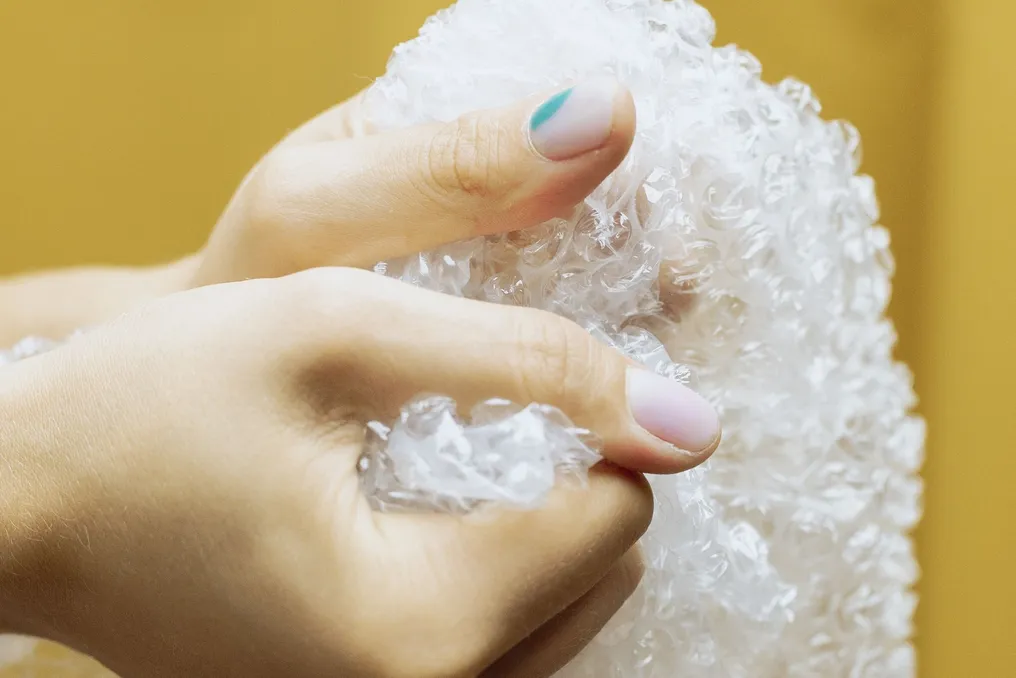
Although bubble wrap is today an integral part of online delivery, protecting fragile items, few people know that its original purpose was not to create packaging material. This plastic film, filled with small air bubbles, became an important element of packaging thanks to a series of failed experiments.
Initially, the idea for bubble wrap arose from an attempt to create a new type of wallpaper. However, this project proved unsuccessful. Subsequently, efforts were made to use the material as insulation for greenhouses, but this experiment also did not yield great success. Ultimately, it was these failed attempts that led to the creation of a product now used worldwide in the packaging industry.
In 1957, engineer Alfred U. Fielding and inventor Mark Shaver were working on creating a new type of wall covering material. They joined two sheets of plastic in such a way that an air layer was trapped between them, forming small raised bubbles across the entire surface. This allowed for the creation of a sheet with a unique three-dimensional texture. Both hoped people would use it as wallpaper, but this concept did not gain widespread adoption.
Nevertheless, the material resulting from this failed experiment possessed several useful properties: it was light, easily foldable, and contained thousands of tiny air pockets. This prompted Fielding and Shaver to consider applying the material in other areas.
Next, the idea arose to use this material in greenhouses as thermal insulation. The air trapped inside the plastic could help prevent heat loss. Although technically sound, this idea did not achieve significant market success. Despite being tested twice for different purposes, the material did not become part of a major commercial breakthrough. However, there was another characteristic to the air trapped inside: when pressed, the small bubbles could function as a shock absorber. It was then that the idea of using the material in packaging emerged.
In 1960, Fielding and Shaver founded Sealed Air Corporation. Later, they noticed the growing needs of the computer industry. At that time, IBM was releasing its 1401 computer. Safely transporting such large and fragile devices presented a serious problem. They needed a lightweight yet effective cushioning material capable of protecting against impacts during transit. This is where bubble wrap came in handy. Thanks to the air bubbles, it helped protect the computer from vibrations. IBM began using it to package its 1401 computer, and that is when bubble wrap found its true purpose.
The history of bubble wrap is interesting because there were no radical changes in its design. The same material that initially failed as wallpaper and later did not achieve much success for greenhouses eventually became a hit in the world of packaging. Its purpose simply changed. Instead of being affixed to a wall, when wrapped around a fragile item, the air inside turned into a protective barrier. Today, bubble wrap is used worldwide for packaging delicate goods. And perhaps each of us has enjoyed the popping of these little bubbles at some point. So the next time you see bubble wrap in a parcel, remember that its story began not with a box, but with a wall.