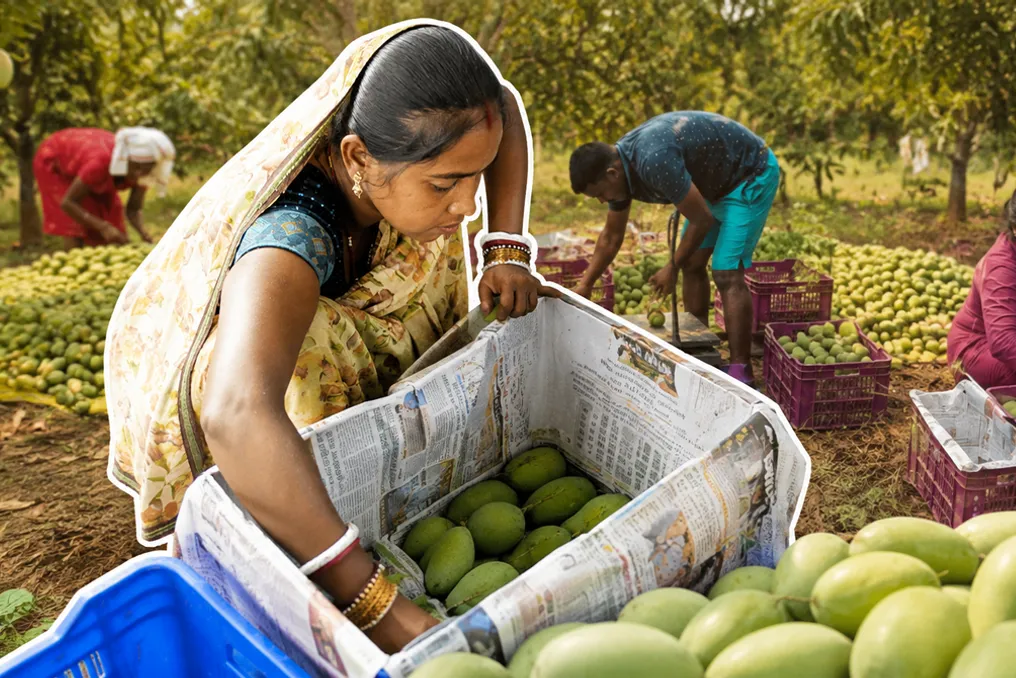
Previously, a farmer from Jharkhand, Jivanti Bara, recounted that if her mangoes could not be sold in time, they inevitably spoiled, forcing her to accept any price offered by local traders.
Jivanti Bara, a 50-year-old farmer from the village of Birnibera in Simdega district of Jharkhand state, grows Amrapali variety mangoes on a plot near her home. Every summer, the trees yield an abundant harvest after careful care, including watering, pruning, and pest protection.
However, the approaching harvest season brought new anxiety: although growing mangoes was a familiar task, finding a buyer at a fair price was extremely uncertain. Like many small farmers in Simdega, her family depended on local traders who dictated prices during the harvest. Refusing an offer risked the spoilage of the fruit before the next buyer arrived.
Bara recalls that they had very limited bargaining power, and there was always a risk of losses due to unsold mangoes.
Across the Jharkhand region, many families faced a similar problem: farmers could produce high-quality mangoes, but it was difficult for them to get beyond local markets. Women spent hours caring for gardens and harvesting, but often lacked a say in sales or pricing decisions.
Today, Jivanti's mangoes can travel far beyond her village. Farmers from Jharkhand now sell their produce to organized buyers across India, with some consignments reaching England, Italy, and the United Arab Emirates.
Jivanti expresses joy and pride upon learning about their mangoes entering the international market. She hopes that in the future they can reach more markets, receive better prices, and improve her family's income.
The story began long before the first export. Thousands of rural families across Jharkhand planted fruit orchards under the Birsa Harit Gram Yojana (BHGY) program—a flagship initiative of the state's Department of Rural Development aimed at creating long-term earning opportunities through horticulture.
Technical support was provided by PRADAN (Professional Assistance for Development Action), in collaboration with the Jharkhand State Livelihoods Promotion Society (JSLPS), district administrations, the District Rural Development Agency (DRDA), and teams working under Mahatma Gandhi National Rural Employment Guarantee Act (MGNREGA).
Over the years, farmers have planted orchards on nearly 1.86 lakh acres of their own land. By 2026, these plantations supported about 2.15 lakh rural households across all 24 districts.
Amrapali and Mallika varieties of mango became popular due to their taste, regular fruiting, and ability to withstand long-distance transportation. As the trees matured, yields increased, bringing with them the question of where all this fruit would go.
Shyam, a 27-year-old livelihood expert from PRADAN who works closely with farmers, farmer producers, and government departments in Simdega, notes that around December 2025, they began observing a good mango harvest from the BHGY-created orchards. He emphasizes that the main challenge was how to link this growing production volume with higher quality and organized markets so that farmers received deserved payment. Production improved, but market access remained a problem.
Tarak Nat Das, a team coordinator at PRADAN, saw the same shortage. He has worked with the organization since 2007 in field implementation, district coordination, and state-level programs, and for the last three years, he has supported the MGNREGA State Planning Cell at the Jharkhand Department of Rural Development under BHGY.
He explains that over the years of work, they identified a huge gap: farmers successfully developed orchards, but many lacked post-harvest knowledge and skills. They did not know enough about sorting, grading, packaging, maintaining quality, or meeting buyer requirements. Consequently, most producers continued to sell their produce to local traders at relatively low prices.
The fruit was ready, but the link to subsequent stages was missing.
Starting in December 2025, PRADAN, in collaboration with the District Administration, JSLPS, DRDA, MGNREGA teams, and Farmer Producer Organizations (FPOs), focused on assessing production, understanding farmer readiness, and studying buyer expectations.
FPOs are farmer-owned enterprises that help members collect produce, negotiate prices, and access larger markets collectively. Officials visited villages, FPOs assessed the volume of fruit that could be harvested and sold together, and potential sellers, exporters, and organized buyers were identified. This was followed by buyer-seller meetings that brought together farmers and buyers.
Shyam explains that they did not immediately move to export. First, numerous discussions, coordination meetings, and buyer-seller meetings were organized so that farmers understood the requirements of organized markets, and buyers understood the farmers, before connections to the markets were established.
Farmers across Simdega received training on garden management, nutrient application, pest and disease control, harvesting methods, and post-harvest processing. They learned to pick mangoes at the right stage of ripeness, remove juice through desapping, prevent damage, and sort fruit by size, appearance, and quality.
For many families, these steps were unfamiliar because local markets rarely encouraged such a level of care.
There was also a practical issue: export buyers only accepted produce that met strict quality standards. Farmers could still incur losses if the rest of the produce could not be sold.
Shyam says they aimed for every category of mango to find a market. If only export-quality mangoes were bought, farmers still suffered losses. Therefore, they created a system where export-quality produce went to premium buyers, and the remaining produce was linked to suitable national and local markets.
Two women-led FPOs, Mahila Jagriti Farmer Producer Company and Biura Farmer Producer Company, played a central role in this system.
For Jivanti, the training changed her perspective on growing fruit near her home. She notes that they studied garden management, pest and disease control, proper harvesting, desapping, sorting, and grading. She adds that previously they paid little attention to these practices because they sold everything to local traders. Now she understands that maintaining quality opens doors to better markets.
She previously earned about 25,000 rupees from mango cultivation. This year, by selling almost two tons through her FPO, her income rose to approximately 80,000 rupees. The price she received also increased from about 20 rupees per kilogram to nearly 30 rupees per kilogram.
She feels more confident knowing that their produce can reach larger markets, which has improved their income and reduced the likelihood of mango spoilage.
Changes are also visible in Simdega. According to Shyam, the amount of mangoes sold through this initiative has increased from about 10 tons to nearly 31 tons. Depending on the quality, prices rose from 20–25 rupees per kilogram in organized domestic markets to approximately 31 rupees per kilogram, and up to 42 rupees per kilogram for export-quality produce.
He concludes that the biggest change has been in market access. Previously, farmers were almost entirely dependent on local traders. Today, they have the opportunity to sell in inter-district, national, and international markets. Through FPOs, they also receive better market information, which has strengthened their confidence and bargaining power.
During the harvest season, the two FPOs provided individual farmers with a way to reach buyers they rarely could visit themselves. They mobilized farmers, collected mangoes, and organized collection centers where the fruit was checked for size, ripeness, appearance, and quality. Export-quality mangoes were packed separately, while the rest was purchased for wholesale domestic markets, organized retailers, and other buyers across India.
For women, this change also meant participation in decision-making regarding aggregation, quality checking, procurement, and marketing.
Devanti Devi, 35, from the village of Buruhondjayer in Bano block, Simdega district, is associated with Biura Farmer Producer Company. She recounts that previously most farmers relied on local traders and nearby markets. They had limited options, so they mostly accepted any offered price. There was always the fear that the mangoes would spoil if not sold quickly.
Devanti adds that their FPO collects mangoes from various farmers and connects them with suitable markets. They also receive information about buyer requirements, which gives them much greater confidence.
This confidence has permeated family and village conversations. Devanti shares that previously women mainly worked in the gardens, and men handled sales. Now they participate in discussions about agriculture and marketing. They understand the markets better and have become more confident in making decisions.
One thought stuck with her: when she heard that mangoes from their village reached the international market through their FPO, she felt immense pride. They never imagined that fruit grown there could travel to another country. She urges other women farmers to join such initiatives because when women unite, they create better opportunities not only for themselves but also for their families and the entire community.
After several months of preparation, the first test took place in May 2026. On May 13, the first consignment left Simdega for Allahabad in India, helping farmers and FPOs understand the processes of procurement, aggregation, packaging, and long-distance transportation.
Less than three weeks later, on June 2, 2026, the first export shipment from Simdega was sent to England. A second followed on June 16 to Italy.
Tarak Nat notes that uniting all these partners was one of the biggest challenges. The district administration and JSLPS mobilized farmers, FPOs aggregated produce, PRADAN built farmer capacity and organized buyer-seller meetings, while APEDA, exporters, and logistics partners advised them on export standards, packaging, and transportation. This initiative demonstrated that when government agencies, civil society organizations, and private buyers work together, even small farmers can gain access to high-income markets.
Currently, the program covers all 24 districts of Jharkhand, nearly 12,000 villages, 3,300 gram panchayats (village councils), and 264 blocks. Of these, 5,231 villages have reached the production stage, and about 46,586 women farmers directly benefit from the orchards that have started bearing fruit.
A network of 37 FPOs, representing 11,347 member farmers, supports aggregation, value addition, and marketing. Together, they have exported 15.8 metric tons of Amrapali mangoes in nine consignments. Among these, 3.5 metric tons from Gumla went to Dubai and Italy, one metric ton from Deogara went to Dubai, six metric tons from Ramgarh went to London and Dubai, 1.6 metric tons from Simdega went to London and Italy, 1.2 metric tons from Jamshedpur went to London, and 1.5 metric tons from Lohardaga went to Dubai.
FPOs also connect farmers with organized buyers and retailers, including Agri Arjuna AI, Apna Mart, Sabri AI, KissanSay, Urvi Mart, Amrai, BigBasket, Blinkit, and Reliance, as well as with urban markets like Ranchi. Farmers now have multiple options during the harvest season instead of depending on a single local buyer.
Tarak Nat concludes that the success of this initiative lies not only in exports. It lies in helping families earn from productive assets created on their own land. This income supports education, healthcare, and children's nutrition.