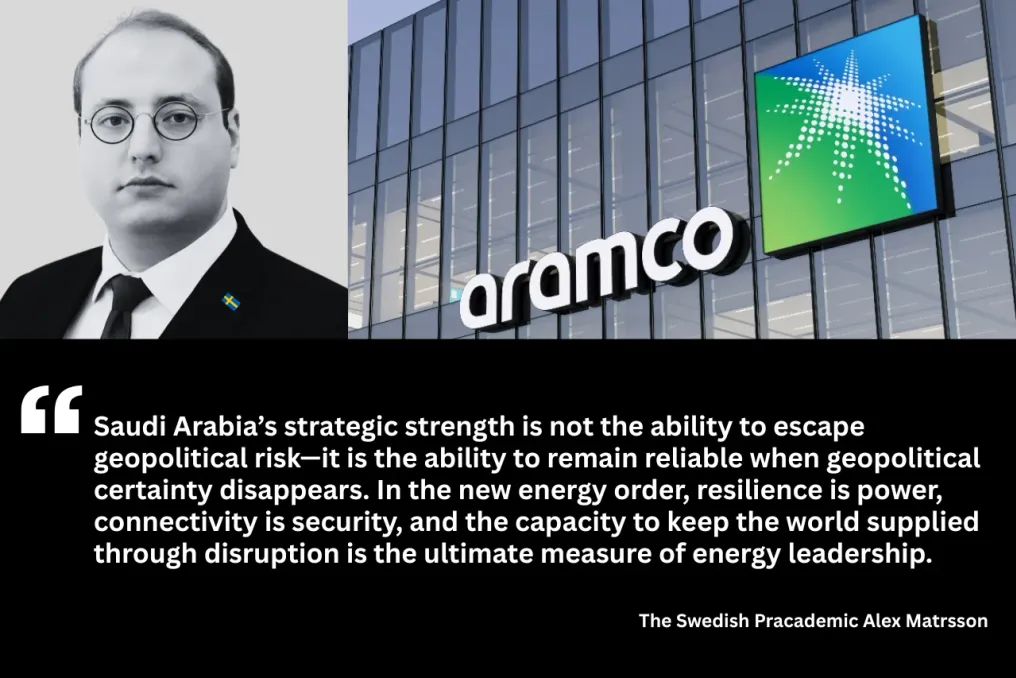
In an exclusive interview with Swedish professor and international business specialist Alex Mattsson, the resumption of Saudi Aramco's operations in the Strait of Hormuz, issues of energy sustainability, and the future of global energy security were discussed.
Mattsson noted that the resumption of crude oil loading from the Strait of Hormuz after a period of disruptions indicates not so much a full restoration of confidence in shipping as it does that Saudi Aramco considers the risks manageable for restoring an important commercial function. He emphasized that for a complex energy company, the risk environment is crucial where expected commercial benefits outweigh additional costs for security, insurance, logistics, and planning.
Thus, Aramco is effectively stating that the export infrastructure in the Persian Gulf remains commercially viable even under increased geopolitical pressure. This reinforces the perception of Saudi Arabia as an energy supplier capable of adapting its operational model, rather than simply waiting for ideal geopolitical conditions.
Trust or Risk Management?
The expert clarified that resilience is often mistakenly equated with the absence of vulnerability. In energy markets, resilience means the ability to absorb vulnerability without causing a systemic failure. Saudi Arabia's advantage lies not in its infrastructure being outside the Gulf's geography, but in the kingdom having developed a network of infrastructure, logistics, and commercial ties that allows it to maneuver when one part of the system is constrained.
Flexibility allows for a change in strategic calculation: a failure at one point does not necessarily lead to a complete halt in supplies. Alternative export schemes, pipeline connections, storage, tanker management, and various loading configurations can buy time and maintain business relationships. Therefore, Aramco's recent activity should be viewed as evidence of institutional resilience, as well as the recovery of maritime confidence. Aramco itself noted the continued use of the East-West Pipeline to ensure flows in its network.
Gulf Supply Chain
The sustainability of the broader Gulf energy system was also discussed. Mattsson stated that this shows that resilience is becoming a competitive advantage in itself. If for decades energy security was viewed through the lens of reserves, production capacity, and long-term contracts, the modern system is also logistical. The question is not only about the presence of crude oil underground but also about the ability to move it from producer to consumer amid deteriorating political, military, or commercial conditions.
Saudi Arabia is particularly important because its energy infrastructure is designed with scale and optionality in mind. This does not eliminate exposure to the Strait of Hormuz, but it creates alternatives and gives the operator more ways to organize exports, redirect volumes, and adjust logistics. The GCC also gains strategic importance here. Gulf producers now compete not only on extraction economics but also on reliability under stress, which represents a much more sophisticated form of energy security.
Asian Refining Market
Regarding the readiness of Asian refineries to continue relying on Gulf oil, the expert noted that dependence should not be confused with complacency. Asian refiners have strong commercial reasons to maintain access to Gulf oil due to refinery configurations, raw material quality requirements, established logistics, and long-standing commercial ties, creating a strong structural dependency. However, this does not mean buyers will ignore maritime risks.
During disruptions, the procurement architecture changes: buyers become more attentive to optionality, voyage duration, freight risk, insurance terms, reserves, and the reliability of alternative routes. The goal is not necessarily to abandon Gulf supplies, but to make Gulf supplies more resilient within a broader portfolio. This difference is important: a buyer can remain deeply committed to Gulf oil while simultaneously demanding greater flexibility in supply conditions. In fact, this could become the preferred model: retaining the economic and quality advantages of Gulf supplies while simultaneously building greater logistical insurance around them.
Oil Markets Without Oversimplified Forecasts
When interpreting market consequences for investors, Mattsson advised against reducing the story to a question of rising or falling crude oil prices, but rather focusing on how risk is transmitted through the physical market. When shipping becomes less predictable, the first consequence is not necessarily a sharp change in the basic availability of crude oil; it can be a change in the cost and certainty associated with transporting that oil. Freight becomes more significant, insurance assumptions change, tankers may be reluctant to enter certain waters, buyers may increase inventories, and sellers may alter loading schedules. Refiners may pay more for logistical certainty.
These costs can accumulate before a shortage of physical supplies becomes apparent. Conversely, when a major producer resumes loading operations, it can have a psychological and commercial effect extending beyond individual shipments. It signals that at least part of the supply chain remains functional, which can soften some defensive actions by buyers and traders. Nevertheless, he cautioned against interpreting this event as the disappearance of the geopolitical risk premium, as current vessel traffic remains heavily restricted, indicating that the market has not yet returned to normal.
Security as an Economic Variable
The expert confirmed that security has always had an economic dimension, but the distinction cannot be ignored. A tanker route is an economic asset, and its value depends not only on the physical existence of the vessel. It depends on whether its owners will use it, whether its insurers will cover it, whether crews can work safely, whether ports function, and whether buyers believe the supplies will arrive on time. This means that geopolitical risk is increasingly integrated into commercial decision-making.
The world is moving towards a system where uninterrupted flows may cease to be a basic assumption. Companies are learning to value continuity itself. This may require building more strategic reserves, diversifying routes, contractual flexibility, and greater tolerance for logistical redundancy. The implication is subtle but important: resilience has a price, just as fragility does. The market is becoming more sophisticated in distinguishing between these two concepts.
Saudi Arabia's Strategic Resilience
Mattsson believes that the resumption of operations strengthens Saudi Arabia's position as a stabilizing force in global energy markets, provided the term 'stabilizing' is used cautiously. He emphasized that Saudi Arabia cannot control the security environment around the Gulf, but it can control the sophistication of its response, including infrastructure, export flexibility, commercial ties, logistics, and the reliability of its commitments to clients.
Saudi Arabia's strongest strategic argument is not that the kingdom is immune to disruptions, but that a disruption does not lead to Saudi Arabia's automatic exit from the market. The ability to continue supplying customers, adjusting routes, using alternative infrastructure, and resuming normal loading operations under favorable conditions gives Saudi Arabia an important form of strategic authority. This also supports the broader GCC position: the Gulf's energy infrastructure can remain commercially operational even under serious geopolitical pressure.
Beyond Hormuz
The expert warned against the danger of international markets concentrating too heavily on the Strait of Hormuz while ignoring the broader Saudi energy system. Although Hormuz is strategically irreplaceable, the security of Saudi Arabia's energy cannot be reduced to a single waterway. A more significant question is how the entire system performs when this waterway becomes unreliable.
Energy infrastructure should be viewed as a network, not as a set of isolated terminals. Pipelines, ports, storage facilities, tankers, refineries, trade relations, and client contracts interact with each other. The strength of the system partly derives from these connections. This is why Saudi Arabia's strategic position should be assessed through the lens of optionality. Every reliable alternative route or logistics scheme reduces the likelihood that a localized failure will turn into a national export crisis. For international buyers, this optionality has commercial value, and for Saudi Arabia, it is strategic capital.
North European Perspective
In conclusion, Mattsson advised energy-producing countries outside the Gulf to understand that physical resources are only part of energy power. From a North European perspective, he cited Norway as a useful comparison, demonstrating how an energy producer can combine resource strength with institutional authority, market integration, and long-term thinking. The lesson is not that systems are identical, but that influence in the energy sector increasingly depends on reliability across the entire value chain. The Gulf teaches an additional lesson: geographical vulnerability does not necessarily diminish strategic importance if the producer possesses the infrastructure and institutional capacity to manage that vulnerability. For all energy-producing economies, the strategic question becomes: in how many different ways can we remain reliable when circumstances change?