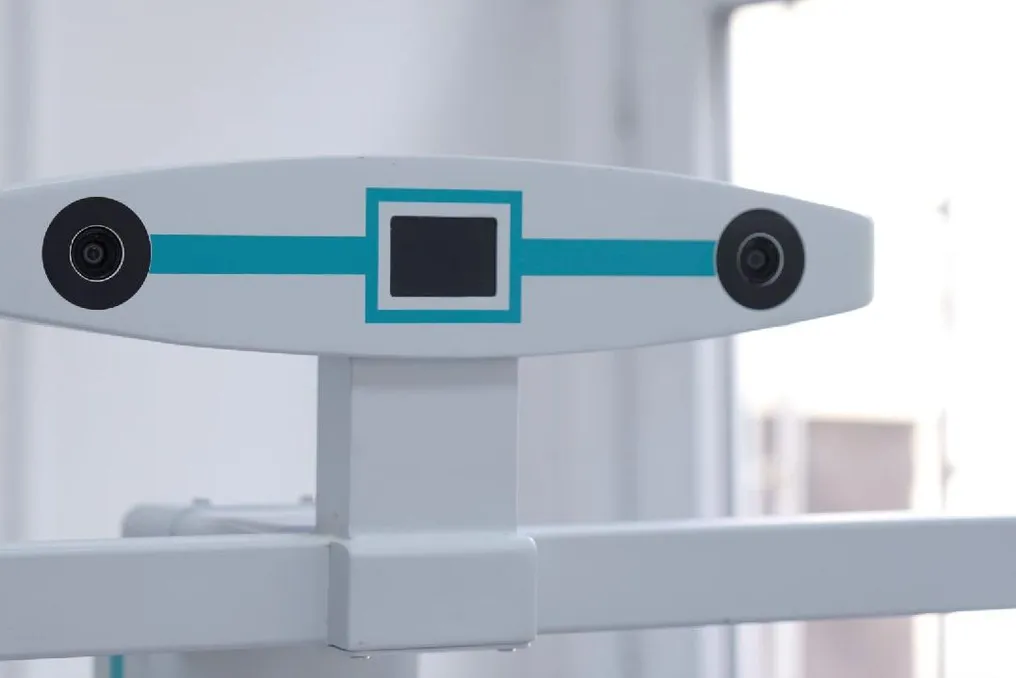
On August 22, an unusual 'rehabilitation therapist' arrived at the Clinical Emergency Hospital in Bishkek, the capital of Kyrgyzstan. This Digital Rehabilitation Therapist (DRT) uses a combination of 3D vision and AI-based motion recognition to detect subtle deviations in movements, ranging from leg lifts to knee flexion.
The system relies on a database containing over 100,000 rehabilitation cases from Peking University's Third Hospital, integrating movement assessment, rehabilitation program prescription, and training guidance into a single digital platform. This equipment was transferred from China to Kyrgyzstan.
Santa Beknazarova, head of the Medical Rehabilitation Department at the Clinical Emergency Hospital, demonstrated the work of the new digital 'colleague.' She explained that the device signals with red or yellow light if a movement is performed incorrectly, and green if it is performed correctly.
Santa Beknazarova expressed hope that this system will help doctors develop more accurate exercise plans for patients and provide them access via mobile phones to a larger number of people.
Traumatology and Orthopedics Challenges in Kyrgyzstan
Issues related to trauma care and post-injury rehabilitation remain significant challenges for Kyrgyzstan. A new National Center for Traumatology and Orthopedics is under construction in Bishkek, a project promoted by Kyrgyz President Sadyr Japarov, and is planned to open by the end of the year. The DRT will also be moved to this center.
Academician Sabyrbek Jumabekov, director of the National Center for Traumatology and Orthopedics in Kyrgyzstan, predicts that the device can serve at least 20 patients daily, including those with spinal and major joint injuries, postoperative patients, and athletes during recovery.
More Than Ten Years of Medical Cooperation
Kyrgyzstan is a member of the Shanghai Cooperation Organisation (SCO) and one of the partner countries of the Belt and Road Initiative (BRI). Medical interaction between China and Kyrgyzstan has been ongoing for over ten years.
Jumabekov recalled that close cooperation with Chinese colleagues has been maintained since 2013. That year, the parties signed a cooperation agreement in traumatology and orthopedics, which was subsequently followed by exchanges of specialists, joint surgeries, research, and academic conferences. In 2023, the memorandum of understanding was expanded to cover more institutions and universities.
He noted that there are over 250,000 orthopedic and traumatology doctors working in China, and they participate annually in scientific conferences where they present their work and share experience.
Over many years, these exchanges have gone beyond conference halls and become part of direct patient care. In 2023, a Chinese free cataract surgery program was launched in Bishkek with plans for vision restoration for 600 patients, which later spread to Osh. By May 2026, over 1,500 Kyrgyz patients had undergone free surgery.
In October 2024, Chinese thoracic surgeons visited Bishkek to exchange experiences and learn minimally invasive surgical techniques. Local doctors emphasized that the exchange of expertise can strengthen clinical potential and improve the quality of patient care.
Joint surgeries, free medical services, professional training, equipment support, and scientific collaboration have formed a growing network of medical interaction between the two states. This cooperation continues to develop within the framework of the BRI and SCO.
Jumabekov stated that governments and heads of state are making significant efforts to promote friendship, cooperation, and common development in the field of traumatology and orthopedics.
Transferring Medical Innovations Across Borders
Yu Yuan, a participant in the DRT development team, noted that while many countries do not suffer from a shortage of doctors, there is an acute shortage of experienced rehabilitation specialists. She believes that rehabilitation intelligent technologies, when used in conjunction with qualified specialists, can help resource-limited regions provide more standardized care.
She recalled a visit by a Kyrgyz medical delegation to China, where they personally examined the operation of the DRT. The delegation expressed a desire to implement this system, which combines China's expertise in sports medicine and rehabilitation with artificial intelligence, in Kyrgyzstan for the benefit of the local population.
This interest transformed a technical visit into routine healthcare practice. Yu Yuan stressed that delivering the device is only the beginning of their cooperation.
The development team reported that training and remote technical support will continue, and feedback from Kyrgyz clinicians will help the team improve the product. Knowledge and needs will be exchanged both ways, transforming technology transfer into a process of mutual learning and growth.
For Yu Yuan, this cooperation marks the transition of China's expertise in sports medicine and rehabilitation from academic discussions to practical clinical application. The arrival of the DRT is a concrete example of medical cooperation within the BRI and SCO following more than ten years of interaction between China and Kyrgyzstan.
What crossed the border is not just equipment, but years of accumulated clinical experience, digital technologies, and continuous technical support. The development team hopes that this project will be the starting point for using the DRT in more countries and regions, allowing medical advancements to reach more needy people. When technologies like the DRT can cross borders and continue to help patients far from their place of origin, the idea of 'health without borders' becomes a tangible reality.